
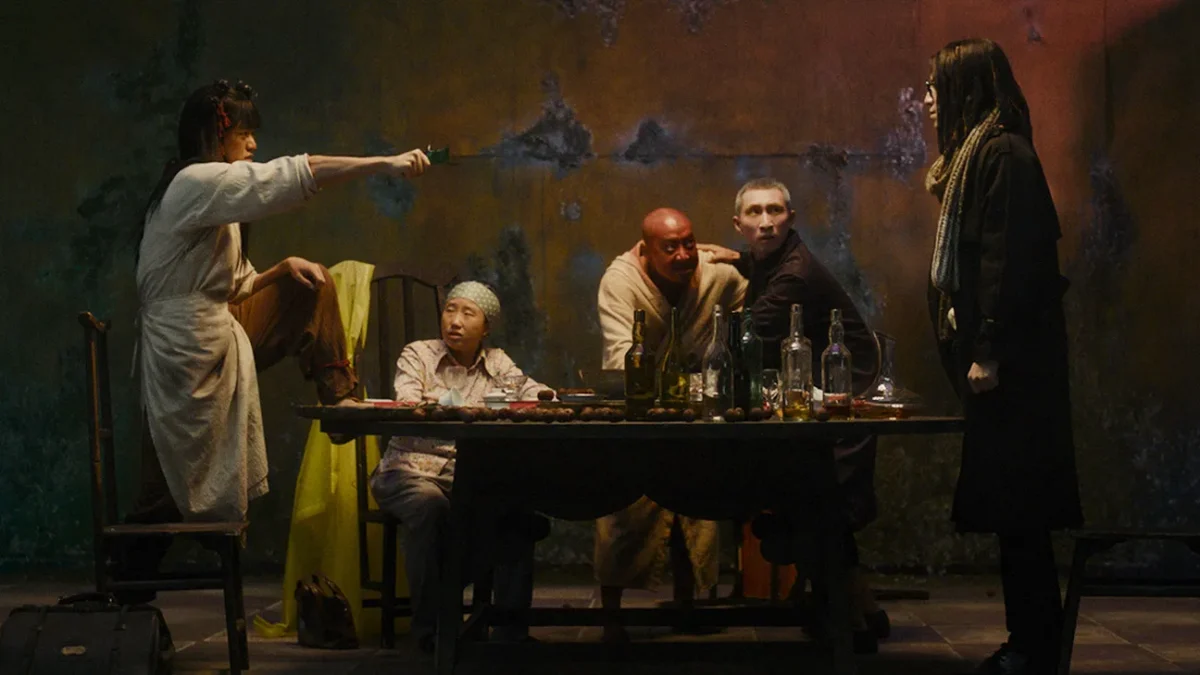
Chinese writer-director Qiu Jiongjiong spans more than 2,000 years of myth, history and mythic history in Fuxi: Four Tales of Feasting, an eccentric 135-minute feature built around four meals and the stories surrounding them.
The film premiered in competition at the Tokyo Film Festival and follows Qiu’s well-received 2021 feature, A New Old Play. While that earlier movie ran three hours, Fuxi compresses its sweeping timeline into two hours and 15 minutes without abandoning the heightened artifice associated with Qiu’s work.
Painted sets, rippling fabric used to represent water and actors dressed as everything from celestial bodies to dogs give the production the character of a theatrical performance. The film also repeatedly breaks the fourth wall, folding its own apparent production into the narrative.
Intertitles explain that “fuxi” can function as a noun for delicious food or as a verb describing the act of savoring those delicacies. That double meaning becomes the organizing principle for four otherwise largely separate tales, each combining feasting with varying amounts of slapstick and mortality.
Four feasts across the centuries
Qiu connects the chapters through scenes involving a film crew supposedly creating them. Two recurring figures add another layer: Sol, or the sun, played by Wen Ke, and Luna, the moon, played by Xiao Luxi. Both appear beneath enormous headpieces shaped for their respective astral roles.
The opening chapter travels to “long ago,” when simian-like ancestors lived in a forest and possessed long tails. Those tails were regarded as sacred fuxi, reserved for life’s most solemn occasions. When an elderly grandmother, played by Lee Kang-Sheng, approaches death, her tail is removed, cut into pieces, stewed and served to the community.
The second story moves into an early agrarian period. King Wang, identified as Sichuan’s fourth king, has given up his throne and transformed into a cuckoo. He nevertheless returns each year to eat fuxi prepared especially for him. Fan Guang Yao plays Wang with giant wings and an expansive white wig.
Fuxi gains greater dramatic weight in its medieval-set third chapter, which remembers poet and gastronome Su Dongpo. Played by Lee Hong-Chi, Su is presented as a multitalented figure whose honesty repeatedly brought conflict with those in power and led to several periods of exile.
Su’s book boy, played by Wang Yitong, prepares food invented by or closely connected to his master. The guests are a collection of supernatural figures: Harvester (Xue Xuchun), who transports souls to the underworld; the water spirit Yaksha (Wang Hai); Granny Spring Dream (Zha Xinji); and a fox appearing in human form (Wang Talu). As the group eats, episodes from Su Dongpo’s life are staged for them.
The final tale shifts to the early 20th century and follows servant boy Zhang Sanxing, played by Zhou Jiarui, as he witnesses the fall of the Qing dynasty, the final dynasty before the ascent of Communism. Harvester, Yaksha and Fox return to dine while the boy transitions to the land of the dead. Sol and Luna again oversee the proceedings.
The movie eventually pulls back one final time, revealing the cast and crew sharing food and drinks at a wrap party.
A deliberately theatrical world
Much of the dialogue is reportedly delivered in the Sichuan dialect, an element likely to carry additional resonance for native speakers. For international audiences, the English-language subtitles and highly physical performances communicate the film’s constant collisions between high and low culture.
Peasants share the screen with aristocrats, while ordinary people move among fantastic creatures. Actors and supposed filmmakers also cross between the individual stories and the framing narrative. Even the crew roles seen early in the movie do not correspond to the names of the actual crew members listed in the closing credits, further complicating the boundary between the film and its staged production.
The result has the playful, openly artificial quality of theater. Qiu’s images never attempt to disguise the handmade devices behind the illusion: fabric becomes water, costumes transform performers into animals or astral bodies, and painted scenery establishes entire historical and mythological worlds.
The ensemble also includes Annie Chen, alongside Lee Kang-Sheng, Lee Hong-Chi, Fan Guang Yao, Wang Talu, Wang Yitong, Xue Xuchun, Wang Hai and Zhou Jiarui. Qiu serves as both director and screenwriter.
ShowBiz Take
Fuxi: Four Tales of Feasting matters because its meals are more than decorative links between historical periods. Eating becomes a route into ritual, remembrance, exile and death, allowing Qiu to place a prehistoric community banquet, an annual royal homecoming, a tribute to Su Dongpo and a young servant’s final passage inside the same cinematic framework.
The four chapters may not connect through a conventional continuous plot, but their repeated feasts, supernatural guests and theatrical framing create a distinct visual and thematic identity. The later stories provide the strongest dramatic foundation, while the painted environments, exaggerated costumes and carefully presented food supply the film’s immediate sensory appeal.
It is an intentionally strange production whose meaning may not fully settle after one viewing. Yet its mixture of Chinese myth, historical change, culinary tradition and self-conscious performance gives Fuxi a flavor all its own.