
For a Halloween marathon that mixes superhero action with werewolves, psychological terror, body horror and science gone disastrously wrong, “Batman: The Animated Series” has no shortage of chilling choices.
The 1992 series could move from mobsters and assassins to supernatural creatures without losing its identity, with Kevin Conroy’s Bruce Wayne fitting comfortably into each corner of Batman’s world. That versatility helped the show push beyond the usual expectations of animated superhero storytelling.
Here are five episodes that bring its darker instincts to the foreground.
“On Leather Wings”
The first episode of the series established its noir-inflected tone with a mystery involving a bat-like creature spotted above Gotham City. Because the authorities mistake the figure for Batman, the hero must investigate what is really haunting the skies.
His search leads to Dr. Kirk Langstrom, voiced by Marc Singer, whose experiments on himself transform him into Man-Bat. Langstrom’s fixation on bats also makes him an unsettling counterpart to Bruce Wayne.
The episode’s transformation sequence supplies its most overt horror imagery. Langstrom’s body pulses, his teeth become fangs and flashing lights add intensity as the scientist changes in front of Batman. It is an early declaration that this series was willing to make its monsters genuinely frightening.
“Moon of the Wolf”
Few premises fit Halloween as neatly as Batman fighting a werewolf. “Moon of the Wolf” gives that classic monster setup a tragic scientific origin through Anthony Romulus, voiced by Harry Hamlin.
Romulus, a former athletics star, begins using a performance enhancer containing wolf DNA as he pursues an Olympic gold medal. Repeated use turns him into a werewolf, and the doctor involved sends the transformed Romulus out to conceal their actions.
Created for the animated series, Romulus closely resembles the comics character Anthony Lupus, who has essentially the same origin and abilities. The episode balances its monster action with superhero adventure, making it an especially accessible choice for younger viewers without abandoning the show’s darker edge.
“Dreams in Darkness”
“Dreams in Darkness” turns Batman’s mind into the haunted house. After exposure to Scarecrow’s fear toxin, the hero finds himself confined inside Arkham Asylum, still wearing his costume and restrained in a straitjacket.
Batman knows Scarecrow intends to release fear toxin across the city, but the staff dismiss his warnings as delusions. Doctors even believe removing his mask could further damage his already fragile mental condition under the toxin’s effects.
The resulting psychological thriller strips Batman of control while using his trauma against him. He fights through terrifying visions, including an enormous version of the gun that killed his parents. Although he eventually pushes through the toxin’s influence, the hallucinations retain their impact and establish Scarecrow as a villain capable of attacking Batman at his most vulnerable.
“House & Garden”
At first, Poison Ivy appears to have been rehabilitated by Arkham Asylum’s staff. She has seemingly settled into suburban life with a husband and children. Meanwhile, giant plant creatures are attacking men across Gotham, and Ivy insists she has no connection to them.
The truth is considerably more disturbing. Ivy has financed experiments that allow her to create a plant-human hybrid family, but the beings dissolve after a limited period. Once Batman and Robin discover what she has done, the domestic mystery erupts into body horror.
Ivy unleashes rapidly growing baby creatures that develop into huge monsters and attack the heroes. The sight of babies emerging from plants is disturbing enough; their accelerated transformation and eventual destruction by weed killer released through the sprinkler system make the episode one of the series’ more unsettling productions. A tragic final twist delivers an additional emotional blow without needing to be spoiled here.
“Mudslide”
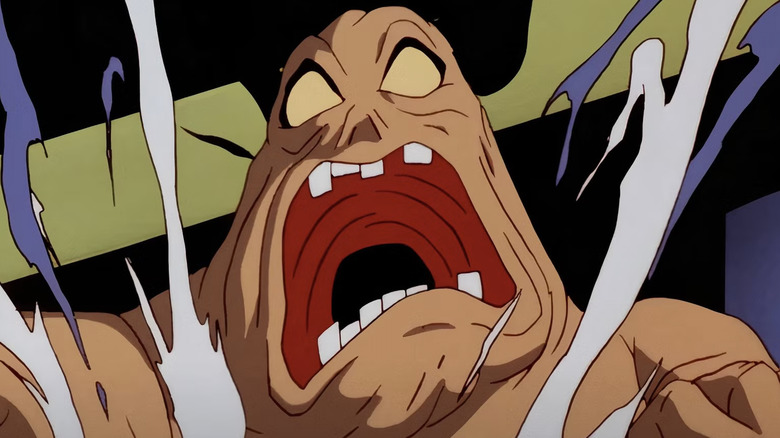
Clayface’s origin was told in the two-part “Feats of Clay,” but “Mudslide” takes the character’s physical deterioration into even more unnerving territory.
Matt Hagen, voiced by Ron Perlman, desperately experiments with chemicals in an unsuccessful attempt to become human again. The episode fully exploits Clayface’s unstable form, allowing him to impersonate others, turn his body into weapons and absorb Batman in an attempt to suffocate him.
One of its most striking images comes when Batman’s face stretches through Clayface’s muddy body before the hero breaks free. The final confrontation is equally grim: Clayface disintegrates in the rain and loses an arm while clinging to the edge of a cliff.
ShowBiz Take
What makes these five episodes work as a marathon is their range. “Moon of the Wolf” delivers traditional creature-feature thrills, while “Dreams in Darkness” trades physical monsters for fear and helplessness. “On Leather Wings,” “House & Garden” and “Mudslide” lean into transformation and body horror, each finding a different way to make familiar Batman conflicts feel unnerving.
The selections also demonstrate how “Batman: The Animated Series” could remain a superhero program while exploring disturbing imagery and emotionally bleak consequences. Viewers looking to extend the marathon have two notable alternatives: the Clayface origin story “Feats of Clay” and “Over the Edge,” in which Commissioner Gordon, voiced by Bob Hastings, is tricked into believing that Batgirl, voiced by Melissa Gilbert, has died.