
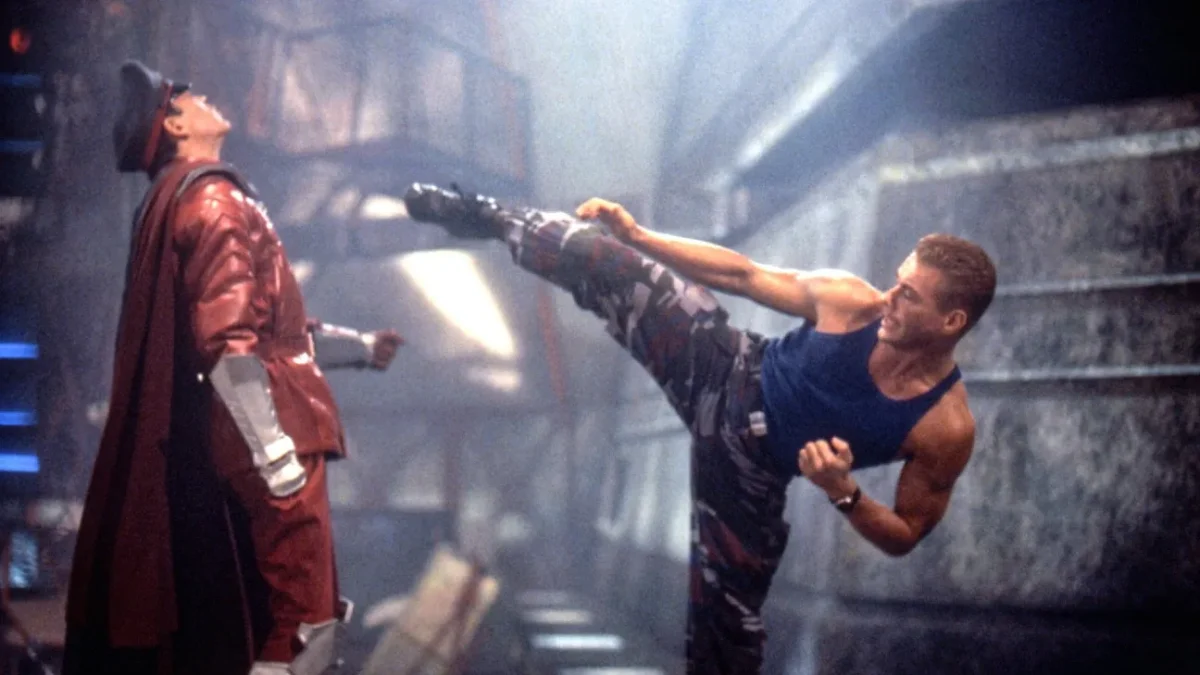
Steven E. de Souza is pushing back on one of the longest-running interpretations of his 1994 Street Fighter movie: The comedy was not an accident.
De Souza, who wrote and directed the first big-screen adaptation of Capcom’s video game, says the film’s humor was deliberate despite reviews at the time suggesting otherwise. Speaking with The Hollywood Reporter, he also welcomed the franchise’s latest revival and the new movie’s nods to his version.
“At that time, we got mostly brutal reviews, and the main gist of the reviews at that time used to be, ‘This movie is so stupid, it is accidentally funny,’” de Souza recalled. “Now, obviously, if you watch the movie, it’s intentionally funny. There’s a lot of comedy.”
The 1994 film starred Jean-Claude Van Damme, Raul Julia and Ming-Na Wen. It ultimately collected nearly $100 million worldwide and developed a cult following, even as its initial critical reception remained a defining part of its history.
De Souza said retrospective pieces published around the film’s 30th anniversary reconsidered its tone, recognizing that its comedy had been intentional. His response to that reassessment is pragmatic: “It’s 30 years too late, but fine.”
A New ‘Street Fighter’ Renews the Debate
The property returned to theaters in 2009 with the underperforming Street Fighter: The Legend of Chun-Li. Now, Paramount and Legendary’s latest Street Fighter has brought the series back to cinemas and opened at No. 1 at the box office earlier this month.
Kitao Sakurai directed the new feature, which stars Noah Centineo, Andrew Koji and Callina Liang. De Souza joked that the franchise “seems to have recovered from The Legend of Chun-Li,” while expressing pride that it continues to draw moviegoers.
He has particularly enjoyed seeing the latest film reference his 1994 adaptation. Among its callbacks is M. Bison’s memorable response to someone whose village he destroyed: “For me, that was a Tuesday.” Julia delivered the line in the original movie.
“It’s a lot of fun that it made that much of a dent for the fans that they want to see these Easter eggs,” de Souza said.
However, the filmmaker has been surprised by social media posts presenting the new movie’s humor as a contrast with his film. According to de Souza, some viewers have praised the latest version for not taking itself as seriously as the 1994 release.
“It’s so funny to see this being embraced for being funny and preposterous, but now the ’94 version is apparently a serious drama,” he said.
Why the 1994 Fights Were Scaled Back
While defending his movie’s comedic intentions, de Souza acknowledges that its action did not deliver what some fans wanted from the game’s signature martial arts tournament.
He said the production had to reduce the intensity of its fights while the movie was before the rating board, during the same week as a November 1994 school shooting in Wickliffe, Ohio.
“We had to cut the fights back to almost Saturday morning cartoon level,” de Souza explained. He added that the filmmakers lacked the budget and resources to fully realize the video game’s more fantastic elements.
That is one area where he believes the latest adaptation goes further. De Souza is pleased that fans are now getting a movie that embraces both the property’s violent action and its more fantastical side.
Street Fighter remains de Souza’s only studio directing effort. His screenwriting work includes Die Hard, 48 Hrs. and the original The Running Man. He also recently reached a deal with Gungnir Books for three graphic novels.
ShowBiz Take
The new film’s success gives de Souza an opportunity to revisit the reputation of a movie that has endured far beyond its difficult reviews. Its nearly $100 million worldwide total, later cult following and the latest adaptation’s callbacks all demonstrate that the 1994 version remains part of the franchise’s cinematic identity.
De Souza’s comments also separate two issues that have often been bundled together: The comedy, he insists, was always planned, while the restrained fight scenes resulted from rating concerns and production limitations. That distinction helps explain why he can defend the original film’s tone while still celebrating what the new version is able to accomplish.
What Happens Next?
A sequel to de Souza’s movie was once in development but was canceled at the last minute. He says he still has his follow-up script and has not entirely ruled out the possibility that it could be used in some form.
“Perhaps it may see the light of day yet,” he said, speculating that demand for a rapid sequel to the new film could revive interest in the material. De Souza added that the script is “in a drawer somewhere at Capcom.”
There is no confirmation that the old screenplay will be revived. For now, its possible return remains de Souza’s hopeful suggestion as Street Fighter begins another chapter on the big screen.