
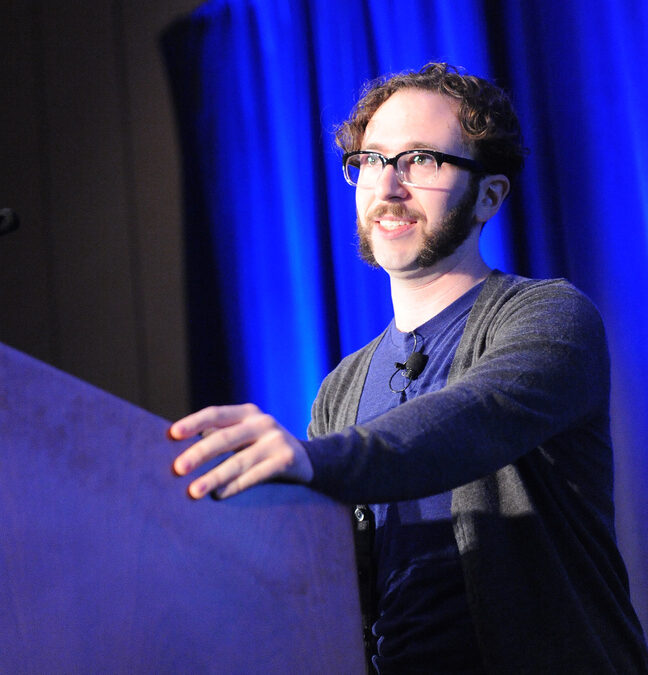
Video game voice actors can earn a fee for a recording session. The agreement for the game sets the minimum pay, how many voices the studio can ask for, and what it can do with the performance afterward. For a sense of what one person can bring to that session, step into the courtyard in Hades. Zagreus, the young prince trying to escape the Underworld, can practice hitting a cheerfully obliging skeleton named Skelly. When the two talk, you hear Darren Korb on both sides of the conversation.
How a temporary voice gets the part
It would be easy to imagine Supergiant Games auditioning one actor to sound princely and another to sound like a guy delighted to get walloped for a living. The process actually ran the other way. Korb, the studio’s audio director, told James Parkinson in a recorded interview that he laid down temporary voices while the game was taking shape. The team tried auditions. For these two characters, his early performances were the ones they wanted to keep.
Listen to the change when the conversation switches speakers. Zagreus has the manners of someone raised at court, even when the business at hand is testing a weapon. Skelly sounds like the fellow who has been waiting all day for somebody to stop by his corner. In Korb’s account of finding Zagreus’ accent, the team drew on the voices audiences associate with screen versions of mythology. For Skelly, Korb recalled drawing on someone he and his friends had met, then turning up the energy. You could take the character portraits off the screen and still follow the exchange.
Two characters in one conversation raise a surprisingly practical question. If the same actor does both, what did the studio buy? Korb’s interviews tell us how he got the roles. Korb does not discuss his fee in those interviews. Public union agreements give us a way to answer the question for a covered production while leaving his pay out of it.
What four hours at the microphone can buy
Start with the heading on the rate card. SAG-AFTRA has a tiered agreement for independent games as well as a separate agreement for work such as recording a game in another language. Even two signatory studios making games that look comparable on your screen may be working from different paperwork. The price in the digital storefront tells you very little about which agreement the producer signed.
Take one line from the union’s 2026 independent-game rate sheet. For a Tier 3 project, a four-hour off-camera voice session has a minimum fee of $749.07 and covers three distinct voices. On a Tier 4 project, the same four-hour booking also covers three voices, with a minimum of $907.96. Those figures describe the minimum for one covered performer’s session in those tiers that year. Three voices on the call sheet don’t turn the booking into three four-hour fees.
Imagine the actor begins as a palace guard, returns to the microphone as a suspicious shopkeeper, then finishes as the traveler the shopkeeper accuses. The producer needs to track which voices the booking covers. The actor has a different problem. On the second take, can the listener still tell the traveler is trying to sound innocent, even though the same throat produced the accusation? A rate card can count the voices. Keeping them recognizable across the scene is the acting.
Why playing for forty hours tells you little about time in the booth
In a game, the audience helps decide which recorded lines get heard. You might return to the courtyard for one more practice swing. Another player might head straight for the exit. Both bought the same game. The actor had to give a convincing performance for the player who stayed, even if the player who left never knows that exchange exists.
Supergiant’s creative director Greg Kasavin and Korb used their Game Developers Conference presentation on the dialogue of Hades to explain how a studio of fewer than 20 people made a game with more than 22,000 voiced lines. They describe a job that spans casting, recording, processing the sound and putting it in the game. The final step matters as much to a listener as the first. A beautifully read greeting sounds strange if the characters have just said goodbye.
Supergiant’s description of the game explains why replaying the escape is central to its design. The pleasure of coming home is that somebody may have something new to say. An actor can help a player feel that a friendship has advanced over hours or days, although the player controls when to visit. Counting the hours on a save file can tell you how much time you spent with a character. It can’t tell you how many times the performer went back to the studio.
Why a battle cry can change the booking
A page of battle noises might look like a light afternoon beside several pages of conversation. Try imagining the direction attached to each sound. One is the effort of lifting a stubborn gate. Another is the moment a fighter takes a hit they didn’t see coming. A third has to come from a creature whose voice bears little resemblance to a person’s speaking voice. Each sound must be legible to a player who may also be listening for an enemy behind them.
The independent agreement’s rules on vocal stress account for the physical demand. Its examples include combat sounds and sustained whispering as well as screams. A session containing vocally stressful work under that agreement is capped at two hours. In the Tier 3 example, the rate sheet lists the same $749.07 minimum for that booking as for the ordinary four-hour session. Even a line delivered at a whisper can change how much time the producer should book.
What happens when a game finds a bigger audience?
Think of two numbers a studio could track after release. One is how many players have bought or accessed a game. The other is how many times a particular player has heard Skelly speak. Those numbers answer quite different questions. Under the tiered independent agreement, one provision measures additional compensation in increments of 500,000 units sold or unique subscribers or users, up to two secondary payments. The agreement gives the calculation for each tier and provides for prepayment.
That helps explain why a player can spend a hundred hours with a favorite companion and still know very little about the performer’s earnings. To understand a particular payment, you would need to know the agreement, whether the performance appeared in the game, which distribution figures count, and what the producer had already paid. Hearing the same recording on your twentieth visit to the courtyard supplies none of those details.
Who gets to make the character say something new?
Imagine two versions of a shopkeeper. In the first, the game picks a greeting the actor recorded. In the second, the player asks an unexpected question, and software generates a fresh answer in a replica of the actor’s voice. From the other side of the counter, both can sound like a conversation. The performer supplied a reading of the first greeting. Nobody necessarily asked them to read the words in the second.
For productions covered by the 2025 Interactive Media Agreement, SAG-AFTRA’s explanation of digital replica consent says the employer must describe the intended use with enough specificity, including whether dialogue will be generated in real time. A performer considering that request can weigh what kind of character will speak and what the project will have the voice do. That is a different decision from agreeing to return to a booth to perform a newly written scene.
Next time you visit Skelly, give the two halves of the exchange a listen. The prince needs a sparring partner. The skeleton seems genuinely pleased to be of service. The small pleasure of the scene is how readily you believe these two spent the afternoon together. One actor found a voice for each of them, and for a few seconds you can forget he’s talking to himself.
More ShowBiz Originals
- How Hollywood Residuals Actually Work
- How Casting Directors Help Shape Every Movie and TV Show
- How Animated Movies Are Made
- How Music Supervisors License Songs for Movies and TV
Sources and further reading
Hear Darren Korb tell the story of casting Zagreus and Skelly or watch Korb and Greg Kasavin discuss the dialogue system. For the contractual examples, consult the dated independent-game rate card, the sample tiered independent agreement and the union’s guide to its 2025 video game agreement.
Featured photograph of Darren Korb by the Official GDC photostream via Wikimedia Commons, cropped on Commons. Used under CC BY 2.0.
