
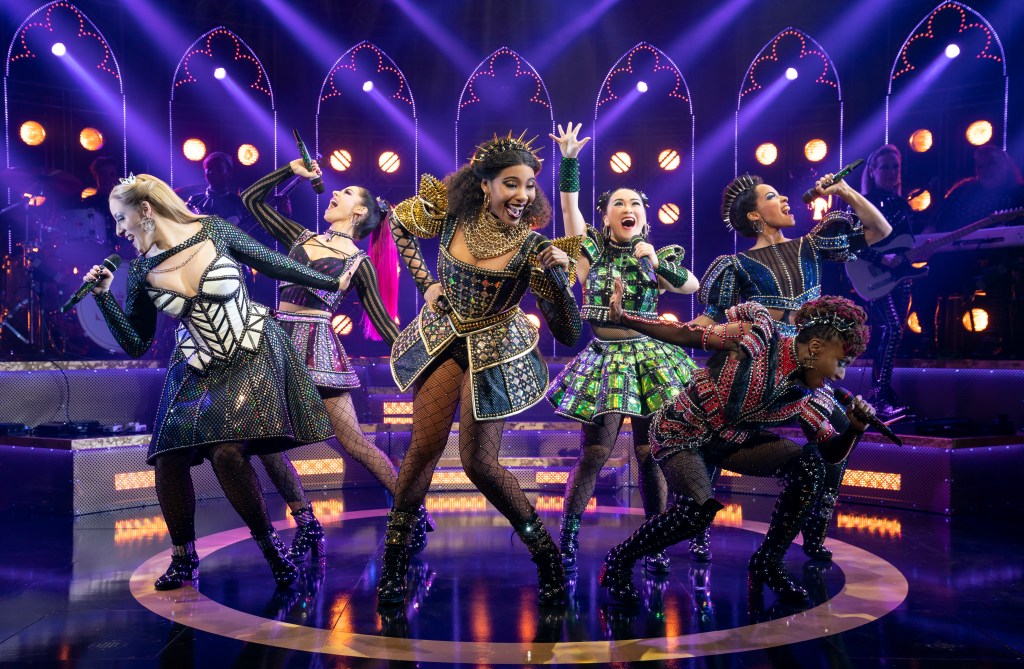
Six, the high-energy Broadway musical that reimagines the wives of Henry VIII as a pop supergroup, will end its New York run in January after 2,178 performances.
The closing will bring down the curtain on one of Broadway’s most distinctive post-pandemic success stories: an 80-minute, concert-style musical that arrived from the U.K. with a cult following, lost its original opening night to the industry shutdown, and returned to become a reliable commercial draw in a marketplace still rebuilding its audience.
Created by Toby Marlow and Lucy Moss, Six turns Catherine of Aragon, Anne Boleyn, Jane Seymour, Anna of Cleves, Katherine Howard and Catherine Parr into contemporary pop archetypes, with each queen reclaiming her narrative through songs inspired by the language of arena tours, streaming-era fandom and chart-topping divas. The show’s premise proved unusually easy to communicate: Tudor history, remixed as a pop concert, with a cast of six women backed by an onstage band.
That clarity became one of its greatest assets. At a time when Broadway producers have faced rising costs, uncertain tourism patterns and a more selective ticket-buying public, Six stood out as a show with a compact running time, strong brand identity and broad demographic reach. It appealed to theatergoers, pop fans, students, history buffs and audiences drawn to female-driven storytelling, helping it cut through a crowded entertainment landscape.
A Defining Post-Shutdown Hit
Six began its Broadway life under extraordinary circumstances. The musical was scheduled to open in March 2020, just as Broadway went dark because of the Covid-19 pandemic. By the time it officially opened in 2021, the show had become a symbol of the industry’s interrupted momentum — and, eventually, its resilience.
Its return helped demonstrate that new Broadway properties could still break through without being based on a blockbuster film or a legacy catalog. While Six had already built international recognition through earlier productions and a widely streamed cast recording, its Broadway success confirmed that a lean, highly stylized musical could generate the kind of attention usually reserved for larger-scale spectacles.
The production went on to earn major awards recognition, including Tony Awards for original score and costume design. Its cast album also became a key driver of awareness, allowing younger audiences to discover the music before buying tickets. That dynamic — a musical theater property circulating like a pop release — reflected a larger shift in how Broadway shows now cultivate fans beyond the physical theater.
For producers, Six offered a model that was both old-fashioned and forward-looking. It relied on live performance, vocal power and character-driven theatricality, but it also understood digital fandom, short-form music discovery and the aesthetics of a pop tour. Its queens became instantly recognizable figures, and the show’s phrases, costumes and choreography translated easily across social platforms.
Why the Closing Matters
The end of Six on Broadway is significant not because the show is fading from public view, but because it marks the close of a particularly important chapter in the industry’s recovery era. Broadway has seen a wave of closings in recent seasons as productions contend with elevated weekly operating costs, shifting audience behavior and increased competition from concerts, sports, streaming and immersive events.
In that environment, a run of 2,178 performances is a substantial achievement. It places Six among the notable commercial wins of the past decade and underscores the continued value of a strong concept executed with discipline. The show did not depend on elaborate sets or a sprawling ensemble. Its spectacle came from precision, sound, lighting, costume and star-making performance energy.
It also helped broaden the conversation around what a Broadway musical can look and sound like. The production embraced a format closer to a live album release party than a traditional book musical, with the queens competing, joking and ultimately reframing their place in history. That structure made the show accessible to first-time theatergoers while still offering enough craft to satisfy more seasoned audiences.
The closing also arrives as Broadway looks for its next wave of durable hits. Long-running staples remain essential to the overall ecosystem, but the commercial health of the industry depends on new shows finding enough traction to sustain multi-year runs. Six proved that originality, when paired with a clear hook and savvy audience development, can still become a Broadway business.
Beyond New York, the Six brand is expected to remain active through touring and international productions, where the musical’s relatively portable design gives it an advantage. Its compact staging and recognizable score make it well suited to a global theater market that increasingly favors titles with built-in awareness and manageable production demands.
What Happens Next
As the Broadway company prepares for its final weeks, attention will turn to how producers mark the end of the run and what may eventually occupy the theater next. For fans, the January closing creates a limited window to see the New York production before it exits the Broadway stage. For the industry, Six leaves behind a clear lesson: a fresh idea, sharply packaged and culturally fluent, can still become a royal success.