
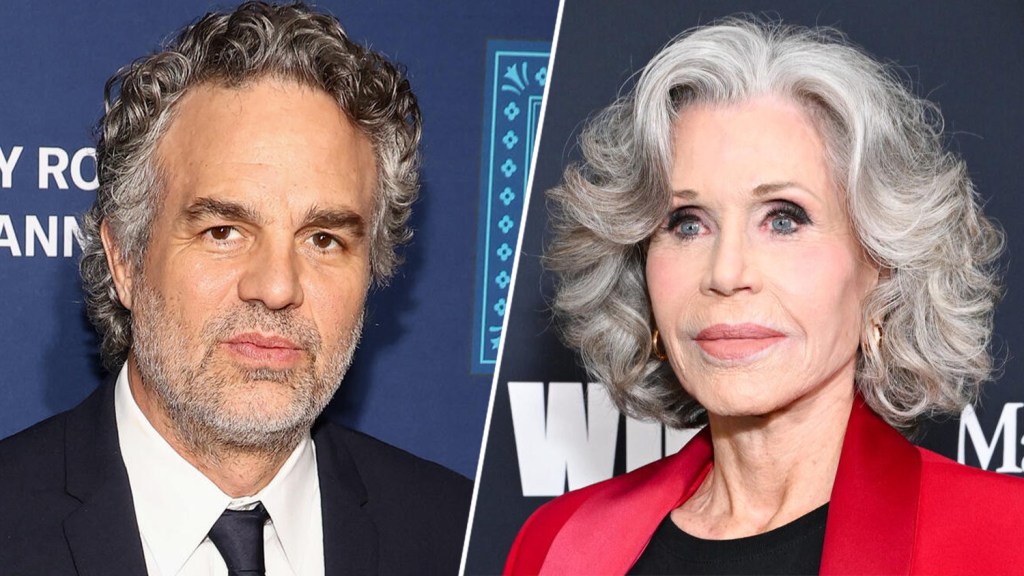
Jane Fonda has stepped into the growing debate around Mark Ruffalo, defending the actor after his criticism of the proposed Paramount-Warner Bros. Discovery merger drew accusations of antisemitism from some industry voices and online commentators.
The Oscar-winning actor and longtime activist is backing Ruffalo amid a backlash that has quickly moved beyond corporate consolidation and into one of Hollywood’s most combustible political fault lines. Ruffalo, who has frequently used his platform to speak about labor issues, climate policy, media ownership and the war in Gaza, recently criticized the potential merger as another sign of dangerous concentration in the entertainment business.
His comments were met by critics who accused him of invoking antisemitic tropes in his critique of power, ownership and influence in the media sector. Fonda, however, has argued that Ruffalo’s position should be understood as a critique of corporate consolidation rather than an attack on Jewish people or Jewish identity.
The exchange has placed two of Hollywood’s most visible progressive actors at the center of a broader industry conversation: where the line sits between political criticism, corporate accountability and harmful rhetoric at a time when studios, talent and audiences are navigating deeply polarized cultural terrain.
Fonda’s defense is notable not only because of her stature in Hollywood, but because she has spent decades as one of the industry’s most politically outspoken figures. From anti-war activism to climate protests and labor solidarity, Fonda has often operated at the intersection of celebrity and advocacy. Her decision to publicly support Ruffalo signals that the controversy is unlikely to remain a fleeting social media dispute.
A Merger Debate Turns Personal
Ruffalo’s original criticism centered on the implications of a Paramount-WBD combination, a deal that would reshape the media landscape by bringing together major studio assets, cable networks, streaming platforms and vast content libraries. Such a transaction would likely trigger intense regulatory scrutiny, especially as Washington continues to examine the power of large media and tech conglomerates.
For actors, writers, producers and below-the-line workers, the stakes are significant. Consolidation can affect everything from greenlight decisions and compensation models to theatrical distribution, streaming residuals and the number of buyers available for creative projects. After years of disruption caused by streaming, pandemic shutdowns, cost-cutting and the dual Hollywood strikes, many artists see further consolidation as a threat to creative and economic diversity.
Ruffalo’s critics, however, focused less on the antitrust argument and more on the language and framing of his remarks. In the current climate, public statements about media control and institutional power are often scrutinized for echoes of longstanding antisemitic conspiracy theories, particularly when they involve entertainment, finance or global influence.
Fonda’s intervention attempts to separate that concern from Ruffalo’s intent. Her defense frames him as an artist challenging corporate power, not as someone targeting a religious or ethnic group. The distinction matters in Hollywood, where conversations around antisemitism, anti-Zionism, free speech and political activism have become increasingly fraught since the Oct. 7 attacks and the ensuing war in Gaza.
Why It Matters in Hollywood
The controversy reflects a larger anxiety inside the entertainment business. Studios are under pressure to cut costs, compete globally and build sustainable streaming models. Talent, meanwhile, is watching a shrinking buyer pool with concern. Every major merger raises questions about fewer jobs, fewer pitches sold and fewer opportunities for mid-budget films, prestige television and independent-minded programming.
Paramount and Warner Bros. Discovery also carry enormous cultural weight. Paramount remains one of Hollywood’s legacy studios, while Warner Bros. Discovery controls brands spanning film, television, news, sports and streaming. A combination would not be just another corporate transaction; it would represent a major reordering of the entertainment ecosystem.
That is why Ruffalo’s comments landed beyond a standard celebrity opinion post. He is not merely an actor reacting to headlines. He is part of the creative class that would be directly affected by consolidation. His long record of activism also means his remarks are often amplified by supporters and scrutinized by opponents.
Fonda’s support adds generational heft to that argument. Both actors belong to a Hollywood tradition in which stars use fame to pressure institutions, even at personal or professional risk. That tradition has grown more complicated in the social media era, where political statements can be clipped, reframed and circulated at high speed, often with little room for nuance.
The Risk for Public Figures
For studios and talent representatives, the episode underscores how quickly industry commentary can become reputationally hazardous. A critique of consolidation may be intended as an economic or labor argument, but public figures now operate in a climate where wording is dissected instantly and interpreted through broader political conflict.
Accusations of antisemitism are especially serious in Hollywood, an industry with deep Jewish history and leadership across multiple eras of studio development. At the same time, artists and activists argue that criticism of corporations, governments or political decisions must not automatically be collapsed into bigotry.
That tension is now part of the daily reality for performers with public platforms. Many actors are being urged to speak out on major world events, while also being warned that one imprecise phrase can create professional consequences. The result is a climate in which silence, speech and clarification can all carry risk.
Fonda’s defense of Ruffalo is therefore more than a personal show of loyalty. It is a statement about who gets to criticize power in Hollywood, how those critiques are interpreted and whether the industry can distinguish between harmful rhetoric and political dissent.
What Happens Next
The immediate question is whether Ruffalo responds further to the accusations or allows Fonda’s defense to stand as the most prominent rebuttal. A clarification could help narrow the dispute, but it could also extend the news cycle around his original comments.
The larger story will unfold around the proposed Paramount-WBD merger itself. If talks advance, expect guilds, regulators, lawmakers and creative talent to weigh in more aggressively on what another wave of consolidation would mean for Hollywood.
For now, Fonda’s defense has ensured that Ruffalo’s comments remain part of the broader industry conversation. What began as criticism of a corporate deal has become a test case for how Hollywood debates power, prejudice and free expression in an increasingly divided moment.