
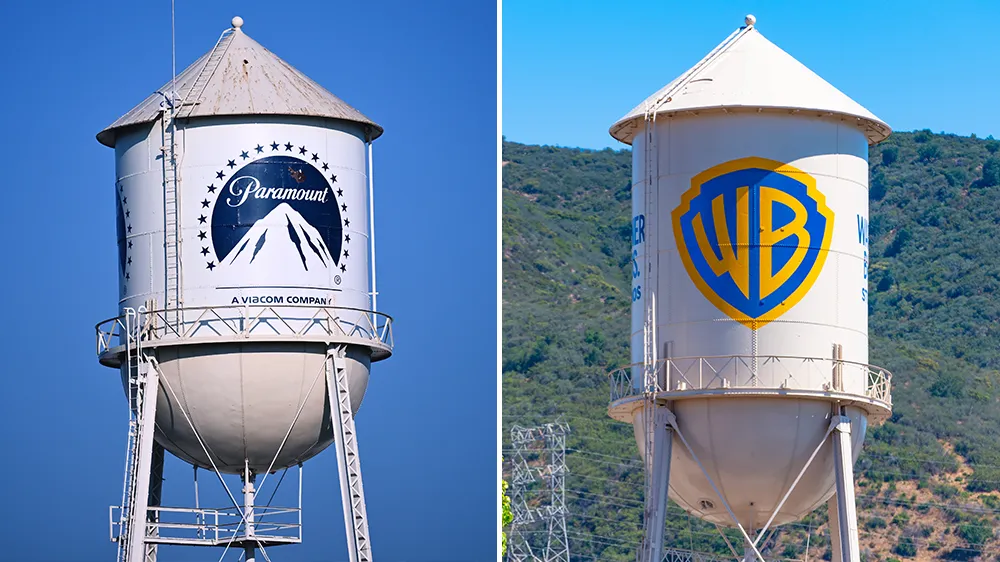
Why This Matters
Paramount is turning one of Hollywood’s most enduring assumptions into an open question: does a major studio still need to be rooted in California? According to executives familiar with the company’s thinking, a partial relocation could begin as soon as October if Paramount is unable to make meaningful progress toward resolving the antitrust challenge brought by California and 11 other states over its proposed acquisition of Warner Bros. Discovery.
The prospect is significant not only because Paramount is one of the industry’s legacy names, but because its presence in Los Angeles is woven into the business infrastructure of film and television. Its Melrose Avenue lot remains a working symbol of studio-era Hollywood, even as the company has increasingly become a streaming, sports, news and global content enterprise. A move would not necessarily mean abandoning production in California altogether, but it would mark a sharp escalation in the standoff between corporate consolidation and state-level regulatory resistance.
Executives have framed the possibility as a business contingency rather than a threat, arguing that uncertainty around the deal has created pressure to evaluate where future operations, investment and executive functions can be managed most efficiently. Still, the message lands with unmistakable force: if California continues to challenge the transaction, Paramount may reconsider the scale of its commitment to the state.
For California, the stakes are broader than one corporate headquarters. The state has already been fighting to retain production against aggressive tax incentives in Georgia, New York, New Jersey, New Mexico, the U.K., Canada and other jurisdictions. Losing additional executive or administrative functions from a studio with Paramount’s history would deepen concerns that Hollywood’s symbolic capital is no longer enough to keep the entertainment business physically anchored in Los Angeles.
The dispute also arrives at a volatile moment for workers across the sector. Studios are cutting costs, streaming economics remain under pressure, theatrical revenues are uneven and production levels have not fully recovered from the contraction that followed the dual labor strikes. Any relocation discussion, even if limited to corporate personnel, is likely to be watched closely by guilds, vendors, real estate interests and local officials who depend on the entertainment economy.
Industry Context
Paramount’s proposed acquisition of Warner Bros. Discovery would be one of the most consequential media combinations of the streaming era, uniting two storied film and television libraries, cable assets, sports rights, news operations and global distribution capabilities. Supporters of the deal argue that scale is now essential as traditional studios compete with tech-backed giants and global platforms that can spend heavily on content, product development and international expansion.
Regulators, however, have been increasingly skeptical of large media mergers, particularly when they involve major content suppliers and distributors. The lawsuit from California and 11 other states centers on concerns that the combination could reduce competition, weaken bargaining power for creators and distributors, and concentrate too much influence over entertainment supply in a smaller number of corporate hands. Those arguments echo a broader political mood in which antitrust enforcement has become more assertive across technology, publishing, sports and media.
For Paramount, the legal challenge complicates an already demanding integration plan. Large media mergers are difficult even when regulators are cooperative. They require decisions about overlapping divisions, leadership structures, debt management, streaming strategy, theatrical output, licensing, international operations and brand architecture. When litigation adds months of uncertainty, executives often begin exploring alternative operating models to preserve leverage and optionality.
California’s position is especially sensitive because of the state’s dual role as both regulator and industry home base. The state has a legitimate interest in reviewing the competitive effects of major corporate transactions. At the same time, California is competing with other states and countries that are eager to attract entertainment jobs and willing to offer lower costs, tax credits and streamlined permitting. That tension gives the current fight an added political charge.
Hollywood has been decentralizing for years. Production crews now routinely move between Atlanta, Albuquerque, Vancouver, Toronto, London and Budapest. Visual effects, postproduction, animation and back-office functions have become increasingly global. Even top executives are less tethered to the studio lot than they once were, particularly after the pandemic normalized remote work and hybrid corporate structures.
Yet headquarters still matter. They shape where senior decisions are made, where legal and finance teams are based, where talent takes meetings and where institutional influence accumulates. A reduced Paramount footprint in California would not end Hollywood’s dominance overnight, but it would reinforce the perception that the entertainment capital is becoming more of a creative brand than a fixed geographic center.
What Happens Next?
The immediate question is whether Paramount and the states challenging the Warner Bros. Discovery deal can reach a settlement framework before the company begins acting on relocation plans. Such a settlement could involve behavioral commitments, divestitures, limits on certain bundling practices or other assurances designed to address competition concerns without fully derailing the transaction.
If talks accelerate, the relocation issue may remain a pressure point rather than a plan. Companies often explore office moves, tax strategies and operational shifts during high-stakes negotiations, and not every scenario becomes reality. But if discussions stall, Paramount could begin identifying departments or executive functions that can be moved with the least disruption, potentially to states offering a friendlier regulatory and cost environment.
Any move would likely unfold in phases. Production would be the most complicated piece to shift because it depends on soundstages, crews, permits, vendors and talent availability. Corporate functions, technology teams, finance operations or certain streaming units could be easier to relocate. The company could also pursue a split model, maintaining a prominent Los Angeles presence while expanding leadership or administrative hubs elsewhere.
California officials, meanwhile, will face pressure from two directions: defend the antitrust case while preventing the optics of driving a historic studio out of state. Expect local business groups, labor representatives and political leaders to push for back-channel conversations aimed at keeping Paramount invested in Los Angeles regardless of the merger’s fate.
For the broader entertainment industry, the episode will serve as a test of how much leverage legacy studios still have in their home state — and how far regulators are willing to go in challenging consolidation, even when jobs and investment become part of the public debate. By October, Paramount may have either a clearer legal path forward or the beginnings of a new geographic strategy, one that could reshape how Hollywood thinks about its own address.