

She won’t be sidelined in Congress?
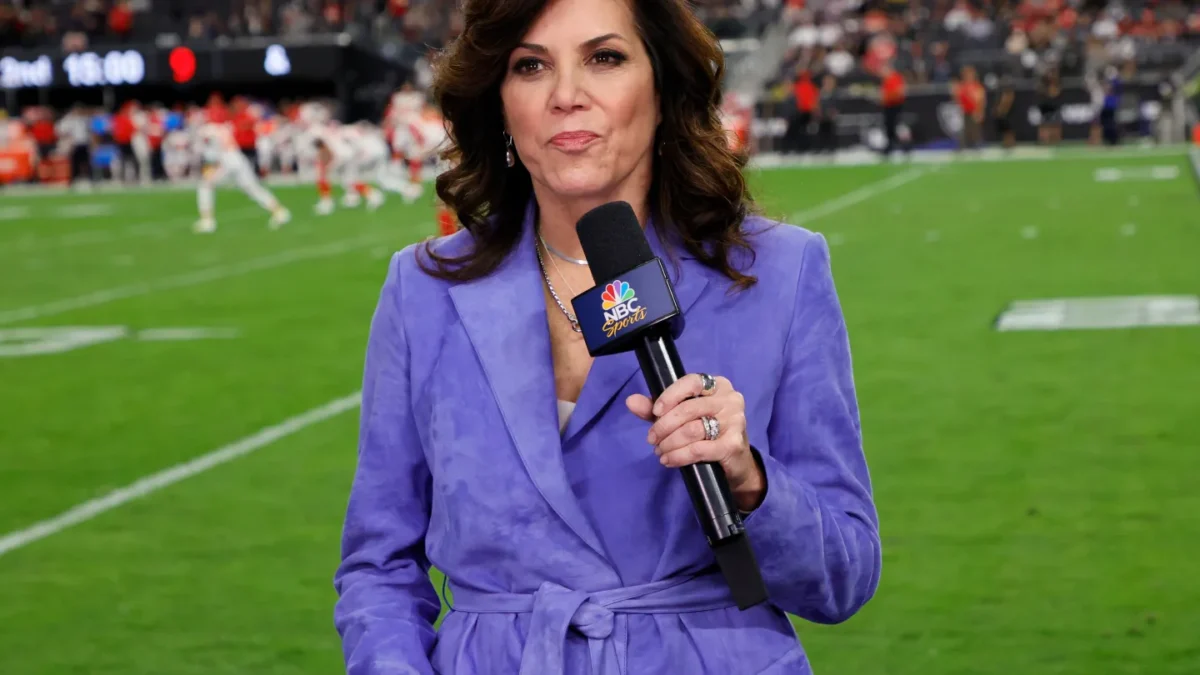
When Michele Tafoya became the Republican nominee for Senate from Minnesota Tuesday night, the longtime Sunday Night Football reporter made a resounding entrance onto the political stage. Tafoya collected more than twice as many votes as her nearest opponent, a former Navy SEAL.
Her chances of winning in November are now surprisingly high for someone who’s never run for public office: the broadcaster has a deep war-chest while some pundits favor her against a vulnerable far-left opponent, lieutenant governor Peggy Flanagan of Democratic-Farmer-Labor (Minnesota’s Democratic Party).
But Tafoya also sent a different signal with her win: the tradition of television entertainers transitioning to Minnesota politics is alive and well.
Former pro wrestler Jesse Ventura did it, winning an election for governor in 1998 in a shocking upset. Comedian and SNL veteran Al Franken did it, winning an election for senator in 2008 in a shocking drama (a recount and a few hundred votes). A pair of local TV fixtures, news anchor Rod Grams and entrepreneur and TV-commercial mainstay Rudy Boschwitz, did it, each serving as senators in the last few decades of the 20th century.
And now Tafoya is looking to do it too.
“We really do seem to out-kick the coverage,” veteran Minnesota political consultant and commentator Blois Olson tells The Hollywood Reporter when asked in a phone interview about the trend, (possibly) intending the pun.
What’s up with TV celebrities and the Gopher State? Part of the reason, Olson says, stems from locals’ eye on national celebrity.
“Minnesotans have a saying that someone is ‘one of us,’” he said. “We take pride in local people who’ve make it nationally. That name recognition goes a long way.”
A Southern California native, Tafoya pulled a kind of reverse Lakers when she moved to Minnesota for her sports-media career. That was decades ago, and she’s since become a fixture as a host and anchor first on local and then national media. For the past 30 years, at many of the leading national TV-sports operations, she’s covered everything from the Olympics to the NBA to of course the NFL at her longtime Sunday night home. She’s also subbed in on Pardon the Interruption and been a correspondent on Outside the Lines.
Tafoya’s electoral entry isn’t the same level of shock as Ventura, who showed little political interest before he ran as a third-party candidate and somehow sneaked in as a proto-outsider years before Donald Trump. The sports reporter, in contrast, has been co-hosting Minnesota talk-radio shows as a side hustle on and off since 2009, often talking about politics and cementing her conservative bona fides (though she broke with much of MAGA by espousing a modified pro-choice stance that allows abortion for the first twelve weeks after conception). She also co-chaired a failed bid for a Republican candidate for governor in 2022.
In fact, so political has Tafoya gotten in her hometown of Edina, an upscale Twin Cities suburb, that many people were shocked the 61-year-old didn’t take a run at public office earlier.
But she is jumping in now, looking to take the seat of the retiring DFL senator Tina Smith — who, oh yes, took over Franken’s seat in 2018 after he resigned in a #MeToo scandal.
There may be structural reasons for the trend of TV personalities in Minnesota beyond the one-of-us phenomenon.
The state’s primaries are a version of “open” — you don’t have to be a member of the party to vote in their primary, though you only get to vote for one party’s candidates in any given election. That privileges independent voters for whom name recognition might matter more than ideology.
Also, a disproportionate number of voters live in Minnesota’s biggest metro area — some 35 percent in the Twin Cities — allowing that region’s media to dominate and someone with a big name to win out over a more grassroots unknown.
“We sure seem to have an interesting history and I think both of these are factors,” says David Schultz, a political science and law professor at the University of Minnesota who is one of the state’s foremost experts on politics. Schultz and a grad student even coined a term — “politainers” — to describe these TV crossovers. Ventura-Franken-Tafoya may not be quite on the level of Reagan-Schwarzenegger-Sonny Bono, that hat trick of California icons. But they sure come from the same coaching tree.
In the three months until the general election, Flanagan will seek to turn Tafoya into a MAGA groupie — a damaging trope in a state where resentment over the administration’s ICE sweeps last year still sting deep and even at times across party lines. Tafoya will tack to the center, already saying in her acceptance speech Tuesday night that she doesn’t always agree with Donald Trump, and generally try to walk the line as a Republican who doesn’t do the Republican things large swaths of Minnesotans don’t like. Her support among Republicans is already undeniable — she scored a majority of Tuesday’s vote, 52%, even with eight other opponents in the race — but she’ll need the many voters in the state who are DFL or independent to win.
(Plenty of primetime-soap level drama also attended the governor race one state over on Tuesday as far-left candidate and social-media lightning rod Francesca Hong lost her Democratic primary in Wisconsin by less than half of one percentage point to Milwaukee County executive David Crowley, who wasn’t even in the race a month ago.)
Minnesota will hit a milestone this year when it elects a female governor for the first time; current senator Amy Klobuchar and State House speaker Lisa DeMuth on Tuesday each won their primaries easily (DeMuth over another TV star, the MyPillow personality Mike Lindell). And it will continue to have at least one female senator with the result of the Tafoya-Flanagan race. But don’t sleep on another marker: Since the 1970’s, Minnesota has gone no more than eight years without a TV personality in the senate. If Dems want to take back Congress, they’ll have to defy that fact too.
Tafoya’s candidacy will test a lot of theories: whether TV-broadcast name recognition still matters at the polls ten years into the Trump experiment; whether American voters will finally choose a second Latin woman ever to the Senate (yes, there has only been one in history); whether a Republican can still win statewide office in Minnesota after a two-decade drought; whether a smooth road awaits a Republican who seeks to distance herself from Trump. We’re waiting all day for Election Night.