
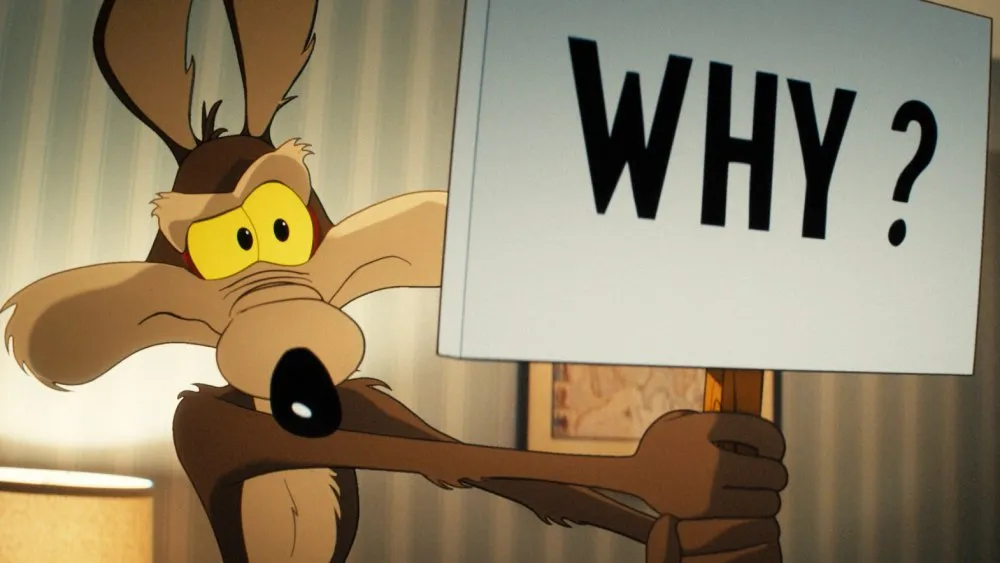
“Coyote vs. Acme” has crossed $100 million at the global box office, three years after Warner Bros. shelved the completed Looney Tunes comedy for a tax write-down. The result has renewed questions about the decision made under Warner Bros. Discovery chief David Zaslav to keep the film out of theaters.
The live-action and animation hybrid, starring Will Forte and John Cena and produced by DC Studios co-chief James Gunn, ultimately reached audiences through independent distributor Ketchup Entertainment. The company paid $50 million for distribution rights and pre-sold foreign territories to help offset that expense.
After launching in late August with $15.9 million domestically, the PG-rated movie climbed to $59.8 million in domestic ticket sales and another $45 million overseas. Strong reviews and positive word of mouth helped turn the once-discarded project into a major win for Ketchup.
The accounting is more complicated
Whether the box-office performance proves Warner Bros. made the wrong financial decision is not entirely straightforward. “Coyote vs. Acme” cost $70 million to produce, while theater owners generally retain half of ticket sales. Warner Bros. took a $30 million tax write-down when it abandoned the film.
Ketchup’s economics were different because of its rights deal and overseas pre-sales. Warner Bros., meanwhile, would have been carrying the original production cost, along with the expense of releasing and promoting the film.
There is also an argument that Warner Bros. could have supported the movie with a larger marketing campaign, potentially driving ticket sales higher. Another possibility is that some moviegoers backed the film specifically because of the controversy surrounding its cancellation.
“It’s easy to opine on a decision after we’ve seen the effects,” said Shawn Robbins, founder of Box Office Theory and director of movie analytics at Fandango. “The movie did well partly because of rallying from fans. But it turned out to be a good movie.”
The film’s performance nevertheless highlights the potential value of family-oriented releases built around familiar properties. Theater owners have frequently complained about a shortage of new movies aimed at families. Although original animation has struggled in the post-COVID period, franchise titles including “Sonic the Hedgehog” and “PAW Patrol” have remained reliable, modest box-office attractions.
A sharp contrast with another Looney Tunes release
“Coyote vs. Acme” also dramatically outperformed Ketchup’s other recent Looney Tunes title, 2024’s “The Day the Earth Blew Up: A Looney Tunes Movie.” Warner Bros. Discovery had quietly offloaded that film as well. Aimed at a much younger audience, it finished with $15.4 million worldwide.
Analyst David A. Gross of FranchiseRe said the stronger showing for “Coyote vs. Acme” demonstrated the lasting value of the property.
“There was legacy value in that IP, and the box office grosses of ‘Coyote vs. Acme’ reflect it,” Gross said. “All-audience films are extremely valuable and among the biggest earners at the box office. And there would have been upside with stronger marketing.”
The success also stands out against Warner Bros.’ poor 2026 box-office performance. The studio’s money-losing releases have included Tom Cruise’s dark comedy “Digger,” Maggie Gyllenhaal’s punk-rock “The Bride!” and DC’s “Supergirl.”
The wider cost of shelving the film
Beyond the financial debate, studio sources said the intense negative attention generated by shelving a finished movie was not worth the resulting trouble. “Coyote vs. Acme” had also supposedly been well received in test screenings, adding to the criticism surrounding its cancellation.
Employees inside Warner Bros. pushed back against burying the film, but Zaslav left the final determination to accountants, according to those sources. The backlash further strained his relationship with members of the film community after his predecessor, Jason Kilar, had alienated many Hollywood creatives by placing Warner Bros.’ 2021 slate in theaters and on HBO Max simultaneously.
At the time it was shelved, “Coyote vs. Acme” became the third major casualty of Zaslav’s post-pandemic cost-cutting campaign. In 2022, Warner Bros. also abandoned the $90 million DC project “Batgirl” and the family title “Scoob! Holiday Haunt” for tax purposes. All three films had been greenlit under Kilar, who departed in 2022 before Zaslav succeeded him.
Zaslav said at the time that Warner Bros. was refocusing on theatrical releases and that “Coyote vs. Acme” did not fit the company’s new creative direction. Its eventual box-office run has intensified the debate over whether that strategy underestimated the commercial strength of Warner Bros.’ recognizable brands.
“We see so many remakes and sequels because they make money,” Robbins said. “The fact that ‘Coyote vs. Acme’ was based on IP plays into the curiosity behind Warner Bros. [getting rid of it].”
The final verdict still depends on which company’s books are being examined. For Ketchup, the film is an unmistakable success. For Warner Bros., the production budget and theatrical economics complicate the picture. But after more than $100 million in ticket sales, “Coyote vs. Acme” has shown that audiences saw value in a movie its original studio had decided was not worth releasing.