
“Passing Strange” is finally getting its proper Southern California premiere, nearly two decades after the rock musical opened on Broadway in 2007 and collected honors from the Tonys, Drama Desk Awards and New York Drama Critics’ Circle Awards.
The Pasadena Playhouse production is being directed by Zhailon Levingston, who won this year’s Tony for best direction of a musical for “Cats: The Jellicle Ball.” When Levingston met with Pasadena Playhouse leadership to discuss potential projects, bringing “Passing Strange” to the region was at the top of his list.
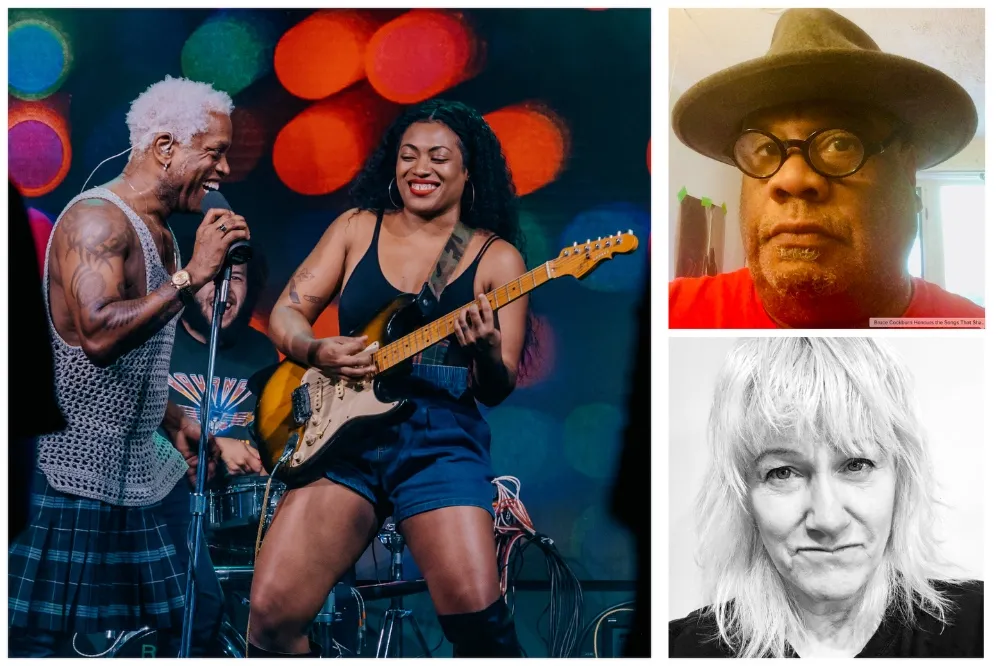
Vintage Trouble singer Ty Taylor takes on the central role of Narrator, the Stew stand-in in a story that draws from elements of Stew’s own coming-of-age and places them inside a rock ’n’ roll framework. Brittany Campbell, Britton Smith and Saycon Sengbloh are also in the cast.
The new staging brings the musical back to an area with deep ties to its creators. Stew and Heidi Rodewald were prominent figures in the Los Angeles music scene as members of the critically acclaimed band the Negro Problem before the show’s development took them to New York in the early 2000s.
A New Team Takes On “Passing Strange”
Stew and Rodewald, who performed throughout the original Broadway and pre-Broadway runs, are not appearing in Pasadena and are not directly working on Levingston’s staging. They are instead watching the production take shape from a distance.
Speaking with Variety, Stew said Levingston had invited the creators to look in on the process, but they chose not to interfere. Calling the director “a total visionary,” Stew said, “All we could do at this point would be drag it down.”
Rodewald expressed similar confidence in Levingston’s understanding of the material: “The way he talks about ‘Passing Strange’ just makes us think: Whatever you’re going to do, you get it.”
The original performers can still be seen in Spike Lee’s filmed version of the musical. That production also includes Colman Domingo, who had a supporting role on Broadway before becoming famous.
For Stew, the Pasadena staging closes a conspicuous gap in the show’s production history. He said “Passing Strange” has been mounted in almost every major city except Los Angeles, as well as in South America and Europe. A London production, he added, had been a dream come true.
“The good news is that this amazing director is doing it in L.A., so who cares about time?” Stew said. “It’s gonna be worth the wait.”
From Club Experiment to Broadway
The musical began with “Travelogue,” a cabaret-style project in which Stew and Rodewald discussed places they had lived and experiences they had shared. They presented that early version at Joe’s Pub and other New York clubs before the Public Theater approached them about turning it into a theatrical piece.
Stew said they rejected the offer three times before agreeing. Even as the project developed through commissions and workshops, the pair continued making albums and touring. Rodewald said they were not staking everything on theater, and neither creator viewed Broadway as a lifelong ambition.
That distance from Broadway convention helped define the finished work. Rodewald recalled that they consciously avoided familiar musical-theater devices, including obvious musical “buttons” designed to prompt applause. The show instead foregrounded social and racial issues through a protagonist who breaks the fourth wall, with a live band sharing the stage.
Stew won the Tony for best book of a musical. In the years that followed, he saw other productions embrace onstage bands and visual ideas that he associated with “Passing Strange.” He remains more cautious about claiming a deeper influence, arguing that much of what followed was stylistic rather than a full embrace of rock ’n’ roll’s unpredictability, vulnerability and immediacy.
Rodewald, however, recalled realizing the scale of the musical’s reach when people around the country told them they had seen it on Broadway. She contrasted its eight-show-a-week schedule and 1,200-person audiences with the pair’s many years of live band performances.
ShowBiz Take
The Pasadena production matters not simply because “Passing Strange” is returning to the stage, but because it is arriving in the region that helped shape its creators. Stew and Rodewald built an audience in Los Angeles before finding a sustainable theatrical career in New York, making this long-delayed Southern California premiere both a homecoming and a handoff.
That handoff is also central to the musical’s continuing life. Stew once had difficulty imagining another performer stepping into the Narrator role, but changed his mind after seeing an early production in Washington, D.C. He came to view new stagings like cover versions: the strongest interpretations honor the original while finding their own identity. Productions in Argentina and Belgium have also adapted aspects of the material to their performers and settings.
What Happens Next?
Stew and Rodewald have several projects underway beyond Pasadena. Stew said the Negro Problem plans to release a record in 2027, while Rodewald is writing songs for a project about Aileen Wuornos, although she has not yet determined whether it will become a song cycle or a full musical.
The pair also operate Stewdio Zero, creating a show every four months with former students from The New School, Harvard and LaGuardia and performing at Jack in New York. They are making a film of their Harlem Stage show “High Substitute for the Head Lecturer,” about Amiri Baraka and Allen Ginsberg.
Stew is additionally working on a Broadway-bound project involving Muhammad Ali and Thelonious Monk. He and Rodewald have received funding for a planned live song cycle about Detroit activists Grace Lee Boggs and Jimmy Boggs. Alongside those projects, Stew teaches theater and music at Harvard in a class titled “Singer Plus Song Equals Story.”