
More than six decades after “The Twilight Zone” ended its original run in 1964, Rod Serling’s anthology continues to look startlingly current. Its stories imagined lifelike robot companions, manufactured youth, erased identities, machine-driven job displacement and computerized voices of authority long before AI partners, deepfakes and longevity businesses became part of contemporary debate.
CBS aired 156 episodes across five seasons beginning in 1959, with Serling’s narration framing the often-fantastical stories. The show’s memorable twists remain a major part of its appeal, but the following 10 episodes went further: Each anticipated a question society is still confronting.
From artificial companionship to manufactured beauty
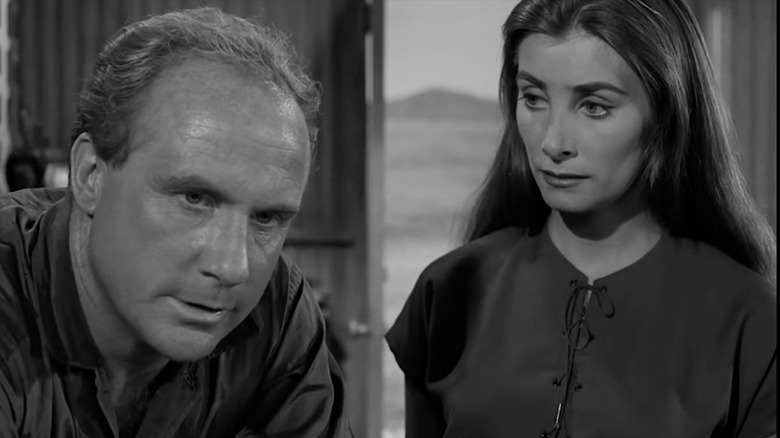
Season 1’s “The Lonely” places convicted murderer James A. Corry (Jack Warden) on an asteroid, where he has more than 40 years left to serve. A supply crew gives him Alicia (Jean Marsh), a lifelike female robot he initially rejects before falling in love with her. When Corry is pardoned, a strict weight limit prevents him from taking Alicia home, and Captain Allenby (John Dehner) destroys her. The emotional dilemma now echoes arguments over whether AI companion apps can meet human needs—or make genuine human contact easier to avoid.
“Eye of the Beholder,” which aired in 1960, follows Janet Tyler, played by Maxine Stuart beneath bandages and Donna Douglas after they are removed. Ten procedures intended to make her appear “normal” have failed, and the State permits only one more. The reveal—that Janet has a conventionally attractive face while her doctors and nurses have pig-like snouts—turns the episode into a lasting examination of enforced beauty standards. Its concerns have gained another dimension as cosmetic injections are marketed as routine maintenance.
Season 2’s “Long Distance Call” begins when Grandma Bayles (Lili Darvas) gives 5-year-old Billy (Bill Mumy) a toy telephone shortly before her death. Billy later speaks through it with a voice that wants him to join her. His father, played by Philip Abbott, eventually bargains with his dead mother through the toy. Bill Idelson’s script, inspired by a toy phone his mother gave his son, now parallels questions raised by chatbots and voice clones created from the texts and recordings of people who have died: Do they help with grief, or make letting go more difficult?
Control, catastrophe and unstable reality
In “The Obsolete Man,” a society that has eliminated books and God declares librarian Romney Wordsworth (Burgess Meredith) useless. Allowed to choose his execution, he arranges for a bomb to kill him on live television and traps the Chancellor (Fritz Weaver) beside him. The episode’s Cold War-era warning about totalitarian control remains connected to censorship concerns. PEN America recorded 11,982 public-school book bans during the 2025-2026 school year, the group’s highest total since it began counting in 2021.
“The Midnight Sun,” a Season 3 episode that aired in 1961, traps Norma (Lois Nettleton) and Mrs. Bronson (Betty Garde) in a nearly abandoned New York City building as temperatures reach 110 degrees and continue rising. The twist reveals that Norma is feverish in bed while Earth is actually moving away from the sun and the city freezes. The story’s vision of social collapse amid extreme conditions feels less remote after NASA reported that 2024 was the hottest year to date.
“Five Characters in Search of an Exit” finds an Army major (William Windom), clown (Murray Matheson), hobo (Kelton Garwood), ballerina (Susan Harrison) and bagpiper (Clark Allen) trapped inside a metal cylinder without memories, hunger or thirst. Their attempted escape reveals that they are dolls in a toy-donation bin. Airing shortly before Christmas during Season 3, the episode anticipated later conversations about simulated worlds and the disturbing possibility that reality was constructed by an unseen creator.
Identity becomes equally fragile in 1962’s “Person or Persons Unknown.” David Gurney (Richard Long) wakes to find that his wife, employer, regular bar and mother no longer recognize him, while every record of his existence has disappeared. After his world apparently returns, his wife suddenly has another face. In an era of deepfakes, scams and competing versions of reality, David’s inability to prove who he is carries a new technological terror.
Bodies, labor and trust in machines
“The Trade-Ins” follows elderly couple John and Marie Holt (Joseph Schildkraut and Alma Platt), who want to exchange their painful bodies for younger ones. Their savings will cover only one replacement. John takes the new body but reverses the procedure after seeing Marie. The episode anticipated consciousness-transfer fantasies while identifying an enduring complication in the pursuit of longevity: Access to youth is determined by who can afford it.
In “Steel,” set in 1974, robot-only prizefighting has replaced human competition. Retired boxer “Steel” Kelly (Lee Marvin) depends on an outdated B2 robot, Battling Maxo, but secretly enters the ring himself when the machine breaks down. Richard Matheson’s story later became the 2011 Hugh Jackman science-fiction movie “Real Steel.” Its battered human fighter, struggling for income while machines take over his profession, now resonates with concerns about AI, automation and displaced workers.
Season 5’s “The Old Man in the Cave” takes place 10 years after nuclear war. Mr. Goldsmith (John Anderson) relays survival instructions from a mysterious authority, but Major French (James Coburn) persuades the town to reject its warning about contaminated food. The residents discover the “Old Man” is a computer, destroy it and eat the tainted supplies, leaving Goldsmith as the lone survivor. Its central question—when to trust a machine over human instinct or a persuasive person—has only become more urgent in the age of chatbots.
ShowBiz Take
What makes these episodes endure is not simply that Serling and his collaborators imagined recognizable technology. “The Twilight Zone” repeatedly focused on the human choices surrounding it: companionship that becomes dependence, beauty transformed into compliance, youth turned into a luxury purchase, and reliable machines rejected because people dislike what they represent.
The gadgets and settings may belong to fantasy, but the conflicts do not. That is why episodes made between 1959 and 1964 can still feel less like television history than warnings whose audiences have finally caught up.