David Ellison and Ynon Kreiz opened their first day as Skydance’s CEO and co-CEO with a full round of interviews, outlining how they intend to share leadership while offering broad assurances on spending, debt and editorial independence.
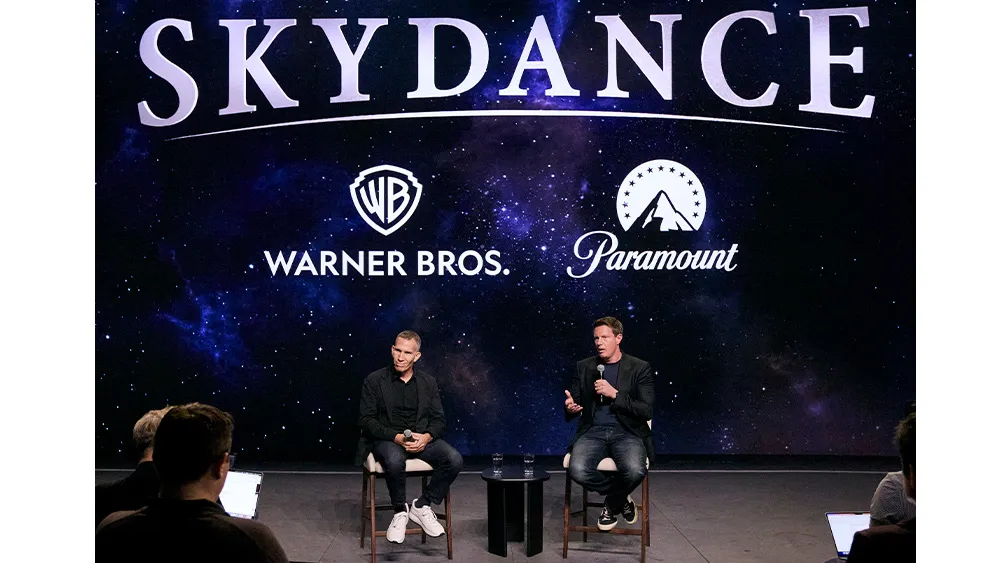
The executives began with a company town hall on the Warner Bros. lot, where they were interviewed by CNN’s Anderson Cooper. They later crossed to the Paramount lot for an afternoon press conference with reporters.
The media event took place on Stage 3, which stage manager Craig Weiss described as “the first of its kind virtual production stage, utilizing laser projection.” Skydance used the immersive technology to screen a Day One sizzle reel bringing together upcoming Paramount and Warner Bros. titles.
Although the presentation was held on a television stage, the reel concentrated heavily on film. Television was largely absent until a rapid selection of series highlights appeared during its final seconds.
The polished setting marked a change from Paramount’s August 2025 post-merger press conference, which was staged in a nearby empty room. The leadership lineup has changed as well: Jeff Shell and Cindy Holland, who previously answered questions alongside Ellison, are no longer there.
How the co-CEO structure will work
One of the immediate questions for Ellison and Kreiz concerned the company’s unusual chain of command. The announcement of Kreiz’s appointment said every business unit would report to both executives, prompting requests for a clearer explanation of their respective responsibilities.
Kreiz said the arrangement would reflect their different areas of experience.
“There will be natural delineation between us in terms of our respective experience and concentration, which we believe are highly complementary,” he said.
Under that division, Ellison will concentrate on creative matters, technology and long-term strategy, particularly where strategy intersects with the creative business. Kreiz will take a greater role in operations and daily management, including the initial phase of integrating the merged company.
Debt and the content-spending promise
Skydance’s financial ambitions also came under scrutiny. The company has $79 billion in debt while committing between $30 billion and $40 billion to produce new content.
Kreiz said the proposed spending sits within a broader financial framework and argued that content should be viewed as an investment capable of generating growth, not simply as an expense.
“We have a business plan,” he said. “There’s a complete financial envelope to how we’re going to run the business.”
While acknowledging the debt, Kreiz said Skydance expects to reduce its leverage.
Ellison cited Paramount’s performance over the past year as evidence that expansion and efficiencies could happen at the same time. He said the company had exceeded its synergy target, reaching approximately $2.7 billion by the end of this year after initially announcing $2 billion.
According to Ellison, Paramount achieved that while increasing its film slate from eight movies to 15 and greenlighting four new and returning series.
Ellison addresses Trump ties and industry opposition
Ellison was also questioned about his family’s close relationship with President Donald Trump. He responded that “it’s important to talk to everybody on both sides of the aisle” and said the company believes in “complete editorial independence.”
Another question focused on opposition to the merger within Hollywood and what Ellison would do to rebuild trust among its critics.
“I do genuinely believe this is the best outcome for the industry,” he said. “I think we will deliver for the creative community. We will deliver for our shareholders. And the best I can say to our detractors is, give us time, and we’ll prove it.”
What Happens Next?
Ellison and Kreiz plan to take their message to investors next, but several major decisions remain without detailed timelines or public plans.
The executives did not provide specifics on when HBO Max and Paramount+ could be combined. They also left open the possibility of eventually consolidating the company’s three television studios.
Other unresolved matters include what Skydance intends to do with its more than 30 cable networks and how film and television operations will be divided between the Warner Bros. and Paramount lots.
There was also no detailed roadmap for how the Paramount and Warner Bros. studios will reach a combined target of 30 movies annually. The status of Barbie 2 was among the project-specific questions left unanswered.
Ellison and Kreiz repeatedly emphasized that the press conference came on Day One. Their debut supplied promises about investment, integration and creative output, but the practical details behind many of the new Skydance’s biggest ambitions are still to come.