
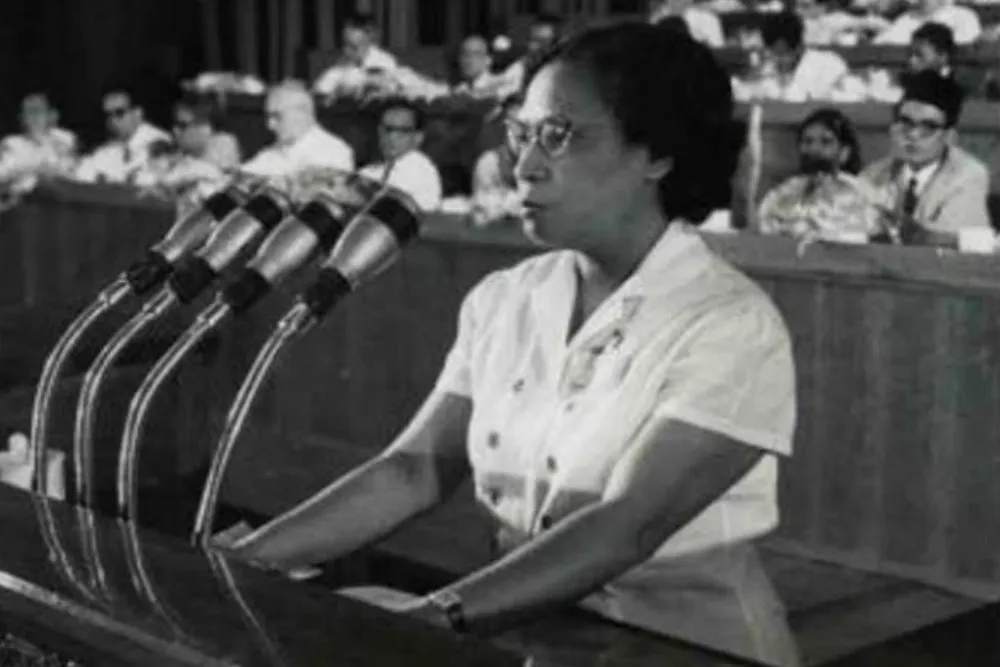
Reza Rahadian is turning a deeply personal chapter of his family history into “Casparina,” his second feature as a director. Inspired by his grandmother, journalist Francisca Casparina Fanggidaej, the film centers on a mother returning to Indonesia decades after the government forcibly stripped her of citizenship.
The project has been selected for the Asian Project Market, held as part of the Busan International Film Festival’s Asian Contents & Film Market. Producers Arya Ibrahim and Gita Fara are bringing “Casparina” to Busan while the screenplay remains in its early stages.
In the film, a journalist named Rina is forced into exile after opposing the government. Thirty-four years later, she receives a letter informing her that the old regime has fallen and that she can return home.
Her homecoming brings her face to face with Andi and Lila, the now-adult children who built their lives without her. Rina must contend with their pain and resentment as the family begins the difficult process of reconnecting. Over time, the children come to understand what their mother sacrificed for both her family and her country.
A Family Separated by Political Upheaval
Rahadian said he was compelled by the idea of examining motherhood from the perspective of children who grew up in their mother’s absence. That separation unfolded during a period when citizenship could be removed suddenly and by force.
Although the film’s story places Rina’s return 34 years after her exile, Rahadian said his grandmother and her children were separated for 32 years. “This is for me a very important story,” he said.
The director wants the film to explore the cost of difficult choices, including decisions shaped by forces beyond an individual’s view or control. He also hopes viewers will consider “what it means to be a mother that is absent for 32 years,” as well as the experience of children who could not safely acknowledge their mother’s identity.
According to Rahadian, openly saying who their mother was could have endangered their lives.
Ibrahim and Fara place the family’s story within the political upheaval of 1965, when families were divided and people deprived of citizenship were left to live in exile. They said Casparina was in Beijing representing Indonesia at an international forum when her citizenship was revoked because of her opposition to the new regime.
She left six children behind and spent 32 years outside Indonesia. Her exile began in Beijing and later continued in the Netherlands before the family eventually reconnected.
The producers describe Casparina as “a victim of an era.” For them, her experience offers a way to examine Indonesian history and identity while warning against repeating the actions that separated families and displaced citizens.
Rahadian Returns to Busan With His Second Feature
“Casparina” follows Rahadian’s first directorial feature, “On Your Lap.” That film received four prizes in the Busan festival’s Vision awards in 2025, including the audience award and the Fipresci award.
His new project approaches political history through the consequences carried by one family: a mother unable to return, children forced to live without her and a reunion complicated by decades of silence and hurt. Rather than limiting the story to exile itself, “Casparina” follows what happens when separation ends but its emotional effects remain.
ShowBiz Take
“Casparina” matters because Rahadian is grounding a story of citizenship and political upheaval in a documented rupture within his own family. The verified details of Francisca Casparina Fanggidaej’s experience — the loss of citizenship, six children left behind and 32 years in Beijing and the Netherlands — give the developing film a specific personal foundation.
Its central conflict also extends beyond the fact of a long-awaited return. The film is built around whether a mother and her grown children can understand one another after political circumstances denied them a shared life. By focusing on resentment, risk and sacrifice, Rahadian is framing history through the people who continued to live with its consequences.
What Happens Next?
With the script still being written, “Casparina” remains at an early point in its development. At the Asian Project Market in Busan, Ibrahim and Fara hope to connect with potential partners and collaborators, identify film-fund possibilities and pursue co-production opportunities.