
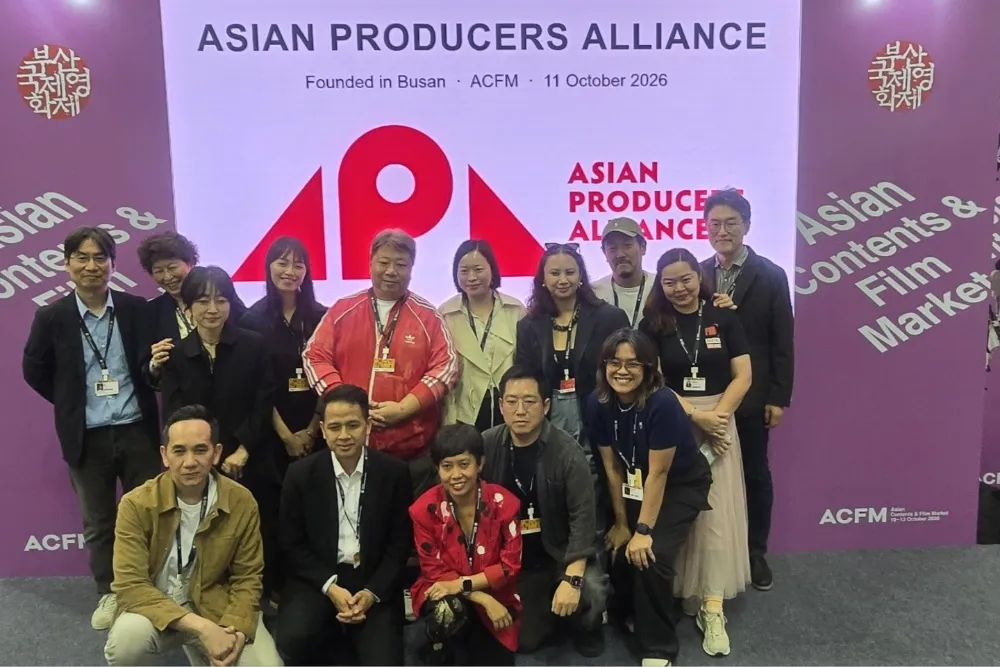
Independent producers from five Asian territories have launched the Asian Producers Alliance, a new coalition designed to expand cross-border co-production and strengthen protections for creators’ intellectual property rights.
The alliance was unveiled Sunday at the Busan International Film Festival’s Asian Contents & Film Market. Representatives from five producer organizations took the stage as “Squid Game” producer Kim Ji-yeon, a board member of the Producers Guild of Korea, read the group’s founding declaration.
“For years, we have faced the same changes alone – in our own markets, in our own languages. Today we choose to face them together,” the declaration said. “We will advance co-production across Asia, so that our stories can be made together and travel further.”
The APA’s founding members are the Producers Guild of Korea, known as PGK; the Indonesian Film Producers Association, or APROFI; the Philippine Independent Producers Group; the Hong Kong Movie Production Executives Association; and the Taiwan Producers Association.
PGK and APROFI initiated the coalition, which was approved online by all five organizations. Its membership is made up of independent producers, without the involvement of studios, conglomerates or state bodies.
A Coalition Built Around Co-Production
The launch closed the seminar “Empowering Asian Cinema: Solidarity and Creative Alliance,” hosted by PGK at the ACFM Producers Hub. The discussion examined international co-production at a time when streaming and short-form content are reshaping the industry.
PGK International Committee director Han Jin moderated the panel, which featured Yulia Evina Bhara of Indonesia’s KawanKawan Media; Rhee Handae, CEO of Korea’s Sidus; Yamaguchi Shin of Tokyo-based Knockonwood; and Bianca Balbuena, co-founder and COO of the Philippines’ Epicmedia Productions.
Yamaguchi summarized his outlook in two words: “Think globally.” He said that as producers confront the practical realities of working across borders, international co-production is becoming an unavoidable part of the industry’s future.
The panelists brought substantial cross-border and festival experience to that conversation. Yamaguchi has spent more than 20 years structuring international co-productions involving Asia, Europe and North America. Rhee oversees Sidus’s Korea-Vietnam co-productions, including projects developed through a joint venture with director Phan Gia Nhat Linh.
Bhara’s credits include Cannes winner “Tiger Stripes” and Venice-winning “Autobiography.” Balbuena has produced films screened at festivals including Sundance, Venice, Cannes and Berlin.
How the Asian Producers Alliance Will Operate
The APA will initially function as a consultative coalition, concentrating on co-production within Asia and creators’ IP rights. Its longer-term aim is to become an organization with a formal decision-making structure.
Producer organizations elsewhere in Asia will be able to join during the alliance’s first year. Membership will not be restricted to one organization per territory, leaving room for multiple producer groups from the same market to participate.
Members plan to meet online every quarter. The coalition will also convene an annual general assembly during the Asian Contents & Film Market.
PGK president Lee Dong-ha and APROFI chair Edwin Nazir have been appointed as the APA’s inaugural co-representatives. Han and Bhara will run the secretariat as co-secretary generals.
Each of the four inaugural leaders will serve a one-year term. Elections are scheduled to take place at every annual general assembly.
“APA is not a declaration – it is a practice of solidarity that begins now,” Lee said.
Hong Kong Movie Production Executives Association chair Johnny Wang also framed the launch as a departure from familiar industry patterns. Producers had long been accustomed to following paths established by those before them, he said.
“Now, with the birth of the APA, we are embarking on an entirely new and unprecedented journey,” Wang said.
ShowBiz Take
The APA’s significance lies in the structure behind its statement of intent. This is not simply a one-off gathering of producers: the coalition has established leadership terms, regular online meetings, an annual assembly and an open first-year membership process.
Its independent composition also defines its mission. With no studios, conglomerates or state bodies participating, the founding organizations are placing producers themselves at the center of discussions about ownership, collaboration and how Asian projects can be developed across national and language boundaries.
The alliance’s next challenge will be turning that framework into practical cooperation. Its decision to prioritize both co-production and creators’ IP rights connects the business of making projects across borders with the question of how creators’ interests are protected.
What Happens Next?
The APA’s second seminar is scheduled for December at the JAFF Market in Yogyakarta, Indonesia. APROFI will host the event, which will focus specifically on creators’ intellectual property.
Beyond that seminar, the alliance will begin its quarterly online meetings, welcome additional eligible producer organizations during its first year and work toward the formal decision-making structure envisioned by its founders.