
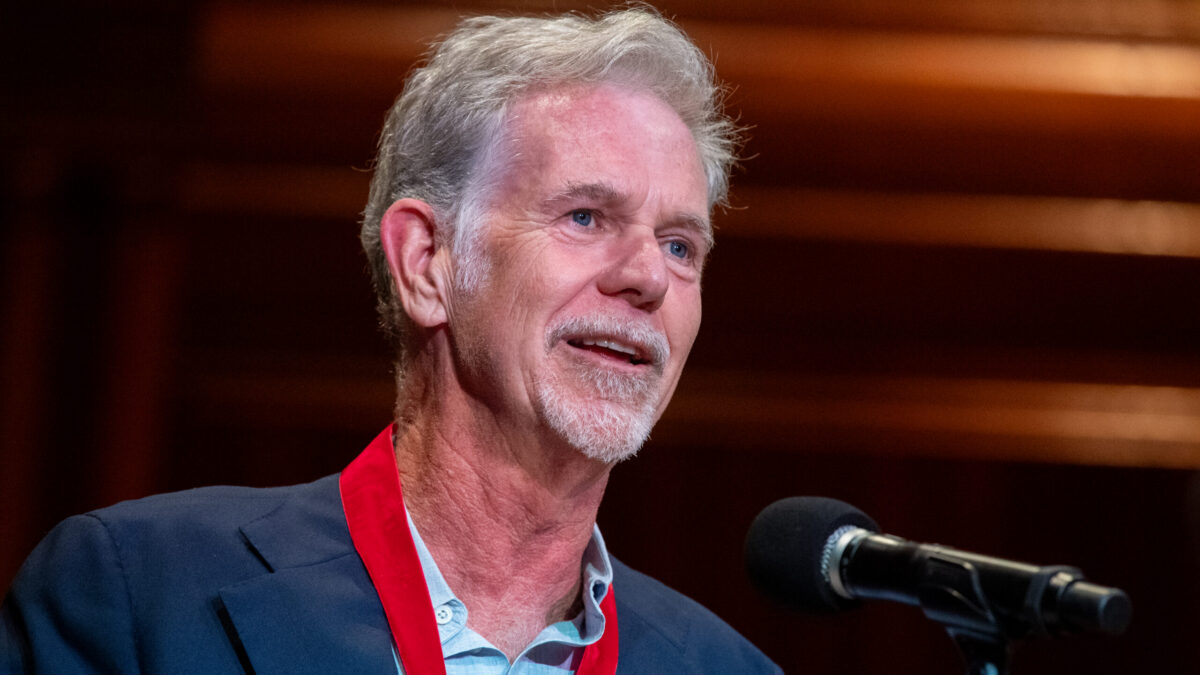
Reed Hastings says he had no advance notice that Netflix was cutting 1,000 jobs, despite his three-decade association with the company he co-founded.
Hastings, who ended his formal ties with Netflix last June, said on the On with Kara Swisher podcast that he “read about” the layoffs. The reductions affected approximately 6% of the company’s workforce.
Although he was not involved in the decision, Hastings acknowledged the human and creative pressures that follow a large round of job cuts.
“It’s hard because I’d like to be in the fray helping,” he said. “Those are traumatic moments, saying goodbye to some people and getting other people to focus on, ‘OK, we really need to take up our creative excellence and just to be supportive.’”
Still, Hastings expressed confidence in those running the company. “They’re very competent people. They’ll figure it out. So I’m not worried about it,” he added.
A Leadership Shake-Up at Netflix
The layoffs arrived during a wider overhaul of Netflix’s executive ranks. Peter Rice replaced Bela Bajaria as content chief, while film head Dan Lin was ousted.
Those changes have intensified questions about Netflix’s programming direction amid a recent slowdown in viewership growth. Asked whether the incoming leadership should substantially rethink the company’s content strategy, Hastings offered a straightforward prescription: “I think the strategy is doing more and better television shows, more and better movies.”
For Hastings, that approach would represent a return to the company’s central entertainment identity, even as newer offerings such as live sports become part of the mix.
“The core brand property is about being thrilling,” he said. “We realized, it took a long time, that we could be distrusted, we could be disliked, but we can never be boring, OK? That the essence of an entertainment brand is to be thrilling.”
Hastings Sizes Up YouTube
Hastings also addressed the growing share of television-screen viewing captured by YouTube while Netflix remains in a holding pattern. He emphasized that the two companies operate with very different models, pointing to YouTube’s vast creator network.
“They have 3 million paid creators who are fighting for attention,” Hastings said.
He cited Obsession and Backrooms as examples of blockbuster cultural properties that can emerge from that system, while arguing that such programming still makes up an “incredibly small amount” of YouTube viewing.
His broader assessment was that YouTube has become exceptionally effective at capturing attention. “It’s a highly tuned machine for attention and it’s winning viewing hours,” he said.
Asked whether Netflix should respond by moving further into short-form programming, Hastings instead drew a comparison with an earlier shift in entertainment. He noted that movie viewing declined with television’s emergence in the 1950s and 1960s, before films experienced a creative transformation in the 1970s through changes in pacing and realism.
In his analogy, YouTube now occupies television’s former position as the disruptive new force. Netflix and other established entertainment companies, he suggested, need to answer by raising their creative standards and producing work that is more “gripping, real” and emotionally connecting.
The Warner Bros. Discovery Bid
Hastings also revisited Netflix’s unsuccessful pursuit of Warner Bros. Discovery’s studios-and-streaming division, a bid whose aftermath continues to weigh on Netflix’s stock.
Paramount ultimately paid Netflix a $2.8 billion breakup fee as part of clinching its $110 billion purchase of all of Warner Bros. Discovery and forming Skydance.
Hastings said Netflix had been comfortable with its own offer before the bidding moved higher.
“At the price that we had bid, we were really happy,” he said. “Then the price went up a bunch and it seemed a bridge too far. … We could have done it. It’s not a ‘can’t,’ but a ‘choose not to.’”
His comments framed the outcome as a deliberate decision not to pursue the deal at the increased valuation, rather than an inability to complete it.
Why Netflix’s Co-CEO Model Worked
The conversation also turned to Netflix’s unusual co-CEO structure. The company first used that arrangement with Hastings and Ted Sarandos, and later with Sarandos and Greg Peters.
Asked why the system had worked at Netflix, Hastings said he did not expect the model to remain common “over the next 100 years of Netflix.” When Swisher questioned why he believed the company would last another century, he replied: “Because I think humans are going to be around, and you love entertainment.”
ShowBiz Take
Hastings’ lack of advance knowledge about the layoffs underscores how fully he has stepped away from Netflix’s internal decision-making. Yet his detailed comments show that he remains willing to publicly assess the company’s creative direction, competition and corporate choices.
His message was notably consistent across subjects. Whether discussing YouTube’s momentum, Netflix’s programming strategy or the failed Warner Bros. Discovery pursuit, Hastings returned to the importance of disciplined choices and stronger entertainment. During a period marked by 1,000 job cuts and major executive changes, his proposed route forward is not a radical reinvention but a renewed focus on making television and movies that audiences find impossible to dismiss as boring.