
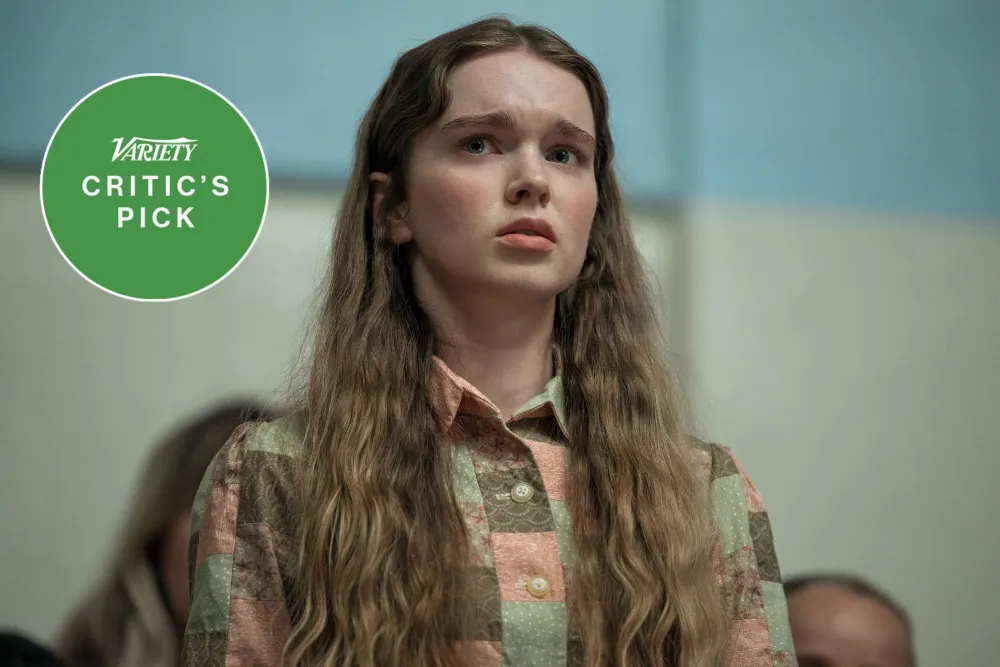
Prime Video’s eight-episode “Carrie” takes Stephen King’s debut novel into the social media era without losing the dread, cruelty and emotional power at the heart of the story. Adapted for television by Mike Flanagan, the present-day series honors both King’s writing and Brian De Palma’s acclaimed 1976 film while giving Carrie White a strikingly different path through a hostile world.
Summer H. Howell delivers a stellar performance as Carrie, a sheltered sophomore whose life has been controlled by her doomsday-prepper father, Ralph (Tahmoh Penikett), and intensely religious mother, Margaret (Samantha Sloyan). After Ralph’s death, Carrie leaves the confines of the family’s modest home and enters high school for the first time.
She arrives with almost no understanding of everyday life, but Howell makes her more than simply naïve. Carrie is eager to learn, curious about the world and open to experiences that have long been denied to her. That innocence, however, immediately makes her a target.
A familiar nightmare with modern weapons
On Carrie’s first day, senior Sue Snell (Siena Agudong) shows her some kindness. Sue’s best friend, Christine Hargensen (Alison Thornton), responds very differently, treating the younger student with open contempt. By the end of Carrie’s second day, an active shooter drill and the unexpected arrival of her menstrual cycle have left her terrified and overwhelmed.
The series finds its sharpest contemporary angle in Christine’s use of Instagram. She creates a gossip account called “Carrie Red,” using it to attack Carrie while also disparaging students, teachers and members of the school administration. The account turns ordinary school cruelty into something far more expansive, allowing humiliation to spread through technology rather than remain contained to a classroom or hallway.
That choice gives the adaptation a distinctly current menace. Carrie is trapped between the relentless antagonism of her classmates and Margaret’s punishing religiosity at home. Sloyan’s Margaret remains vile, but her behavior emerges from a more loving place than the terrifying cruelty of Piper Laurie’s version. The distinction does not make Carrie’s home life safe; it makes the relationship more complicated.
As the pressure grows, Carrie begins striking back in astonishing ways. The story still moves toward its defining prom confrontation, where she is drenched by a bucket of pig’s blood, but Flanagan is not merely restaging familiar images. His version uses those essential moments as the foundation for a wider examination of violence, technology, religious zealotry and the cost of power.
The young women reclaim the story
One of the series’ most effective changes is its focus on the agency of Carrie, Sue and Christine. Carrie is not presented only as a victim awaiting destruction. Her growing knowledge of her abilities, along with her determination to explore them, gives her an opportunity to avoid the fate suffered by Sissy Spacek’s Carrie in De Palma’s film.
Sue, meanwhile, faces a moral choice: remain loyal to her closest friend or stand against behavior she knows is wrong. Christine’s journey is darker and more volatile, as she wavers between flashes of humanity and the viciousness she uses as emotional armor. Together, the three characters provide a broader view of how power can be expressed, abused or resisted.
The first season also reaches beyond Carrie’s small town. She is able to connect with other young women around the world who possess special abilities, expanding the narrative while linking the series to King’s wider universe. That development gives this Carrie possibilities unavailable to earlier versions of the character.
Across eight episodes, the show presents a contemporary America saturated with technology and brutality. Violence is not treated as an isolated eruption; it filters through institutions, homes and young people who are still trying to understand themselves. Carrie’s pain remains central, but the series allows that pain to become a source of resilience rather than only a force of destruction.
Howell anchors that approach with a performance that preserves Carrie’s vulnerability without denying her strength. She can be meek and childlike, yet she is also driven by a fierce desire to claim the life she wants. By giving its central character room to understand and use her talents, the adaptation transforms a familiar tragedy into something more defiant.
What Happens Next?
All eight episodes of “Carrie” premiere Oct. 7 on Prime Video. The complete first-season release will reveal how far Carrie’s new connections—and her hard-won agency—can carry her beyond the story’s most famous night.