
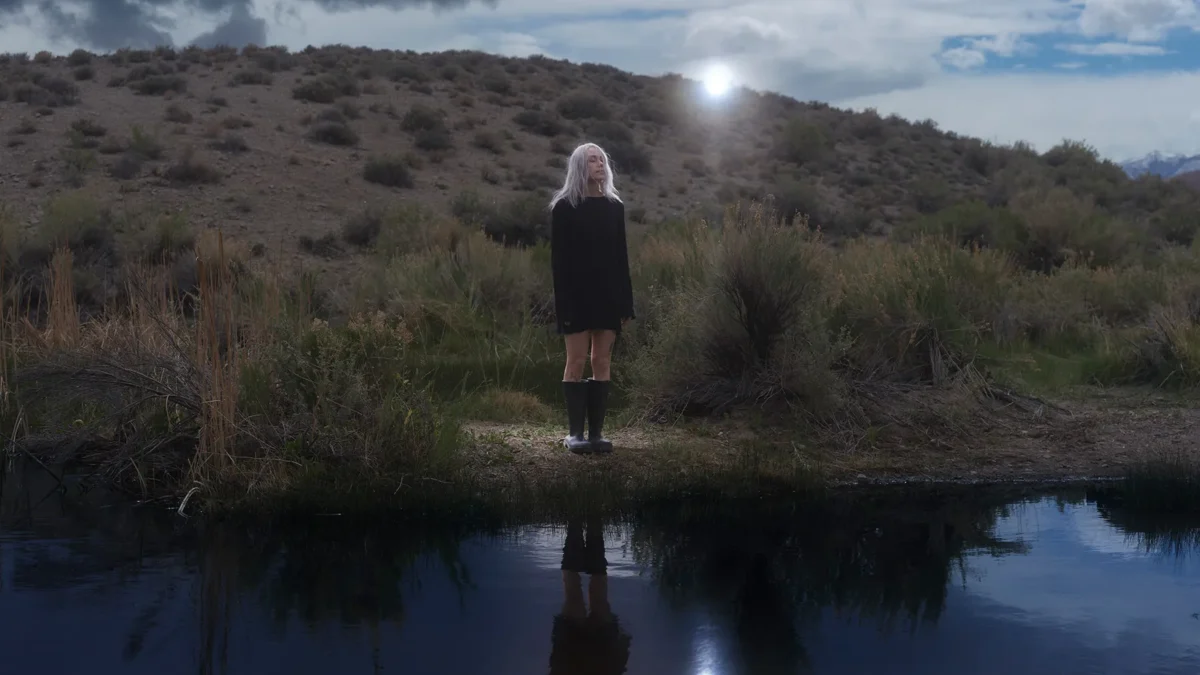
Phoebe Bridgers set out to make her third solo album sound unmistakably different from her first two. On Lost Weekend, that meant keeping longtime producers Tony Berg and Ethan Gruska close while opening the studio doors to Jack Antonoff, Alex G and a much larger circle of musicians.
“I knew I wanted to work with Tony and Ethan again,” Bridgers said. “But I knew I wanted to change the sound of this one and that fresh blood would help.”
The approach pushed Bridgers’ predominantly rock sound toward ambient electronics, country and other melodic territory. The 16-song album, released in August 2026, ultimately reached No. 2 on the main U.S. albums chart and placed the four-time 2024 Grammy winner among indie rock’s leading prospects for the 2027 ceremony.
Lost Weekend arrived six years after 2020’s Punisher, the breakthrough album that earned Bridgers a best new artist Grammy nomination. The gap was packed with other work: She released The Record, the Grammy-nominated boygenius debut made with Lucy Dacus and Julien Baker; toured solo and with the group; opened nearly a dozen dates on Taylor Swift’s Eras Tour; launched Saddest Factory Records as a Dead Oceans imprint; and filmed her acting debut in Lance Oppenheim’s recently released Primetime. Dead Oceans absorbed Saddest Factory in June.
The period also included the end of Bridgers’ relationship with actor Paul Mescal, the death of her father, Tony Bridgers, and the beginning of her relationship with comedian Bo Burnham. Those experiences fed into material that began taking shape as early as 2022, though intensive writing and recording started in 2024.
A Familiar Team Opens Up the Process
Bridgers’ first two albums were made largely with Berg and Gruska at Sound City Studios in Van Nuys, California. This time, the sessions expanded to Electric Lady Studios in New York and Tamarind in Los Angeles. Gruska said Bridgers wanted new musicians who could “inspire us and surprise us,” preventing the established team from becoming too settled in its usual methods.
Alex G entered the process before Antonoff, working on sketches with Bridgers and songwriter Christian Lee Hutson. Bridgers, Hutson, drummer-songwriter Marshall Vore, Burnham and Alex G also spent several days making songs in Philadelphia. One discarded Alex G idea became “Lost Boys,” while his Mellotron work shaped the unusual closing section of “Liberty Tree.”
Antonoff’s involvement began unexpectedly after Bridgers was evacuated from her home for three weeks during the Los Angeles fires in January 2025. She went to New York, where Electric Lady studio manager Lee Foster provided a writing room. Antonoff encountered her there and brought her a small drum machine.
That meeting led to work on the first of three versions of “Lost Weekend” heard on the album. A voice memo developed into an expansive outro that sampled composer Paul Lansky’s “Notjustmoreidlechatter.” Vore said Bridgers had used a melody from Damien Jurado’s “The Last Great Washington State” as a writing exercise while dealing with writer’s block.
Antonoff described the goal as moving without warning from the intimacy of a phone recording to a maximal burst of sound. He also helped establish one of the album’s defining production ideas: blurring the boundary between organic and synthetic elements until they could no longer be easily separated.
Bridgers said Antonoff gave her confidence to experiment, pointing to “Kill Me” as a prime example of his instincts. Her concise verdict: “He made the whole album 30% stranger.”
New Sounds, Final Decisions
The expanded lineup included Chris Thile, Caroline Shaw, Greg Leisz and Jon Brion. Thile spent three days at Sound City in November 2025 and contributed mandolin to the title track’s outro. Shaw, who met with Bridgers at her New York apartment on March 23, 2025, worked as a vocal arranger and encouraged her to retain control of the increasingly crowded creative process.
Bridgers said the many producers functioned like a “reverse band”: plenty of ideas came from around the room, but she made the final decisions. Leisz similarly recalled that she remained active throughout the sessions, walking around, listening and driving the musicians’ enthusiasm.
Brion’s late-night visit brought another unpredictable jolt. Bridgers said he arrived at Sound City at 9 p.m. with a U-Haul full of instruments, gave Berg a Guatemalan marimba, played a synthesizer whose sound opens the album, recorded a guitar solo and departed around 5 a.m.
Some songs required years of work. “As Above,” which Bridgers called both the first and last song of the project, began as an indie-rock idea played during 2022 tour sound checks. It initially drew on walking around Saint Petersburg, Russia, while she was reading Elif Batuman’s Either/Or, before evolving into a song involving abortion, her father’s death and her first consideration of possibly having a child someday. Hutson said “As Above” was the most difficult song to complete, while “Haunted” came together fastest.
A Rollout Built Around Surprise
Bridgers began unveiling the music in May through phone-free secret shows at small venues, starting at a New Mexico club. The run culminated at Madison Square Garden in New York on June 4. After announcing the album’s August release later that month, she performed “Lost Boys” on consecutive July episodes of The Tonight Show Starring Jimmy Fallon—first with a children’s rock band, then acoustically with veteran musicians.
The “Lost Boys” video, co-directed by Oppenheim, was filmed over two days in Atlanta in April. Bridgers wanted a live-action role-playing concept in which she led an off-grid vagabond troupe, and she reunited onscreen with her Primetime co-star Skyler Gisondo. Worldwide planetarium listening sessions followed during release week.
For Bridgers, putting the finished record into listeners’ hands carried particular emotional weight. She described writing it as intense and releasing it as “acutely painful,” adding that hearing audiences sing back the songs she wrote about her father remains profound. “I wish he could have seen it,” she said.