
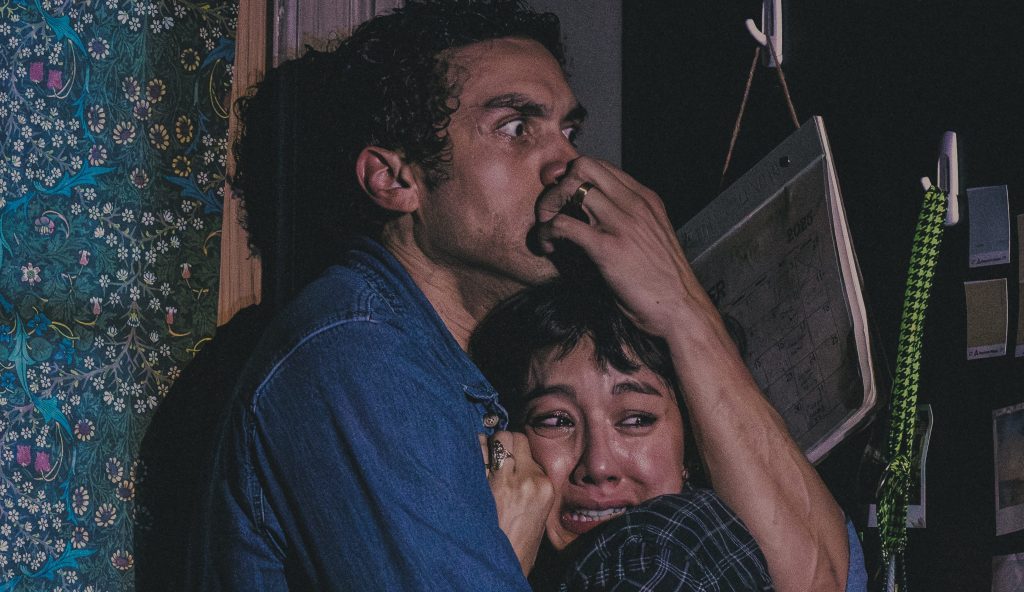
The Broadway adaptation of Paranormal Activity has arrived with a clear mandate: make a theater full of skeptical New Yorkers jump, gasp and glance nervously at the darkened corners of the room. On that count, the production delivers with impressive force, translating the found-footage horror franchise into a muscular piece of live suspense that understands the stage can be just as cruel, intimate and unpredictable as a camera left running overnight.
What might have sounded, on paper, like a cynical brand extension turns out to be a surprisingly savvy piece of theatrical engineering. The show does not merely restage familiar beats from the films. Instead, it uses the grammar of theater — silence, distance, shadow, bodies moving in real time — to build a fresh kind of dread. Doors do not simply slam; they wait. Lights do not simply flicker; they seem to think. The air in the room becomes part of the performance.
That is the production’s most effective trick. The original Paranormal Activity became a phenomenon because it weaponized domestic normalcy: a bedroom, a hallway, a sleeping body, a noise too faint to identify. The Broadway version honors that DNA while expanding the scale. The result is less found footage than live haunting, with the audience placed in the uncomfortable position of watching people ignore warnings that everyone else can feel gathering around them.
The premise remains elegantly simple. A couple in a seemingly ordinary home begins to experience disturbances that escalate from irritating to impossible. But the stage adaptation wisely resists over-explaining its mythology. Its strongest moments are not built around exposition but anticipation — the long pause before a sound, the empty doorway that somehow becomes more threatening the longer it is left alone, the sense that the house is not a setting but a predator.
A Franchise Finds a New Language
For Hollywood, the significance of this production goes beyond whether it frightens a paying audience, though it certainly does. The show arrives at a time when studios and rights holders are increasingly looking to the stage as a premium space for familiar intellectual property. Broadway has become a testing ground not just for musicals adapted from films, but for immersive and genre-forward experiences that promise audiences something streaming cannot: the danger of being in the room.
Horror has always had a complicated relationship with theater. It thrives on immediacy, but it also requires precision. A scare that works on film can collapse under stage lights if the timing is even slightly off. This production meets that challenge with considerable discipline. Its shocks are not random jolts dropped in to keep the room awake. They are planted, delayed and released with an understanding of how collective fear travels through an audience.
The technical design is the evening’s principal star. Sound moves with predatory intelligence, often seeming to come from places it logically should not. Lighting carves the space into pockets of uncertainty, making even familiar corners feel newly suspect. Illusion effects are deployed with enough restraint that the audience is left debating what it has just seen rather than simply applauding a trick. At its best, the production turns theatrical mechanics into supernatural evidence.
That said, the adaptation is not without bumps. The human drama occasionally struggles to compete with the machinery of fear. Some character beats feel functional rather than fully inhabited, designed primarily to get the audience to the next nocturnal disturbance. The dialogue is most persuasive when it is plain and frayed, less so when it reaches for psychological explanation. Horror often works best when people behave believably badly, and the show is strongest when it lets panic erode common sense without underlining the point.
The performances meet the demands of a difficult form. Stage horror requires actors to sustain credibility while reacting to events that may be triggered by timing, design and invisible choreography. The cast keeps the emotional temperature grounded enough to make the more operatic moments land. No one overplays the terror too early, which allows the dread to accumulate rather than peak prematurely.
Why It Matters
The commercial question is whether Broadway audiences, accustomed to splashy musicals and prestige dramas, will embrace a production built around fear as its central value proposition. Early response in the room suggests there is appetite for it. The audible reactions — screams, nervous laughter, the occasional communal groan of dread — are not incidental. They are part of the event.
That matters because Broadway is still redefining what kinds of stories can command premium ticket prices in a post-pandemic marketplace. Audiences are selective. The shows that cut through tend to offer either major stars, beloved music, visual spectacle or a reason to leave the house that feels unrepeatable. A well-executed horror production can offer the last of those in abundance. You cannot pause it. You cannot look away without wondering what you missed. You cannot experience the room’s fear alone.
The Paranormal Activity brand also carries a particular industry symbolism. The first film was famously built on minimal resources and maximal audience imagination, becoming one of modern horror’s great return-on-investment stories. Bringing that property to Broadway inverts the original equation: a once-tiny cinematic phenomenon is now being expanded into a high-end live event. The surprise is that the material survives the upgrade. In some ways, it benefits from it.
The production is not trying to be the scariest haunted house in Times Square. It is aiming for something more theatrical: the pleasure of watching control collapse in front of you. When it leans into that, it becomes an unusually potent reminder that live performance and horror share a primal contract. Everyone agrees to sit in the dark. Everyone knows something is coming. No one knows exactly when.
What Happens Next
If the show finds sustained traction, expect producers to look more aggressively at horror libraries as stage assets, particularly properties with contained settings and recognizable mythology. The lesson here is not that every film franchise belongs on Broadway. It is that the right one, adapted with imagination rather than imitation, can feel newly dangerous in front of a live audience.
For now, this Paranormal Activity stands as a tense, technically polished and frequently nerve-rattling night out — a production that proves a familiar screen nightmare can still make the room feel unsafe.