
Why This Matters
Brenda Fricker’s death at 81 closes a singular chapter in Irish screen history: the rise of a performer who built a career not on stardom’s machinery, but on emotional precision, lived-in humanity and an instinct for characters who rarely arrive with the glamour of leading roles. Her agent, Phil Belfield, said the actor died Thursday night in Dublin following a period of ill health.
For international audiences, Fricker will forever be linked to “My Left Foot,” Jim Sheridan’s 1989 drama about writer and painter Christy Brown. As Bridget Fagan Brown, Christy’s fiercely protective mother, Fricker delivered the kind of supporting performance that reshapes the entire center of a film. Opposite Daniel Day-Lewis, whose physically exacting performance earned him the best actor Oscar, Fricker gave the film its moral gravity: unsentimental, exhausted, compassionate and unshakably devoted.
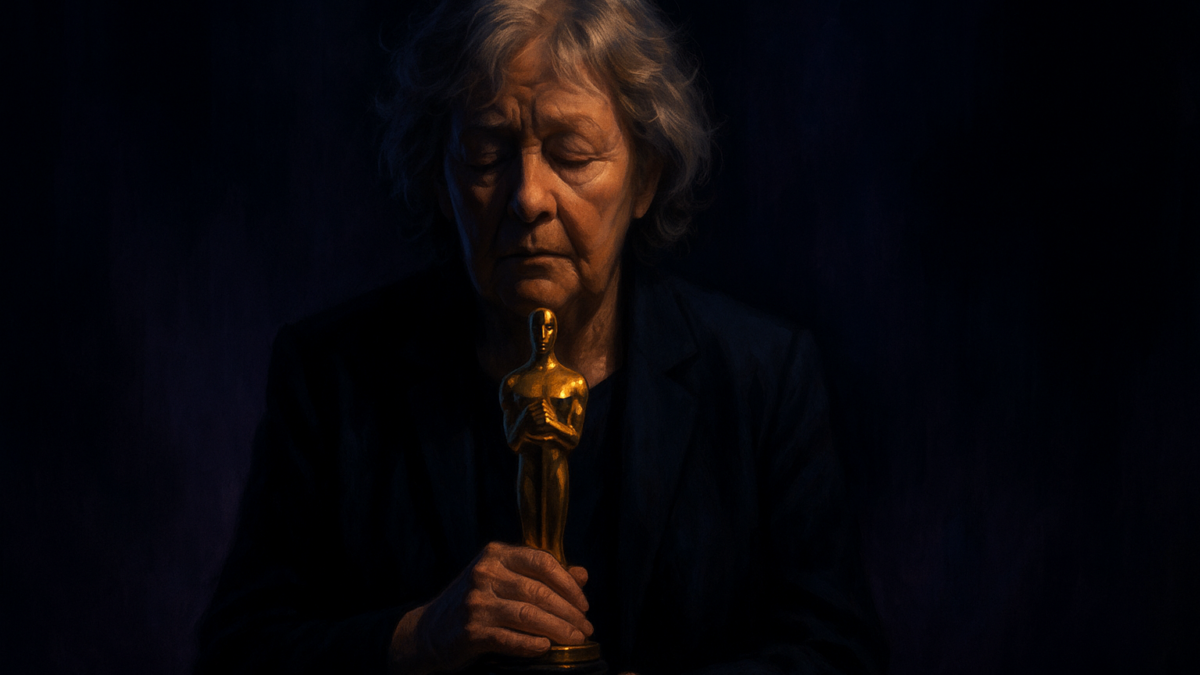
Her Academy Award for best supporting actress in 1990 made her the first Irish woman to win an Oscar, a milestone that resonated far beyond one awards season. At a time when Irish talent was still often filtered through British or American production systems, Fricker’s win placed an unmistakably Irish performer on Hollywood’s most visible stage. She did not convert that moment into a conventional celebrity career. Instead, she continued to choose work that prized character over profile.
That choice is part of why her career endures. Fricker was not a performer who asked the audience to admire technique. She disappeared into women carrying private histories: mothers, nurses, neighbors, survivors, eccentrics and quiet witnesses to other people’s chaos. Even in a broad studio comedy such as “Home Alone 2: Lost in New York,” where she played the so-called Pigeon Lady opposite Macaulay Culkin, she brought a bruised tenderness that gave the holiday sequel one of its most unexpectedly moving emotional threads.
Industry Context
Fricker emerged from a generation of Irish and British character actors whose work moved fluidly among theater, television and film. Before global prestige television made such cross-pollination fashionable, performers like Fricker developed their craft in practical, demanding environments: repertory stages, public-service broadcasting and film sets where supporting players were expected to define a world quickly and truthfully.
Her television work was central to her reputation. In the U.K., she became familiar to viewers through “Casualty,” playing nurse Megan Roach during the medical drama’s formative years. The role connected with audiences because Fricker understood the authority and fatigue of caregiving long before “frontline worker” became a cultural shorthand. She could make a glance feel like a diagnosis and a pause feel like a life story.
Film brought wider recognition, but Fricker’s screen presence never lost its local texture. In “The Field,” Jim Sheridan’s adaptation of John B. Keane’s play, she joined a formidable ensemble led by Richard Harris in a story steeped in land, pride and generational conflict. Later credits including “So I Married an Axe Murderer,” “A Time to Kill,” “Veronica Guerin” and “Albert Nobbs” demonstrated her range across comedy, legal drama, biographical crime story and period piece.
Her career also underscores the complicated relationship between awards recognition and long-term opportunity, especially for women character actors. An Oscar can make a performer immortal in Hollywood history, but it does not always guarantee a steady supply of richly written parts. Fricker’s post-Oscar path reflected both her own independence and the industry’s limitations. She did not become a fixture of franchise cinema or a constant red-carpet presence; she remained, by temperament and by trade, an actor’s actor.
That distinction matters now, in an era when performance is increasingly discussed through the lens of branding, social reach and awards campaigning. Fricker represented an older but still vital model: the performer whose authority comes from the work itself. She was acclaimed without seeming eager to be adored, funny without pushing for approval, heartbreaking without asking for tears. Her best roles carried the weight of people who had lived before the camera found them.
What Happens Next?
In the immediate days ahead, tributes from Irish film institutions, former colleagues and admirers across the industry are likely to frame Fricker as both a national trailblazer and a deeply respected craftsperson. Her Oscar milestone will understandably lead many remembrances, but the fuller measure of her legacy lies in the consistency of her performances across decades and mediums.
Her death may also prompt renewed attention to “My Left Foot,” a film that remains central to the modern history of Irish cinema. The movie’s international success helped open doors for a wave of Irish storytelling on the global stage, and Fricker’s contribution was essential to its impact. Her portrayal of Bridget Brown avoided easy sainthood; she played motherhood as labor, faith, fear and endurance, giving the film a pulse that balanced its more triumphant elements.
For younger viewers, “Home Alone 2” may provide the most immediate point of recognition. That is not a minor footnote. Holiday films have a peculiar permanence, returning annually to living rooms and streaming queues, and Fricker’s Pigeon Lady has become one of the sequel’s most memorable figures. In a movie built around slapstick spectacle and New York fantasy, she offered loneliness, dignity and a reminder that family entertainment can still make room for melancholy.
As the industry reflects on Fricker’s passing, her body of work stands as a reminder that screen history is not shaped only by stars at the center of the poster. It is also built by performers who give stories their moral atmosphere, who make fictional families believable, who turn supporting roles into emotional anchors. Brenda Fricker did that with unusual grace, and her influence will remain visible wherever actors are valued not for volume, but for truth.