
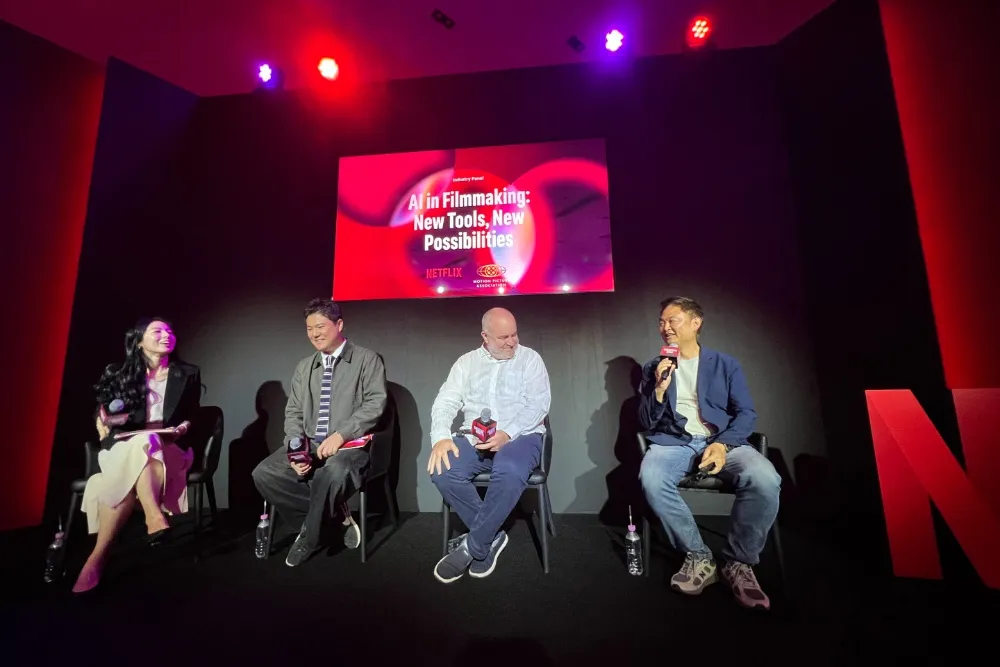
Netflix has deployed artificial intelligence in some form across approximately 300 titles, according to Lee Sung-gyun, the streamer’s senior director of APAC production.
Speaking at the Busan International Film Festival, Lee said the technology has been applied at multiple stages of filmmaking, including previsualization, production design, advance planning for set decoration, editing and visual effects.
Lee appeared alongside “The Outlaws” director Kang Yoon-sung and Wētā FX chief technology officer Kimball Thurston during a session titled “Film Production and AI: New Tools, New Possibilities.” Film critic Yun Sung-eun moderated the panel, which was co-hosted by Netflix and the MPA as part of Creative Asia, a Netflix and BIFF program for emerging Asian talent.
Netflix Demonstrates Its Hybrid Approach
During the session, Lee presented footage from Eyeline, Netflix’s VFX studio, demonstrating what the company describes as hybrid production: a combination of live-action photography, visual effects and generative tools.
Another clip showed AI and traditional VFX being used together to create large crowd scenes for the Netflix India title “Glory.” According to Lee, budget and scheduling pressures would ordinarily have forced the production to abandon those sequences.
Despite the growing range of applications, Lee argued that technology addresses the mechanics of production rather than the reason a story should be told.
“All these technological changes and new tools have helped a great deal with the ‘how,’ how we make what we make better, but they never decided the ‘why,’ why we have to tell this story,” he said. “AI is the same.”
Netflix is not rushing to adopt every emerging model, Lee added. He said the company operates under strict internal guidelines and evaluates new tools before putting them into use. “If you’re asking about speed, I’d like to say that we’re not wildly obsessed with it,” he said.
Kang Yoon-sung Details Potential Savings
Kang said AI-supported workflows could reduce a feature film’s production budget by 30% to 40%. For “The Gulf of Aden,” a project centered on military operations at sea, the filmmaker said calculations prepared for fundraising showed an estimated reduction of approximately 40%.
Those savings were not limited to replacing CG or VFX work, he explained. AI also simplified the shoot and shortened the overall production period to some degree.
Kang created a test clip for “The Gulf of Aden” entirely with AI earlier this year, using the Chinese software Kling. Although that particular test was rendered at reduced quality, he said current tools can produce 4K images with 10-bit color or higher, which he considers sufficient for cinema exhibition.
The director previously co-directed “Run to the West” with AI filmmaker Kwon Han-seul. The movie opened in Korean cinemas last October and was billed as Korea’s first feature to employ AI throughout its production.
Kang said the technology was much more rudimentary at the time. The production primarily used AI as an alternative to CG for compositing and creature creation, but even the creatures did not blend convincingly with the filmed material. In his assessment, the quality has advanced enough in the year since then to be used commercially without difficulty.
Lower costs could also revive projects that previously collapsed during the budgeting process, Kang said, potentially making genre and science-fiction films more achievable while the Korean industry struggles to grow.
Creative and Technical Limits Remain
The panelists did not frame AI as a complete replacement for human filmmaking. Kang warned that when the technology assumes too much creative work, it can remove the discussion, effort and shared experience traditionally contributed by many people. The resulting images may reflect one individual’s ideas rather than a collaborative process.
“So the quality of the footage AI makes is very high, but when it comes to delivering emotion and moving audiences, I think we’re in a period where it has actually gotten worse,” Kang said.
Lee agreed, saying that even when material can be generated with one click, a person must still refine it to convey emotion. He described the human touch as “absolutely essential.”
Thurston distinguished that kind of generative work from what he called “assistive AI.” He cited the deep-learning denoiser behind his second Academy Scientific and Technical Award, saying it is not permitted to alter creative intent: “It touches pixels, but it only fixes them.”
Wētā has used machine learning for at least a decade, Thurston said, or for 20 to 25 years when counting early forms of Massive, the system developed for “The Lord of the Rings.” He also identified color accuracy as a continuing weakness, noting that models trained on video imagery may not reproduce the precise red of a Coca-Cola can.
Wētā is developing an open-source tool through the Academy Software Foundation to document AI use and provenance. The system is designed to connect with initiatives including C2PA.
On sustainability, Thurston said Wētā’s closed-loop-cooled data center in Wellington, New Zealand, now uses “zero liters of water per year.” Lee said Netflix assesses sustainability across the company, including its goal of cutting carbon emissions by 2030, rather than examining AI’s environmental impact separately.
ShowBiz Take
The significance of Netflix’s 300-title figure is not simply its scale. The panel’s examples show AI moving across the full production pipeline, from early visualization and design through editing, effects and crowd creation. Kang’s projected savings also explain why filmmakers may view the technology as a way to rescue ambitious projects that cannot survive conventional budgets.
But the conversation in Busan drew a clear boundary between efficiency and authorship. All three speakers emphasized human-led storytelling, while Kang and Thurston rejected the idea that AI should replace performers. Kang instead sees potential for the technology in stunt and stand-in work, arguing that actors remain creators who communicate emotion to audiences.
What Happens Next?
Kang expects AI production to develop along two paths: short-form content emphasizing productivity and films and dramas prioritizing credibility. He pointed to short-form projects in China made entirely with AI from planning through distribution.
He is also developing a feature animation combining photorealistic backgrounds with animated characters intended to move like live-action performers. Whatever new tools emerge, Lee said the central aim remains unchanged: more stories written and told by humans.