
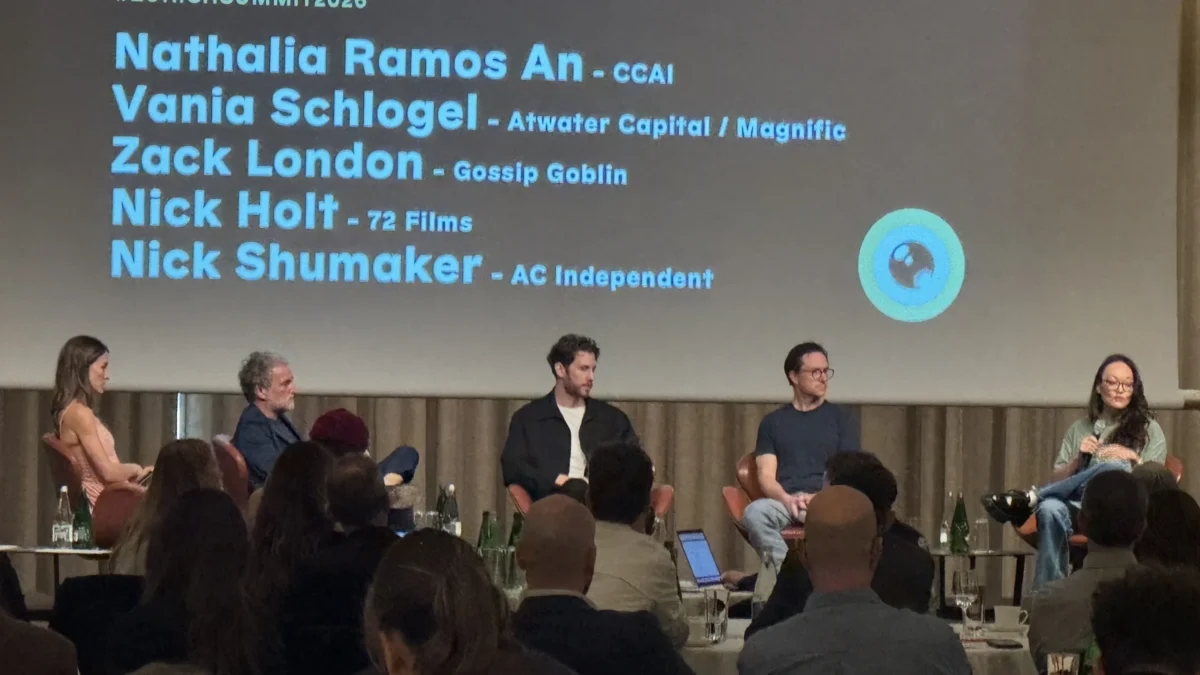
Filmmakers, producers and financiers confronted both the creative promise and ethical risks of artificial intelligence during a wide-ranging discussion at the Zurich Summit this weekend.
The panel brought together Musk producer Nick Shumaker, Atwater Capital founder Vania Schlogel, Gods Don’t Give Gifts director Zack London and filmmaker Nick Holt, whose documentary AI: Probably Nothing to Worry About was playing at the Zurich Film Festival.
While the speakers approached AI from different corners of the film business, the conversation repeatedly returned to a shared reality: The technology is already affecting creative work, and the industry must decide how actively it wants to shape that change.
Vania Schlogel urges Hollywood to engage
Schlogel, the founder and managing partner of Los Angeles-based Atwater Capital, added another role this summer when she became chief strategy officer at AI creative platform Magnific, formerly known as Freepik.
Although her career roots are in Hollywood film finance, Schlogel said a Magnific board meeting changed her view of the need to understand and participate in the technology’s development. About a year ago, she had publicly joked that when AI became sufficiently prominent, she would retreat to Idaho and “disappear into the mountains.”
That instinct shifted after Magnific’s founder showed the board viral material from its largest competitor. Schlogel described images and videos involving sexualized children’s intellectual property, degrading portrayals of women and racist content.
“I had this light bulb moment that this might not be something that I have necessarily been inured to historically, but I actually do need to be involved in,” she said.
Schlogel said she has since encountered situations in which AI can make sense on both commercial and ethical grounds. However, she remains troubled by the confident way AI assistants can present information, warning that it can encourage “cognitive surrender” even when the person using the system knows more about a subject than the large language model being consulted.
“It really is on all of us to get in front of it so that we can shape the ethical direction it goes,” Schlogel said. “Because this will shape society, is shaping society, is even shaping human empathy and how we view each other. So it’s so important to get in the driver’s seat of it, whether you love it or hate it.”
Nick Shumaker challenges AI’s use of creative work
Shumaker, head of AC Independent at Anonymous Content, acknowledged AI’s potential across the filmmaking process but pressed the industry to address how generative systems ingest original material.
“The whole fair use in AI thing needs to be addressed,” he said, referring to lawsuits involving the New York Times and other media organizations. From his perspective, taking and ingesting material without properly resolving the intellectual-property issues is “totally inappropriate.”
Shumaker argued that accepting AI as inevitable cannot mean overlooking potential theft involving intellectual property. He also warned that allowing the matter to remain tied up in litigation for five or six years would be damaging to creators and to the futures of writers and cinema.
He also clarified how little AI was used in Alex Gibney’s Musk, which Shumaker produced. Although the documentary addresses Elon Musk’s use of AI to shape the future — and does not necessarily portray that influence positively — the production itself relied on very little AI.
According to Shumaker, an Elon Musk avatar in the film was created by human artists using CGI at a company that had previously worked with Gibney. AI was used only during post-production to assist with lip-synching.
AI as a route to films that might never be made
London, also known on YouTube as Gossip Goblin, is preparing for the theatrical release of Gods Don’t Give Gifts, a fully AI-generated science-fiction anthology.
He argued that discussions around AI often fail to account for the broad range of possible uses, from complete end-to-end automation to limited augmentation. London said the debate has become sharply polarized between those who want to upend Hollywood and those who refuse to accept AI as part of filmmaking.
“The reality is that it’s happening. It’s coming,” he said, adding that previous efforts to resist advanced technology had not stopped its adoption.
For London, AI was not a substitute for a conventional production of Gods Don’t Give Gifts; it was what made the project possible at all.
“This film would never get greenlit otherwise,” he said. “It’s way too esoteric and niche and cerebral.” London maintained that the project was not replacing another version that would have employed more people, because without the technology, the story would not have been made.
Nick Holt sees the potential to widen access
Holt’s documentary AI: Probably Nothing to Worry About examines whether artificial intelligence will save humanity or destroy it. The film is built around interviews with figures including computer scientist Geoffrey Hinton, described as the “godfather of AI” for his work building artificial neural networks, DeepMind founder Demis Hassabis and engineers from Anthropic and OpenAI.
Addressing AI’s effect on creativity, Holt said the tools could, at least for now, make filmmaking more accessible. He compared access to AI with access to a pen and pencil: Having the tool does not guarantee that someone can produce an award-winning work.
Holt suggested that creators could use AI to develop concepts and films that otherwise would not exist, while expressing hope that the strongest work would still rise above the rest. He also raised the possibility that a 14-year-old working from a bedroom could use AI to create a major hit, even as Hollywood studios remain capable of making costly failures.
At the same time, Holt said deeper questions remain about whether AI systems are being “grown rather than built” and where their development could ultimately move beyond human limitations.