
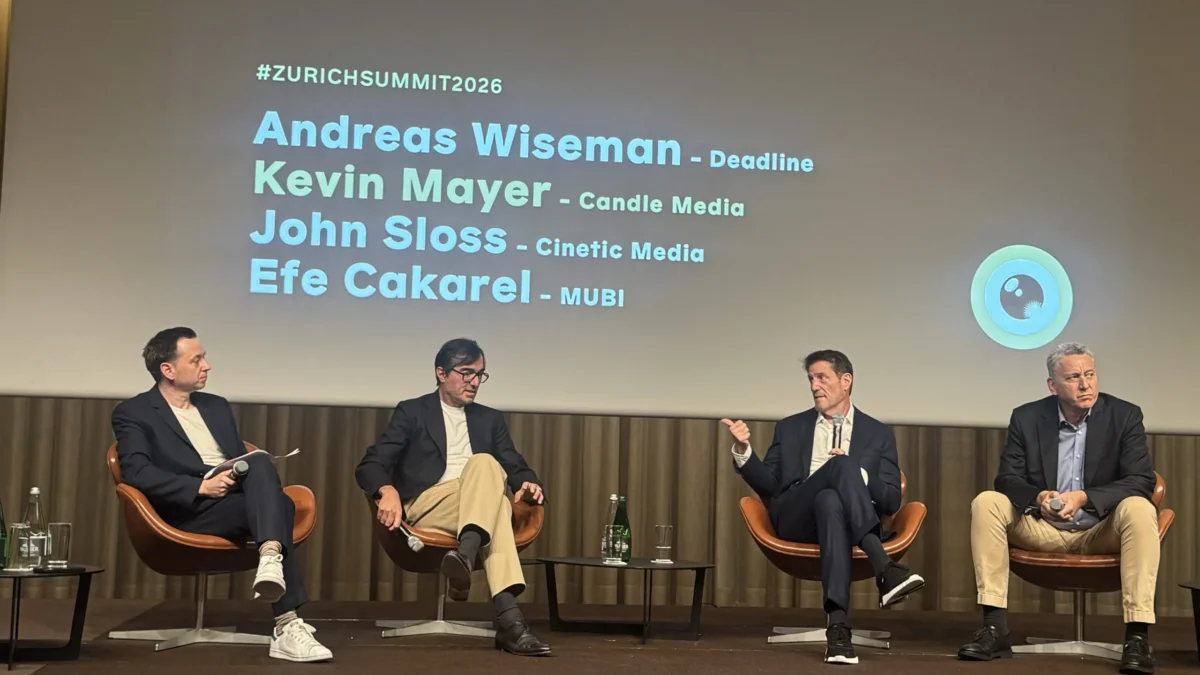
Kevin Mayer is backing consolidation as a financial necessity for the entertainment business, while warning that a Paramount-Warner Bros. merger could bring substantial job losses.
The former Disney executive addressed the combination during a weekend panel at the Zurich Summit, arguing that any assessment of the merger must also consider what could happen if the companies remain separate.
“If we’re going to be intellectually honest about answering this question, you have to also ask yourself, what would happen if the merger didn’t happen,” Mayer said.
Mayer, who has served as co-CEO of Blackstone-backed Candle Media since 2021, described a film sector facing declining revenues and “fewer and fewer” strong financial outcomes. In his view, maintaining the current lineup of standalone studios no longer makes financial sense.
He argued that weakening businesses would increasingly struggle with the fundamental work of financing, distributing and marketing movies.
“Their ability to finance, to distribute and to market product is going to start to deteriorate very substantially,” Mayer said. “It already has, frankly.”
Without consolidation, he said, the industry could be left with more companies that lack the strength to remain effective competitors.
“If we keep the standalone, the status quo, you’re going to have a larger number of very weak companies unable to do much in the future,” he continued. “That’s the future you’ve got to measure this consolidation against, in my opinion, not against some fanciful future where everything is as good as it was five, 10 years ago.”
Mayer expects Ellison to honor movie commitments
Mayer also weighed in on the commitments made by Paramount Skydance CEO David Ellison. He said he expects Ellison to follow through on promises to produce 30 movies annually for at least five years after the deal is sealed.
His confidence is informed by direct experience with a major studio combination. Mayer oversaw Disney’s 2019 acquisition of 20th Century Fox and said he both negotiated Disney’s purchase of 21st Century Fox and carried responsibility for integrating the companies.
“David Ellison made some promises. I expect he’ll keep them,” Mayer said. “We have public promises that are that explicit… are very hard to reverse yourselves.”
Mayer predicted that Ellison would maintain those commitments for five years, including making the movies and giving them theatrical releases.
He also said Warner Bros. would likely continue operating as a separate entity, basing that view on his own experience at Disney.
The human cost of consolidation
Although Mayer characterized consolidation as “necessary,” he identified employment losses as the deal’s most difficult consequence. In particular, he pointed to the promise of $6 billion in synergies as an indication that widespread layoffs could follow.
“When you hear these promises of $6 billion in synergies, that’s a euphemism for a lot of layoffs,” Mayer said. “That’s an extremely difficult thing, obviously, and that’s what I think this merger portends.”
His assessment presents a stark trade-off for the industry: consolidation may create stronger companies with greater capacity to finance, market and distribute films, but the savings attached to such a combination could come at a significant cost to workers.
For Mayer, the merger should therefore be judged not against the entertainment business of five or 10 years ago, but against the risks facing independent studios as revenues decline. He expects the public production promises to hold for a defined period and believes Warner Bros. could retain a separate identity, yet his comments make clear that he sees layoffs as the merger’s most consequential downside.