
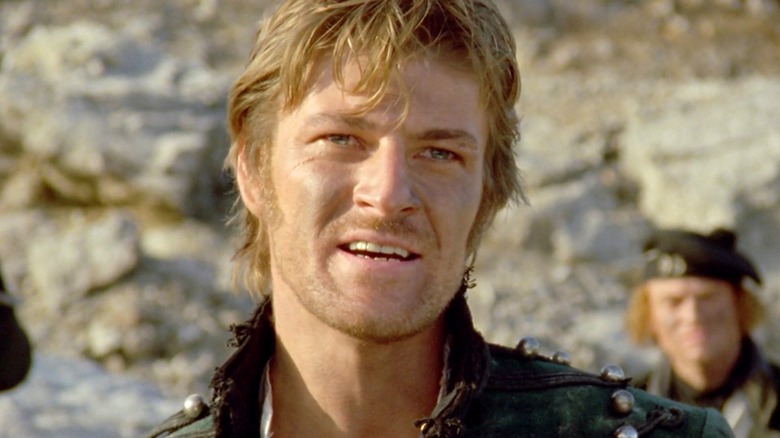
Long before Sean Bean became associated with “Game of Thrones,” he led an expansive British historical drama adapted from Bernard Cornwell’s popular “Sharpe” novels.
Bean made his debut as fictional soldier Richard Sharpe in 1993, beginning what the source material describes as his big break. The original five-season run aired from 1993 to 1997, with the franchise later returning for two-part television movies in 2006 and 2008.
Across the 16-part adaptation, Bean played a tough, working-class soldier serving during the Napoleonic Wars. Sharpe’s fortunes change after he saves the life of the future Duke of Wellington and receives a promotion to lieutenant. He is then placed in command of a makeshift unit of marksmen from the 95th Rifles, leading them on dangerous assignments through Portugal and Spain.
The role arrived before many viewers noticed Bean as Boromir in Peter Jackson’s “The Lord of the Rings” trilogy and well before his work in “Game of Thrones.” For Bean himself, however, Sharpe has remained a particularly meaningful character.
In an interview with the fan website The Compleat Sean Bean, the actor described Sharpe as “a fantastic role” and “something I look back on with great fondness.” Asked whether it was the character of which he felt most proud, Bean answered, “I suppose it probably is, bearing in mind the length of time I was involved with it and the whole adventure of it.”
Bean’s Performance Changed Sharpe’s Literary History
The television adaptation did more than translate Cornwell’s books for the screen. Bean’s interpretation eventually influenced the character’s background in later novels.
In the original books, Sharpe was born in London to a sex worker mother and an unknown father. Bean, who frequently performs with his native Yorkshire accent, brought that voice to the television role. Cornwell responded by expanding Sharpe’s history in subsequent books, establishing that the character had been born in London but raised in Yorkshire.
The change brought the novels closer to Bean’s portrayal in the series. Cornwell’s admiration was emphatic: “Sean was brilliant,” the author told Big Issue. “I hear him in my head when I write Sharpe.”
That connection between performer and author gives the adaptation an unusual legacy. Bean did not simply embody a character whose identity had been permanently fixed on the page; his performance helped shape how Cornwell continued writing Sharpe afterward.
Where the Series Can Be Watched
The complete original run from 1993 through 1997 is currently available through several streaming options. All five seasons can be watched free on Tubi and The Roku Channel, while BritBox offers them with a subscription.
Availability is more limited for the later television movies. “Sharpe’s Challenge” and “Sharpe’s Peril,” the two-part productions from the 2000s, are currently available only on DVD or Blu-ray.
Viewers seeking another television adaptation from a Cornwell novel series can also turn to “The Last Kingdom,” which has been characterized as combining elements associated with “Game of Thrones” and “Vikings.”
ShowBiz Take
“Sharpe” matters within Bean’s screen story because of both its scale and its lasting creative impact. It gave him a substantial leading role over multiple seasons and later television movies, years before the fantasy projects that brought him to the attention of many other viewers.
More significantly, Bean’s performance traveled in the opposite direction from most adaptations: from screen back to page. Cornwell’s decision to revise and enlarge Sharpe’s origins around Bean’s Yorkshire-inflected interpretation shows how completely the actor became identified with the fictional soldier.
With the first five seasons now accessible on Tubi, The Roku Channel and BritBox, audiences can revisit the performance Bean has said he remembers with great fondness—and the portrayal that ultimately changed the hero’s own literary history.