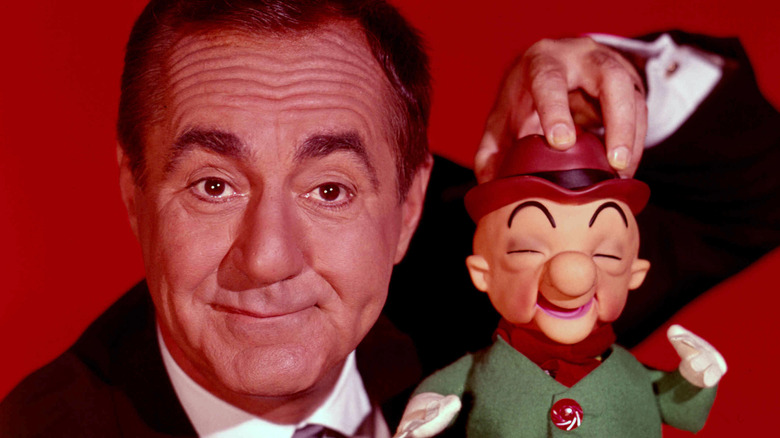
Jim Backus may be most closely associated with billionaire castaway Thurston Howell III on “Gilligan’s Island,” but another character kept the actor busy for four decades across movie theaters and television.
Backus was the unmistakable voice of Mr. Magoo, also known as Quincy Magoo, the severely nearsighted older man whose misunderstandings fueled a long run of animated adventures. The actor began playing Magoo 15 years before “Gilligan’s Island,” continuing in the role until his death in 1989.
Created by United Productions of America in 1949, Mr. Magoo first appeared in “Ragtime Bear,” an animated theatrical short directed by John Hubley. Hubley’s uncle provided the original inspiration for the character, who was drawn with squinting eyes and a bulbous nose and portrayed as both irritable and accident-prone.
Backus, however, supplied more than the character’s gravelly sound. Animation historian Jim Korkis said the actor developed Magoo’s voice from a figure in his own comedy nightclub act: a “loud-mouth traveling salesman” who told dirty jokes.
“It was the same with Magoo in the beginning. He was a dirty old man,” Backus once recalled. “Half the time you couldn’t understand what he was saying; he just used to mumble.”
Mr. Magoo found success on television and in theaters
The character’s screen career expanded into dozens of television specials and theatrical shorts, with two shorts earning Academy Awards. “When Magoo Flew” and “Magoo’s Puddle Jumper” both took home the honor.
Magoo also moved into feature-length animation with 1959’s “1001 Arabian Nights,” which cast him as Aladdin’s uncle. His television credits included the 1962 holiday production “Mr. Magoo’s Christmas Carol,” as well as three animated series: “The Mr. Magoo Show,” “The Famous Adventures of Mr. Magoo” and “What’s New, Mr. Magoo?”
That extensive run made Magoo one of Backus’ defining performances, although the actor did not always welcome the association. At one point, he openly complained that the cartoon role was getting in the way of more serious opportunities.
“I’d like to bury the old creep and get some good dramatic roles in movies,” Backus admitted. “Every time I start to be a serious actor I lose out because someone — usually a producer — says I’m Magoo.”
By 1978, Backus was acknowledging the benefits of the part even while maintaining some comic distance from his animated alter ego.
“Magoo has been very good to me, but I certainly don’t think of him as myself,” he said in an interview that year. “He is a pain in the posterior.”
Whatever his frustrations, Backus remained connected to the role. Beyond continuing to provide Magoo’s voice, he was known to drive around Hollywood with a customized license plate reading “Q MAGOO.”
The character continued after Backus
Backus’ death in 1989 ended his four-decade tenure as Magoo, but it did not mark the character’s final screen appearance. Other performers subsequently took over for new versions of the visually impaired figure.
Leslie Nielsen, a comedy veteran associated with “The Naked Gun,” starred in the 1997 live-action feature “Mr. Magoo.” Jim Conroy later voiced the character in the 2010 animated movie “Kung-Fu Magoo.”
For viewers who remember Backus primarily as Thurston Howell III, the breadth of his Mr. Magoo work offers a second major screen legacy. From the character’s 1949 debut and Oscar-winning theatrical shorts to holiday television, animated series and a feature-length movie, Backus’ distinctive voice helped carry Magoo through decades of entertainment.