
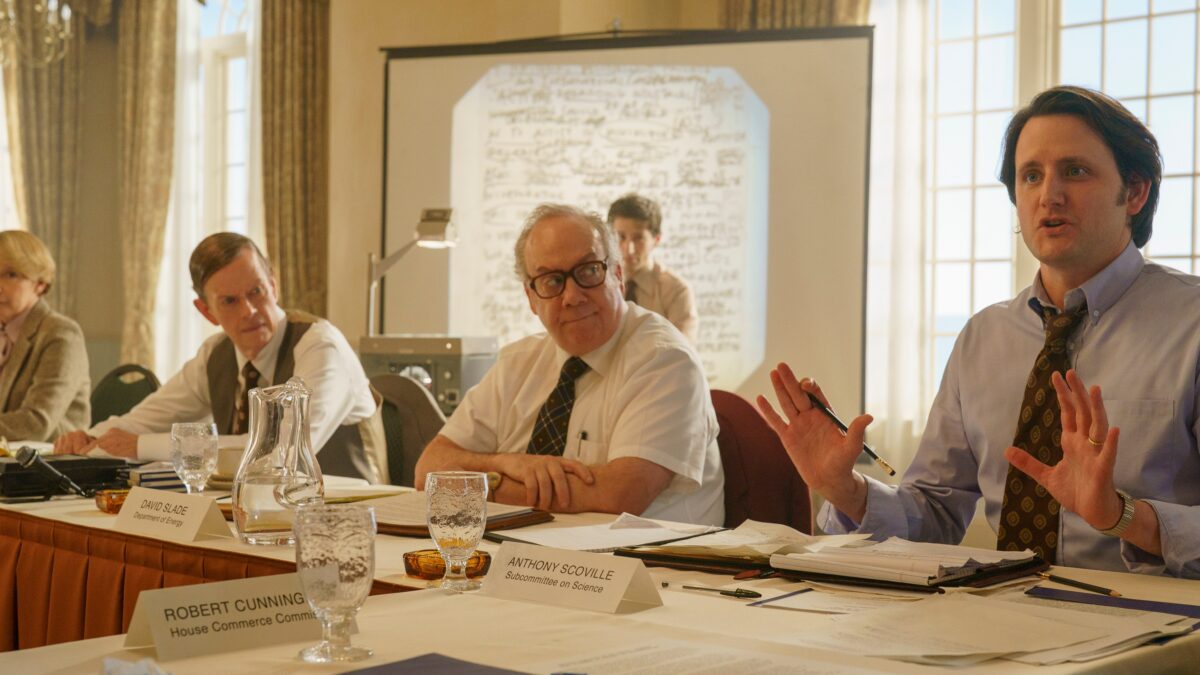
Tom McCarthy finds unexpected dramatic momentum in a failed attempt to confront climate change in A Statement, an absorbing docu-drama powered by a deep ensemble led by Paul Rudd, Amy Ryan, Paul Giamatti and John Turturro.
Set over 36 hours in 1980, the film gathers 20 scientists, environmental activists, bureaucrats, academics and policymakers inside a conference room at Florida’s beachside Don CeSar Hotel. Congress has asked them to draft a statement addressing the climatic effects of burning fossil fuels — provided they can first agree on whether the situation should even be called a problem.
The result is a marathon of argument, qualification and compromise that ends without the requested statement. Yet McCarthy makes that institutional deadlock the source of the movie’s tension, turning technical exchanges and procedural wrangling into a sobering portrait of collective inaction.
McCarthy wrote the screenplay with Noé Debré and Thomas Bidegan, adapting a brief chapter from Nathaniel Rich’s 2019 book Losing Earth: A Recent History. Sections inside the conference room incorporate word-for-word transcripts, giving the 1-hour, 51-minute film its verbatim foundation and distinctly theatrical character.
A formidable cast enters the debate
Rudd plays conference moderator Tom Jorling, who must keep the discussion moving, make room for every participant and somehow guide competing viewpoints toward consensus. His increasingly difficult balancing act gives the movie a human center without elevating him above the rest of the ensemble.
Giamatti is particularly sharp as David Slade, the cynical director of the Energy Department’s Office of Carbon Dioxide Effects. Slade questions the urgency of acting while research remains uncertain and argues that American carbon emissions are modest beside those of other continents. One of his observations — “presidents come and go, but if there’s one thing we will always agree on, it’s science” — underlines how the film presents climate change as a nonpartisan subject at that moment, shortly before Ronald Reagan’s election to his first term.
Evan Peters brings tightly contained fury to Rafe Pomerance, a Friends of the Earth director frustrated that his alarm is not more widely shared. Turturro supplies sly humor as MIT nuclear engineer Dr. David Rose, who points to the Egyptians as an example of a civilization that ignored warning signs. Jason Clarke takes a more flippant approach as John Perry, a meteorologist turned government science authority who believes humanity will have about a century to adjust after definitive findings emerge. His proposed solution includes relocating Americans to landlocked states.
Tatiana Maslany’s legal scholar Edith Brown Weiss and Ryan’s public health official Annemarie Crocetti are among the few women in the room. Both are made to feel out of their depth at different points, but each becomes more forceful as the session continues. Ryan delivers one of the film’s strongest moments when Annemarie intervenes near the end of the second day and urges the participants to treat climate change as a human problem.
Nina Arianda plays Bernadette, the stenographer initially maintaining professional detachment as she records every argument, glance and silence. During breaks, she grows closer to young atmospheric sciences expert Robert Cunningham, played with nervous energy by Noah Robbins. A lively interlude finds Bernadette, Cunningham and Dr. Rose crashing a wedding in the hotel ballroom, giving the characters a brief escape from the conference while allowing its ideas to keep working on her.
The broader cast includes Zach Woods, Mary Catherine Garrison, Michael Chernus and Dylan Baker. Eli Bildner appears as a representative from Exxon, a presence that points toward the oil and gas industry’s later influence on climate policy.
Process becomes the drama
Arguments over possible solutions are just as fraught as the debate over the threat itself. Discussion of renewable energy remains inconclusive, while Dr. Rose objects when proposed language favors solar and wind but leaves out nuclear power. The Three Mile Island accident from the previous year is raised, although Edith unexpectedly supports Rose’s challenge to nuclear energy’s exclusion.
McCarthy’s patient approach recalls the procedural rigor he brought to Spotlight. The material is undeniably talk-heavy, but Stuart Dryburgh’s agile cinematography prevents the single-room setting from becoming visually static, while Bryce Dessner’s reflective score reinforces the gravity beneath the verbal sparring.
The uniform strength of the cast is crucial. Rather than allowing one star to dominate, A Statement gives its participants distinct rhythms, anxieties and flashes of humor. The actors play off one another with the responsiveness of a seasoned stage company, making uncertainty itself feel active.
The group’s inability to produce a statement could make the movie seem destined for anticlimax. Instead, that failure becomes its point. With global CO2 emissions continuing to reach record highs despite increased adoption of clean energy, the 1980 stalemate lands as more than a historical reconstruction.
A Statement plays in the Spotlight section of the New York Film Festival and is set for release Friday, Dec. 4. It may not offer conventional excitement, but its incisive performances and disciplined construction make a roomful of debate surprisingly vital.