
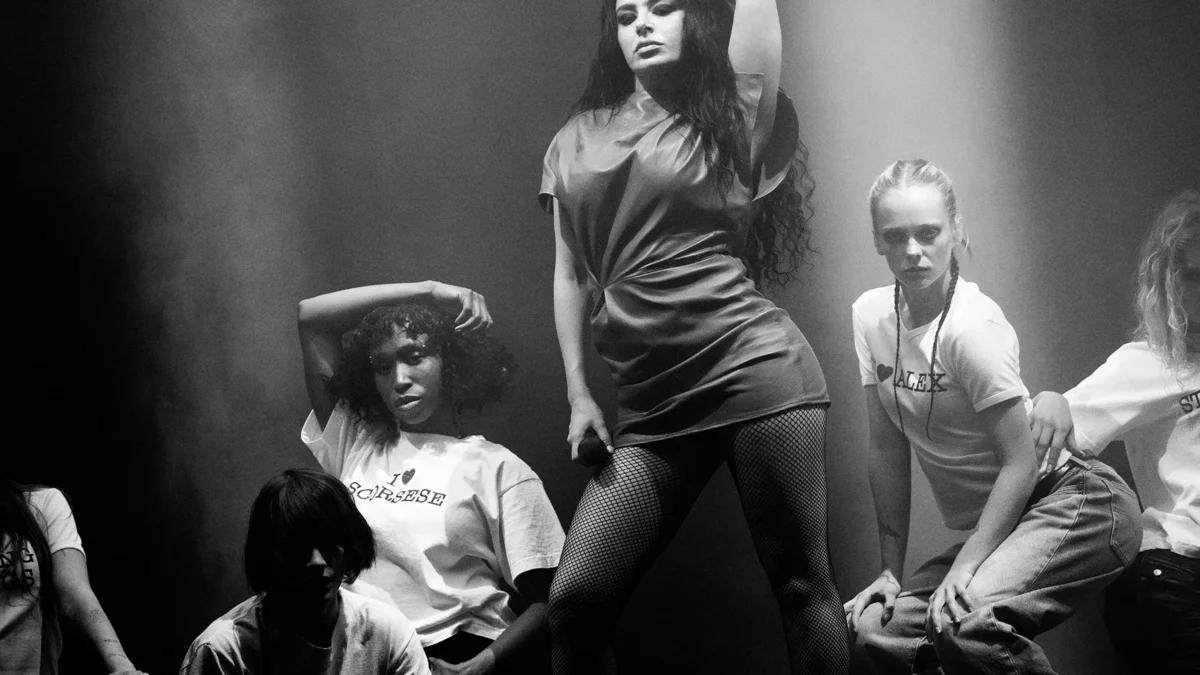
Charli xcx is taking a deliberately uncompromising approach to her latest arena tour, using the scale of the production to challenge herself — and her audience — rather than deliver a conventional crowd-pleasing set.
The 34-year-old is touring behind July’s rock-infused Music, Fashion, Film, while continuing to draw heavily from Brat, the Grammy-winning 2024 album that made her an arena headliner for the first time. The North American leg wraps in October, with European dates following in February.
“I’m not really performing to please anyone other than myself,” Charli said. “Which is maybe not the attitude that everybody takes, but that’s the attitude that I take.”
That philosophy shaped the show from its debut at Chicago’s Lollapalooza, where Charli was headlining the festival for the first time. Although she considered the expectations surrounding such a high-profile set, she resisted building the performance around familiar songs from across her catalog.
Instead, she viewed the festival slot as a chance to present what she called her “most pure vision as an artist” and reconsider what a headline performance could look like. Charli acknowledged that the choice might not appeal to everyone, but could also introduce new listeners to her current work.
A cinematic arena show built with restraint
Despite the possibilities that come with an arena production, Charli and her team did not simply deploy every available effect at once. Their aim was to create something cinematic while remaining conscious of the practical limits of an arena.
She said the production embraces restraint so that its biggest moments carry more force. Pyrotechnics, for example, are used selectively rather than continuously, allowing their arrival to stand out.
The scale marks a dramatic shift from Charli’s earliest live setup. “I’ve really climbed my way up from nothing,” she said, recalling that she once performed with an iPod on a makeshift stage.
Getting closer to her ideal show has also changed how she thinks about its finances. Rather than simply taking the earnings, Charli said she sees value in putting money back into the production to create something artistically demanding.
“I feel challenged,” she said. “I hope people who watch it feel challenged at points too.”
The creative team behind the production
Charli developed the show with several longtime collaborators. Creative director Imogene Strauss, whom Charli described as one of her best friends, has worked with her on numerous tours. Their established shorthand allows them to reach the heart of an idea quickly, Charli explained — a dynamic she compared to her studio relationship with producer A. G. Cook.
Musical planning began months in advance with Mitchell Snyder, another longtime member of her live team. Charli likened that process to assembling a remix album: returning to the stems, beginning from scratch and determining how elements such as the phrase “oblivion is freedom” would be threaded through the performance.
Movement was another essential part of the concept. Charli worked with choreographer Eric Christensen, who has extensive runway-related experience and works frequently with Mugler. The two had previously collaborated when Christensen provided movement direction for a Saint Laurent photo shoot.
Charli specifically wanted someone familiar with fashion shows and the range of walks seen on a runway. That connection complements an album whose artwork features John Cale, Marc Jacobs and Martin Scorsese.
From Caravaggio to Béatrice Dalle
The tour’s visual direction was not primarily inspired by other concerts. Charli instead looked toward paintings and individual tableaux, particularly the work of Caravaggio. She cited the rawness of his paintings and his use of unconventional models to portray real people.
For the performance’s energy, she thought about actress Béatrice Dalle and her strength. Charli also said she does not attend many live shows, making the tour’s references less about borrowing from other musicians’ productions and more about translating ideas from visual art, fashion and film into an arena setting.
One of the show’s central ideas comes from the David Cronenberg monologue that closes Music, Fashion, Film. The line “oblivion is freedom” recurs throughout the concert because, for Charli, it captures both the physical intensity of performing and the album’s broader creative mission.
She described live performance as physical and, at times, painful. To feel free onstage, she said she must abandon her inhibitions, throw herself into the moment and enter a different state. In her view, dismantling what feels familiar or comfortable can open the door to creative freedom.
Charli sees the completed show as more than a statement about being an artist. While she is content for audiences to experience it simply as a pop concert, she also intended it to hold the chaos, freedom, sadness and beauty she associates with human existence.
She characterized herself as a “walking contradiction” throughout her artistic life — something she believes is also part of being human. Whatever meaning audiences ultimately take from the production, its personal purpose is clear: to put that tension onstage without sanding down its edges.
What Happens Next?
Charli will continue filling arenas and headlining festivals as the North American leg of the Music, Fashion, Film tour moves toward its October conclusion. The production is then scheduled to head to Europe in February.