

In 2023, concerns over the rise of generative AI animated the writers’ and actors’ strikes, with many rank-and-file workers fearful that it could put wide swaths of the entertainment industry out of work. Three years later, with those concerns still alive and well, some Hollywood workers have been moonlighting in AI training, working to help improve the tech, anyway.
As Hollywood adapts to the technology — particular corners of the business running towards it, others away — a smattering of creatives have begun to go public with their time in the world of Reinforcement Learning from Human Feedback (RLHF). In May writer Ruth Fowler (Little Disasters, Rules of the Game) published a personal essay for Wired about her own experience with AI training jobs, a field she says she resorted to as entertainment work dried up and she needed money to pay rent and buy groceries. The same month screenwriter Robin Palmer, who has written TV movies for Disney Channel and Hallmark, spoke with CBS News about working in AI training, even as she admitted that some in her field might compare it to crossing the picket line.
Editor Gabe Sena is another entertainment worker whose side hustle is helping to fine-tune AI models. “I’m mid-career and I don’t want to be a dinosaur in my field,” he explains to The Hollywood Reporter. “This is a thing that people are fearful of, that seems like a black box to a lot of people who aren’t in the tech industry. And so it made more sense to me to try to immerse myself in it as opposed to just going, ‘I don’t like that it’s new.’”
As the traditional film and television job market narrows, this kind of gig work is on the rise and current and former entertainment workers are taking part. The phenomenon is raising uncomfortable questions in a creative community where the use of the tech can be a third-rail topic, as illustrated by the recent saga of animator Jorge Gutierrez dropping out of a generative AI series he was set to create for Amazon following backlash. Are these workers proactively helping to contribute to an eventual displacement of jobs in the industry? Or are they simply trying to survive in a system where AI adoption is moving full steam ahead due to forces far larger than any individual?
For Sena, the decision was one rooted in curiosity about the future and how he should be preparing himself. A University of California Los Angeles film school alum, Sena typically edits small documentaries and videos for nonprofits like the Make-A-Wish Foundation and the Children’s Defense Fund. He says he was eager to learn more about AI when he was between jobs in the summer of 2025. “It was very open curiosity and not even being 100 percent clear about exactly the sort of work I would be doing,” he says. He signed on for a job facilitated through a recruiting platform for AI work called Mercor.
Mercor was founded in 2023 by three college dropouts and Thiel Fellows, or participants of billionaire Peter Thiel’s program offering funding and connections to people who leave college or never attend and want to “build new things.” Backed by the venture capital firms Benchmark, General Catalyst, Robinhood Ventures, Felicis and Menlo Ventures, Mercor’s lodestar is “organizing human intelligence to power the AI economy,” or providing domain experts to improve AI models. Its $350 million series C funding round in 2025 valued the firm at $10 billion.
Though he can’t disclose specifically what he’s worked on — Sena, like many workers in this field, has signed non-disclosure agreements — he says one of his recent jobs involved comparing prompts given to a generative AI system with its outputs and seeing how the two matched up.
When asked whether he’s concerned that this kind of work will replace jobs in the future, Sena says he believes some roles may be “phased out” but workers who are capable, diligent and adaptable will be able to maintain their careers. “There’s some parts of my job that I would be happy to hand off to a very intelligent sort of way of doing things,” he adds. “But even if it seems like rote tasks, there’s a lot of subjectivity in what I do.”
Like Sena, Steven Woolworth, a former development executive with HBO and Studio TF1 America, felt he had to dive headfirst into AI rather than shy away from it. After a grueling year-and-a-half period of fruitless job searching in Hollywood, Woolworth came to this world through a friend — a member of the Writers Guild of America — forwarding an email from Mercor.
Woolworth, who says he is a supporter of AI regulations and guardrails in entertainment, explains, “I looked at it one of two ways. I can keep my head buried in the sand or I can enter this world and get a very inside perspective of what is happening in AI training and its capabilities. And also be a part, obviously a very small part, of a team of people training this so it becomes productive in a healthy and positive way.”
The work has “kept a roof over my head for the past year, [of] which I am deeply appreciative,” he says. And he doesn’t believe it could replace his prior occupation as an executive, saying that tech can’t go to in-person events like film festivals or a play to discover new talent. “Obviously none of us know what the future holds, but I know today it can’t do the essential human things that I do,” he says.
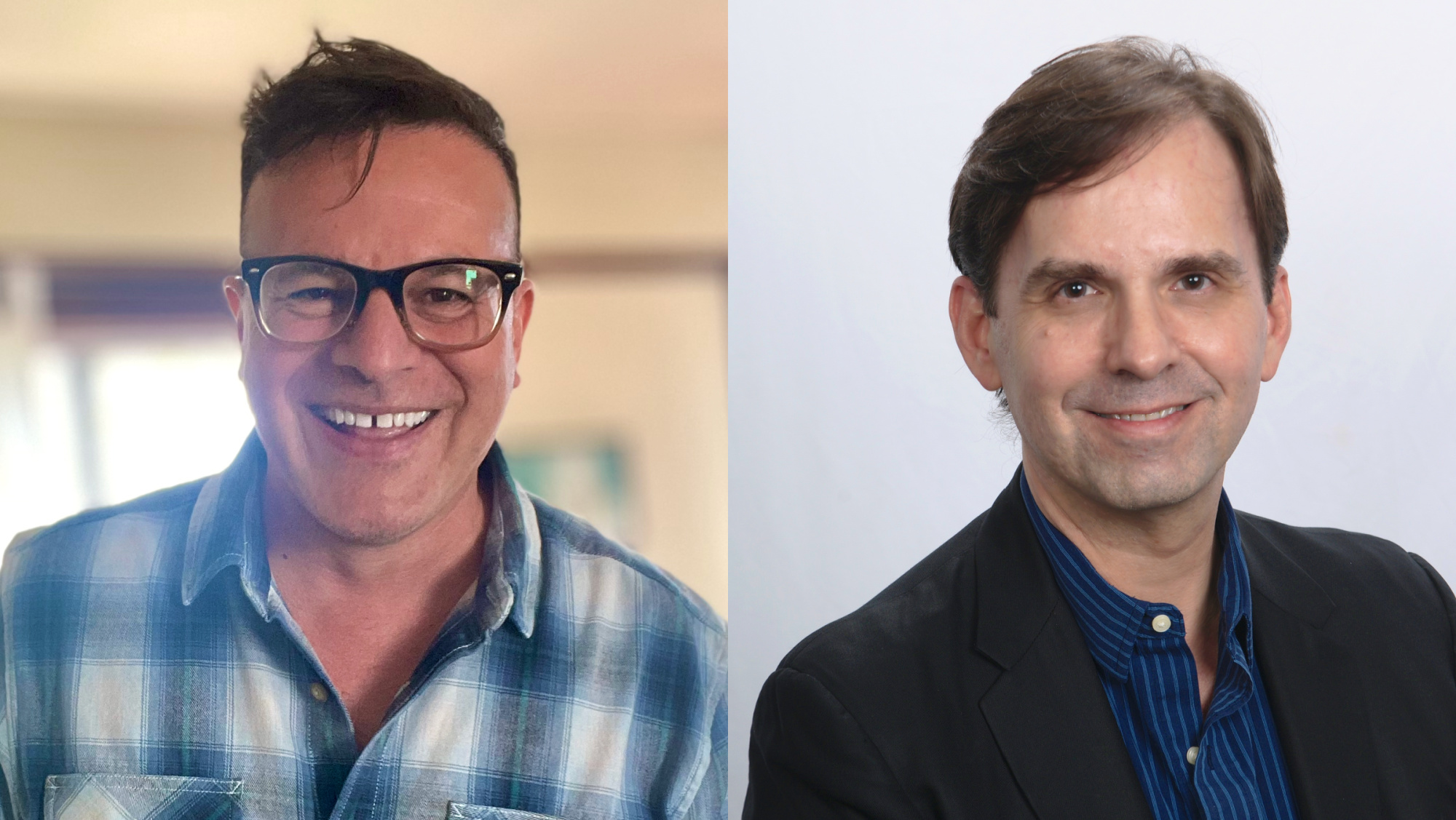
(At left): Editor Gabe Sena is an entertainment worker whose side hustle is helping to fine-tune AI models; (At right) Steven Woolworth, a former development executive with HBO and Studio TF1 America, found work training AI at Mercor.
**
RLHF operates as a three-part process. First a human scores a model’s outputs — say, how likely a character in a drama would be to react to news of a tragedy with a host of jokes or expressions of sympathy — going back with one score after another to various responses. Once a data set is fully trained on those responses, the AI itself trains a second “reward model,” which is then used to train the original AI, removing the humans from the process.
The actual job for human reinforcers can be mind-numbing. A machine makes choices that go anywhere from reasonable to laughable, and a human tells it what it got right or wrong. One veteran writer who helped train a model described an environment akin to a high-school standardized test, with a strict human proctor in the room telling people what they can and can’t do as one output after another flashed across their screens. What at first felt fun — like guiding a sweet wayward child — soon felt like a crazymaking psychological experiment.
“How many times can you tell a machine it’s wrong without losing your mind?” the person recalled.
In the last few years AI companies have been reportedly shifting from training their models with the help of data annotators (who, in some instances, have experienced allegedly exploitative and toxic working conditions) doing drudging work in developing countries. Now, firms are seeking “experts” in their field, not just Hollywood professionals but also doctors and lawyers, who can earn, depending on their expertise, more than $100 an hour by helping make an AI tool sound more human and by correcting its mistakes in specialty areas, among other tasks.
Unlike traditional Hollywood, this is a growing sector. According to data provided by the jobs platform Indeed, the share of job postings related to AI within the arts category doubled between May 2025 to April 2026, from nearly five percent to nearly 11 percent. That growth is greater than even job postings related to AI broadly, which rose from 2.8 percent in May 2025 to 5.5 percent by April 2026. As of press time, “creative writers” could earn “up to $44 an hour” to help on an AI project facilitated through jobs platform Handshake; a “music professional” with a master’s degree or above could earn “up to $100 an hour.”
Labor complaints have dogged the field of AI training as it’s grown in the U.S. Workers have described in published news reports highly unstable employment, cutthroat environments as demand for jobs exceeds supply, rushed work and lack of information about who, exactly, is the client. Two major firms that provide RLHF work, Surge AI and Scale AI, have been accused of unpaid wages and worker misclassification as well as exposing workers to traumatizing content in lawsuits, respectively.
Even Hollywood critics of the generative AI economy express sympathy for those working in this precarious field. One of those people is Breaking Bad and Pluribus creator Vince Gilligan. “I’ve been extraordinarily lucky throughout my career, so I’m not going to judge folks who are simply trying to provide for their families,” he wrote to The Hollywood Reporter in an email. “I just thank god I’ve never been faced with that choice myself. And I appreciate that my career started in 1990, not 2026.”
Adds Sam Tung, a storyboard artist who worked on Citadel and Twisters, “The people who are taking this work are not doing it because they’re eager to undercut other human workers. People are really struggling in this current downturn and they have mortgages to pay and kids to feed.”
But Tim Friedlander, a voice actor who leads the National Association of Voice Actors (NAVA), cautions that this work may offer short-term gains with long-term consequences. AI training opportunities currently proliferate on go-to job platforms for his peers like Voices dot com and Voice123 but, Friedlander says, a recent survey from the organization found that about 20 percent of respondents have knowingly lost jobs due to work being done by AI tools. NAVA’s stance is currently that no licensing or training deals should take place in voiceover.
“I don’t really necessarily fault somebody if you’re all of a sudden you’re given potentially $1,200 for four hours worth of work. Then it’s really enticing, but that may be the only four hours you’re ever going to work in that job,” he adds. “I think in the long term it is more damaging to the entire creative sector to be training these systems.”

The Writers Guild of America is in a difficult position as its members are taking AI training jobs even as leadership advocates against those same AI systems.
**
The guilds are in a tough position. The specter of members helping to train systems leadership opposes would seem to present an easy path for the groups: issue guidance against (if not an outright ban on) taking the work. But at least two writers — both active in WGA politics — noted they believe WGA leaders’ hands are tied on RLHF, and in fact their group and others might be in a kind of Catch-22. They can’t tell members not to use their skills to make money, especially at a time when so many are struggling to find regular work. Of course if they don’t stop it then people could be struggling even more and they’ll really need to take these gigs.
When asked if they had a policy on members working in AI training, major Hollywood unions reached for this story either said they had no comment or never responded.
In some ways, the cat may have already come out of the bag. In 2025, Disney and Universal filed suit against the image and video generator Midjourney, alleging plagiarism after, they argued, company vacuumed up copywritten material on the Internet as training data; later that year, Warner Bros. Discovery also sued the company with similar claims. Says storyboard artist Phil Langone (Thunderbolts*, Skeleton Crew), “I’m an artist and I know it’s crawled my own work and it’s stolen from me. I’m like, ‘Well, that war was lost before we even knew it was being fought.’”
How much RLHF could ultimately improve models for writing or anything else is an open question among engineers. While there’s little doubt that humans are helpful and even necessary in training machines — the technique is so powerful it won its creator the prestigious Turing Award last year — it also is hardly foolproof. Among RLHF’s challenges are sycophancy, which will have a model essentially agreeing with a human trainee but then generating what it wants to in a real-life situation anyway. That could make the model weaker and actually pose less of a threat to human entertainment workers worried about getting disrupted out of a job.
Still, AI companies seemingly need subject matter experts to turn the slop into more polished outputs — which could, in turn, convince more entertainment companies to hire fewer humans. And in desperate times, people don’t tend to think in hypotheticals or a decade out. When asked if he has friends in Hollywood also working in AI training, Woolworth said, “Yes.” He adds, “And a lot that are certainly trying.”