

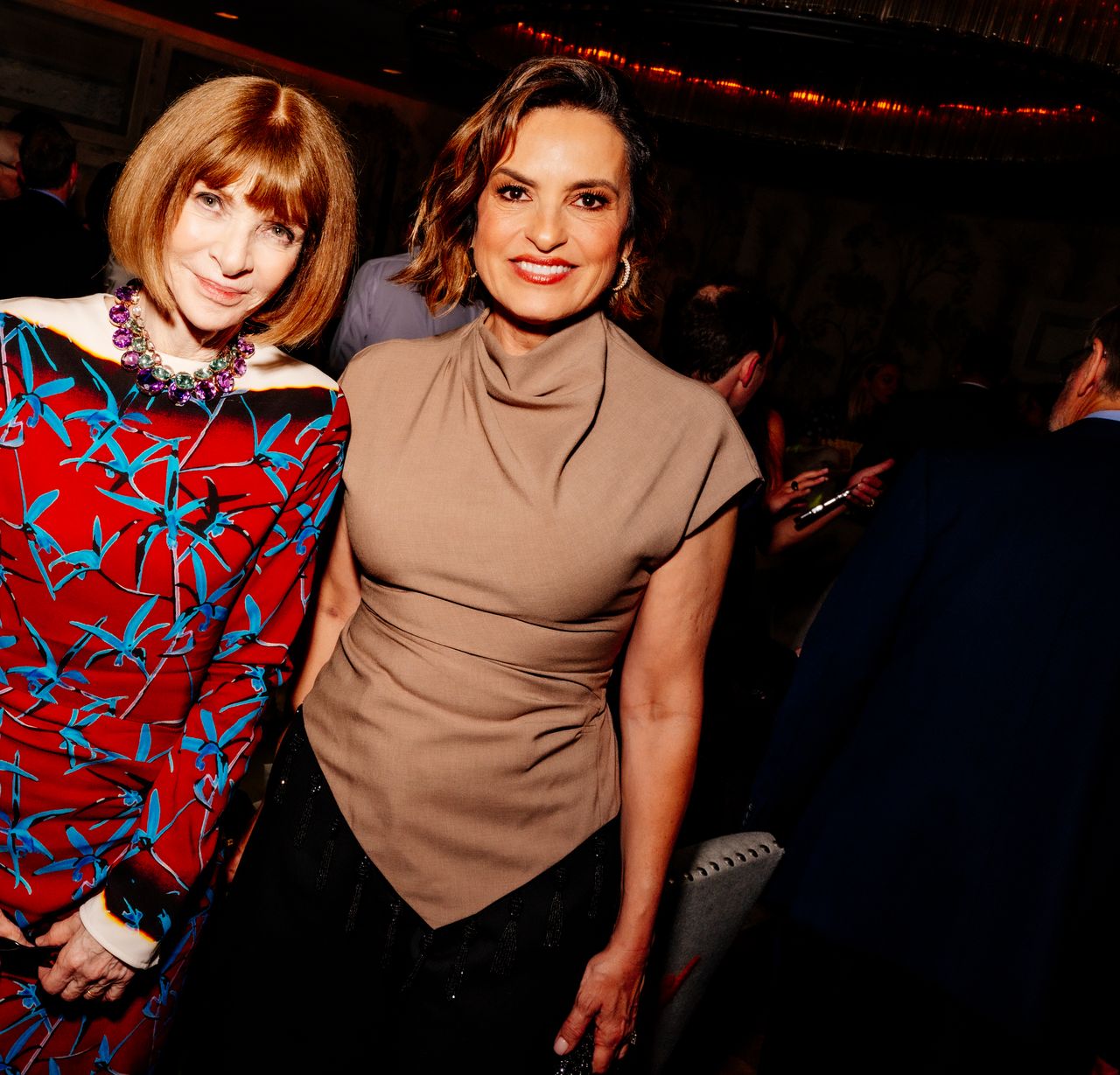
“I heard there was going to be a storm,” said Vera Wang upon entry to the Crosby Street Hotel, gesturing towards her waterproof jacket. For the designer and some forty guests who filtered into the SoHo venue, not even a flash flood warning could keep them from showing up for an important cause: the annual benefit dinner for the Center for Youth Mental Health at NewYork-Presbyterian hosted by Anna Wintour, Mariska Hargitay, Dr. Zandy Forbes, Dr. Brian G. Donley, Jon Shirley, and Kim Richter Shirley.
The evening highlighted a shared commitment to expanding access to mental health care and ensuring young people receive the support they need in order to thrive. Amongst the pop art in the Crosby’s lower-level salon, guests gathered to share stories about their involvement with the organization, which was co-founded by pioneering child psychiatrist Dr. David Shaffer over a decade ago.
“I was one of the original founding committee members,” Vera Wang told Vogue, citing her own experience of parenthood as an early influence for getting involved. “Back then, mental health was still very verboten. You didn’t talk about therapy or psychiatry. There was a stigma, and I didn’t feel I had any tools to deal with it. I confided in Anna and Dr. Shaffer, and I’ve been involved ever since.”
At dinnertime, attendees converged in the Prince Room, where a conversation ensued between two Department of Psychiatry chairpersons from two esteemed institutions: Dr. Francis Lee of Weill-Cornell Medicine and Dr. Josh Gordon of Columbia University.
Moderated by Dr. Charlie Shaffer—co-chair of the CYMH’s Young Patrons Committee, who follows in the footsteps of his late father through his own work with the Center—the talk segued from the vulnerable nature of the childhood psyche to a call for federal funding for stronger resources. “You need year-to-year funding in order to plan experiments that might take three to four years,” said Lee, decrying the current administration’s culling of vital research funds. “In the midst of all this uncertainty, philanthropic organizations like the Center are stepping up to the plate and saying, ‘We are going to be able to help make sure that staff are here, so that you’re still able to dream big.’”
Dr. Shaffer also drew attention to declining youth suicide rates over the last five years—which Dr. Gordon attributes to mental health practitioners’ ability to follow the scientific data and double down on what works. “Universal screening, healthcare settings, teaching teachers how to recognize children in trouble, and setting up the 988 line—these things work,” said Gordon. “Research showed they work. Investment by people, like you, in places like the Center has showed they work.”
Brian G. Donley, CEO and president of New York-Presbyterian, also drew attention to the 45,000 “wonderful people” at the Manhattan hospital who “get up every single day and try to make things better for other individuals.” He told the room: “You made it possible for all those 45,000 people to be their best. So on behalf of all of them, on behalf of the patients that we serve and their families, we thank all of you.”
By the time scoops of sorbet were served, the room buzzed as guests spoke about resources and hope for the future. “You can feel so hesitant to bring up [struggle] or acknowledge it, but it’s so important to talk about it,” said Wang. “People do need help. [Otherwise] you can grow so isolated, frightened, and powerless—especially now.”
Mariska Hargitay, who is currently appearing in the Broadway show Every Brilliant Thing, which deals with topics of mental health, added: “I believe deeply in the power of bearing witness to suffering, of paying a particular kind of healing attention. I want the fierce commitment and knowledge that filled the room tonight to reach those who are so deeply in the grip of the conviction that there is no hope. Because there is. There is hope. I know that so very deeply in my heart.”