
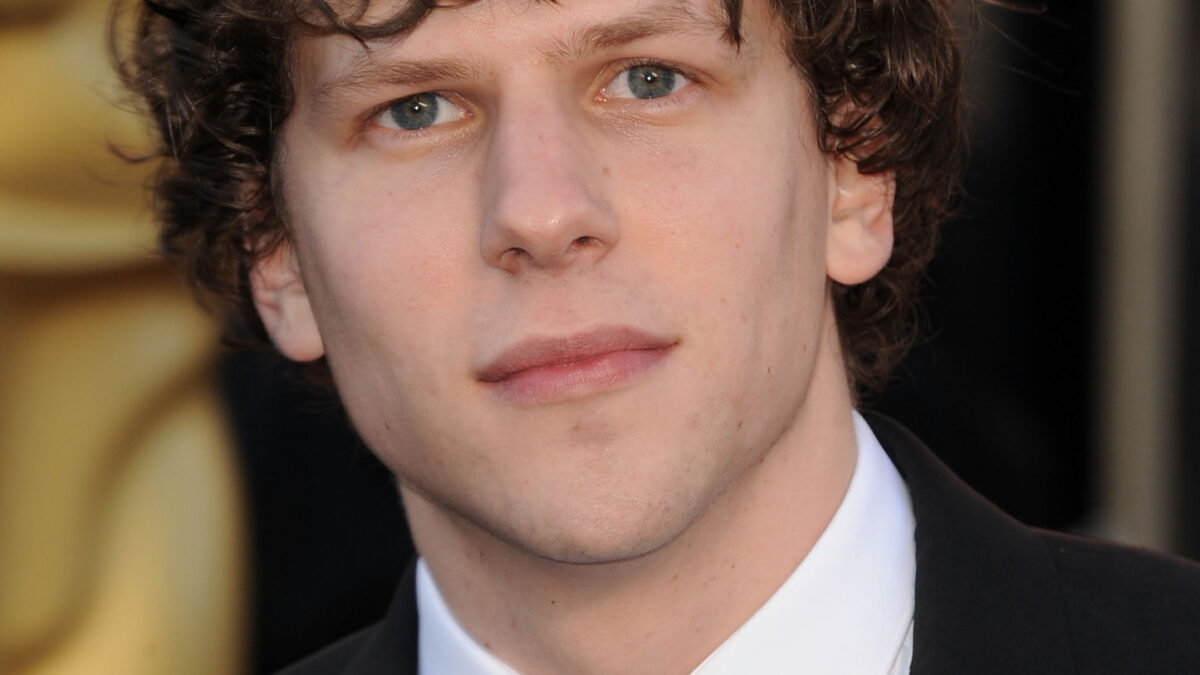
FEATURED ENTERTAINER OF THE WEEK
Jesse Eisenberg
Actor, writer and director
September 06, 2026
Jesse Eisenberg Turns a Telluride Premiere Into the Next Chapter of an Unusually Restless Career
Jesse Eisenberg has never seemed especially interested in the most obvious version of movie stardom. He became internationally famous by playing Mark Zuckerberg as a brilliant, brittle, socially armed young man in The Social Network, then spent the next decade refusing to let that performance become a cage. He moved between studio franchises, tiny character studies, voice work, stage plays, short fiction, domestic drama and, increasingly, filmmaking of his own. That is why his Telluride moment this week matters. The premiere of The Debut, his third directorial feature, is not a sudden detour into prestige filmmaking; it is the latest evidence that Eisenberg has been quietly building one of the more idiosyncratic second acts among actors of his generation. The A24 film arrived at Telluride with strong critical attention, seven original songs written by Eisenberg, and early awards conversation around one of those songs. For an actor once treated by many viewers as the embodiment of hyper-verbal millennial anxiety, Eisenberg has become something more interesting: a filmmaker preoccupied with inheritance, embarrassment, moral performance, family language, and the strange ways people reveal themselves when they think they are being decent.
Quick Facts
| Born | October 5, 1983 |
| Birthplace | Queens, New York, United States |
| Nationality | American |
| Years Active | 1999-present |
| Residence | Bloomington, Indiana |
| Spouse | Anna Strout |
| Children | One son |
Early Life
Eisenberg’s childhood explains more about his career than the usual origin-story details suggest. Born in Queens and raised in East Brunswick, New Jersey, he grew up outside the traditional Hollywood pipeline, in a family that valued language, education and performance without being a show-business dynasty. He has spoken publicly about experiencing anxiety from a young age, and acting became less an escape from reality than a way to organize it. A script gave him rules. A character gave him a frame. A stage gave nervous energy somewhere to go. As a teenager, he began working professionally in New York theater and television, and by the time many actors his age were still deciding whether to study drama, Eisenberg had already learned the odd discipline of being young on adult sets. He attended East Brunswick public schools and later studied at The New School in New York, an education that suited the version of Eisenberg who would eventually become as interested in writing and ideas as in performance. His early professional life did not announce a conventional leading man. Instead, it introduced an actor with a quick mind, a guarded manner and an unusual ability to make self-consciousness dramatic rather than merely awkward.
Family
Parents
- Amy Fishman, who has taught cross-cultural sensitivity in health-care settings and previously worked as a children’s party clown
- Barry Eisenberg, who worked in hospital administration and later as a college professor
Siblings
- Hallie Eisenberg, actress known for her work as a child performer, including the Pepsi commercials that made her widely recognizable in the late 1990s
- Kerri Eisenberg, also known professionally as Kerry Lea
Career
Eisenberg’s first major screen job came on the short-lived Fox series Get Real, which ran from 1999 to 2000 and is now remembered partly because it featured two future stars before they became famous: Eisenberg and Anne Hathaway. His film breakthrough followed with Roger Dodger, a sharp 2002 independent drama in which he played a teenager receiving dubious lessons in confidence from Campbell Scott’s cynical Manhattan adman. The performance established a pattern. Eisenberg was rarely simply playing shy. His characters often wanted status, moral clarity or intellectual control, and the friction between that desire and their emotional immaturity became his territory. Noah Baumbach’s The Squid and the Whale in 2005 deepened that impression. As Walt Berkman, the adolescent son of divorcing literary parents, Eisenberg found something painfully specific: a teenager borrowing arrogance from adults because vulnerability felt too humiliating. The film became a key marker in his early career because it showed that his nervous rhythm could carry real emotional damage underneath the wit. By 2009, Eisenberg had two very different cultural footholds. Adventureland made him a romantic lead for viewers who preferred melancholy to gloss, while Zombieland turned his verbal unease into a comedy engine inside a mainstream horror-comedy hit. Then came The Social Network in 2010. David Fincher’s film, written by Aaron Sorkin, did not make Eisenberg famous in the simple sense; it fixed him in the public imagination. His Mark Zuckerberg was not a biographical impersonation so much as a study in velocity, resentment and loneliness. The performance earned him an Academy Award nomination for Best Actor and placed him among the defining screen actors of his generation. The danger of such a role is that it can follow an actor around, especially when the performance is as precise as Eisenberg’s was. His answer was not to soften into familiarity. He took commercial assignments, including the Rio animated films and the Now You See Me franchise, but he also pursued strange, uncomfortable or formally risky work: Richard Ayoade’s The Double, Kelly Reichardt’s Night Moves, Nima Nourizadeh’s American Ultra, James Ponsoldt’s The End of the Tour and Riley Stearns’s The Art of Self-Defense. Some projects connected more widely than others. Some did not. But together they made clear that Eisenberg was less interested in protecting a brand than in testing how far his screen persona could bend. His casting as Lex Luthor in Batman v Superman: Dawn of Justice was perhaps the most public example of that risk. It was divisive, but it also showed his willingness to bring twitchy psychological eccentricity into the center of a massive studio machine. Away from the screen, Eisenberg had been writing all along. He wrote plays including Asuncion, The Revisionist and The Spoils, acted opposite Vanessa Redgrave, published humor and fiction, and released the short-story collection Bream Gives Me Hiccups. That literary life eventually fed directly into his filmmaking. His directing debut, When You Finish Saving the World, premiered at Sundance and translated his interest in moral self-image into a prickly mother-son story starring Julianne Moore and Finn Wolfhard. A Real Pain, his second feature as writer-director and one of his most personal works, brought him to a new level of recognition behind the camera. Starring Eisenberg and Kieran Culkin as cousins on a Jewish heritage tour in Poland, the film used comedy not to soften grief but to make it more volatile. It earned Eisenberg major screenplay recognition, including an Academy Award nomination and a BAFTA win for original screenplay. That made The Debut feel less like a curiosity and more like the next stage of a writer-director coming into focus. The seven original songs are significant because they suggest Eisenberg is expanding the language of his films without abandoning the subjects that have long interested him: performance, discomfort, family mythology and the gap between what people say and what they mean.
Television
- Get Real (1999-2000) — Kenny Green
- Lightning: Fire from the Sky (2001) — Eric Dobbs
- Cinema Verite (2011) — Albert Maysles
- Saturday Night Live (2011) — Host
- Modern Family (2014) — Asher
- Fleishman Is in Trouble (2022) — Toby Fleishman
Filmography
- Roger Dodger (2002) — Nick
- The Emperor’s Club (2002) — Louis Masoudi
- The Village (2004) — Jamison
- The Squid and the Whale (2005) — Walt Berkman
- Cursed (2005) — Jimmy Myers
- The Education of Charlie Banks (2007) — Charlie Banks
- Adventureland (2009) — James Brennan
- Zombieland (2009) — Columbus
- Solitary Man (2009) — Daniel Cheston
- Holy Rollers (2010) — Sam Gold
- The Social Network (2010) — Mark Zuckerberg
- Rio (2011) — Blu
- 30 Minutes or Less (2011) — Nick Davis
- To Rome with Love (2012) — Jack
- Now You See Me (2013) — J. Daniel Atlas
- The Double (2013) — Simon James and James Simon
- Night Moves (2013) — Josh Stamos
- Rio 2 (2014) — Blu
- American Ultra (2015) — Mike Howell
- The End of the Tour (2015) — David Lipsky
- Batman v Superman: Dawn of Justice (2016) — Lex Luthor
- Café Society (2016) — Bobby Dorfman
- Now You See Me 2 (2016) — J. Daniel Atlas
- The Hummingbird Project (2018) — Vincent Zaleski
- The Art of Self-Defense (2019) — Casey Davies
- Vivarium (2019) — Tom
- Zombieland: Double Tap (2019) — Columbus
- Resistance (2020) — Marcel Marceau
- Zack Snyder’s Justice League (2021) — Lex Luthor
- When You Finish Saving the World (2022) — Writer and director
- Manodrome (2023) — Ralphie
- Sasquatch Sunset (2024) — Male Sasquatch
- A Real Pain (2024) — David Kaplan; writer and director
- The Debut (2026) — Writer, director and songwriter
Awards & Honors
- 2011 — Academy Awards (Best Actor) — Nominated
- 2011 — Golden Globe Awards (Best Actor in a Motion Picture – Drama) — Nominated
- 2011 — BAFTA Awards (Best Leading Actor) — Nominated
- 2011 — Screen Actors Guild Awards (Outstanding Performance by a Male Actor in a Leading Role) — Nominated
- 2011 — Critics’ Choice Movie Awards (Best Actor) — Nominated
- 2024 — Sundance Film Festival (Waldo Salt Screenwriting Award: U.S. Dramatic) — Won
- 2025 — Academy Awards (Best Original Screenplay) — Nominated
- 2025 — BAFTA Awards (Best Original Screenplay) — Won
- 2025 — Golden Globe Awards (Best Screenplay – Motion Picture) — Nominated
- 2025 — Critics’ Choice Awards (Best Original Screenplay) — Nominated
Business Ventures
- Eisenberg has not built his public career around a consumer brand or celebrity company; his business footprint is centered on authorship, producing and creative control.
- Served as writer, director and producer on his own feature projects, including When You Finish Saving the World and A Real Pain.
- Has maintained a commercially flexible acting career by balancing independent films with studio franchises such as Rio, Zombieland and Now You See Me.
- Published fiction and theater work, including the short-story collection Bream Gives Me Hiccups and stage plays that have extended his career beyond screen acting.
Philanthropy
- Has been a longtime supporter and volunteer for Middle Way House, a domestic-violence shelter and services organization in Bloomington, Indiana.
- His connection to Middle Way House is personal as well as philanthropic; his wife, Anna Strout, is the daughter of Toby Strout, the organization’s former longtime executive director.
- Has participated in charitable readings and fundraising connected to domestic-violence awareness and survivor services.
- Has publicly supported animal welfare and rescue causes, including advocacy connected to fostering and adopting animals.
Current Projects
- The Debut, Eisenberg’s third directorial feature, premiered at the Telluride Film Festival with seven original songs written by him.
- One original song from The Debut is receiving an awards-season push, placing Eisenberg in an unusual conversation that now includes songwriting as well as acting and screenwriting.
- A Real Pain continues to define his current reputation as a filmmaker after its awards success and strong critical reception.
- He remains associated with the Now You See Me franchise as J. Daniel Atlas, one of his most recognizable mainstream roles.
Interesting Facts
- Eisenberg and Anne Hathaway played siblings on Get Real years before both became Oscar-nominated film actors.
- His younger sister Hallie Eisenberg was widely known in the late 1990s as the child actress in Pepsi commercials.
- He has said acting helped him manage anxiety because the structure of performance gave him a controlled place to put nervous energy.
- The Squid and the Whale was a major turning point because it showed filmmakers he could play adolescent intelligence without making it charming or harmless.
- He did not become a franchise actor in just one lane: his commercial work includes animated family films, zombie comedy, comic-book spectacle and heist thrillers.
- His Social Network performance remains one of the rare modern acting turns closely associated with the creation myth of a major technology company.
- He has written for literary and humor outlets, including pieces outside the film industry, which helped shape his later voice as a screenwriter.
- His short-story collection Bream Gives Me Hiccups was published in 2015, the same year he appeared in both American Ultra and The End of the Tour.
- He wrote and acted in stage plays before his film-directing career took off, including The Revisionist opposite Vanessa Redgrave.
- A Real Pain drew on his interest in Jewish history, family memory and travel through Poland, subjects connected to his own ancestral background.
- He has often played characters who are articulate but emotionally evasive, a quality he has increasingly examined rather than merely performed.
- His move into directing has not been a late-career vanity project; it grew out of years of writing plays, essays, fiction and screen material.
- When You Finish Saving the World began as an audio project before becoming his feature directing debut.
- The Debut adds songwriting to his public creative profile, an unexpected expansion for an artist best known for language, timing and psychological precision.
Why ShowBiz Selected This Entertainer
Eisenberg is ShowBiz.com’s featured entertainer this week because The Debut gives the industry a fresh reason to reconsider the shape of his career. The Telluride premiere would be notable on its own, but the added detail that the film includes seven original songs written by Eisenberg, with one receiving an Oscar push, makes the moment more revealing. This is not simply an actor trying directing between roles. Coming after When You Finish Saving the World and the awards-season success of A Real Pain, The Debut suggests a filmmaker widening his tools while staying close to the themes that have always animated his best work: family discomfort, inherited identity, private shame, ambition and the performance of goodness. Eisenberg matters this week because his career is no longer defined by the afterglow of The Social Network. That performance remains central, but it is now part of a larger story about an actor-writer who has turned nervous intelligence into a durable artistic language.
Watch Next
- The Social Network
- The Squid and the Whale
- Adventureland
- Zombieland
- The Double
- The End of the Tour
- The Art of Self-Defense
- Fleishman Is in Trouble
- When You Finish Saving the World
- A Real Pain
- The Debut