
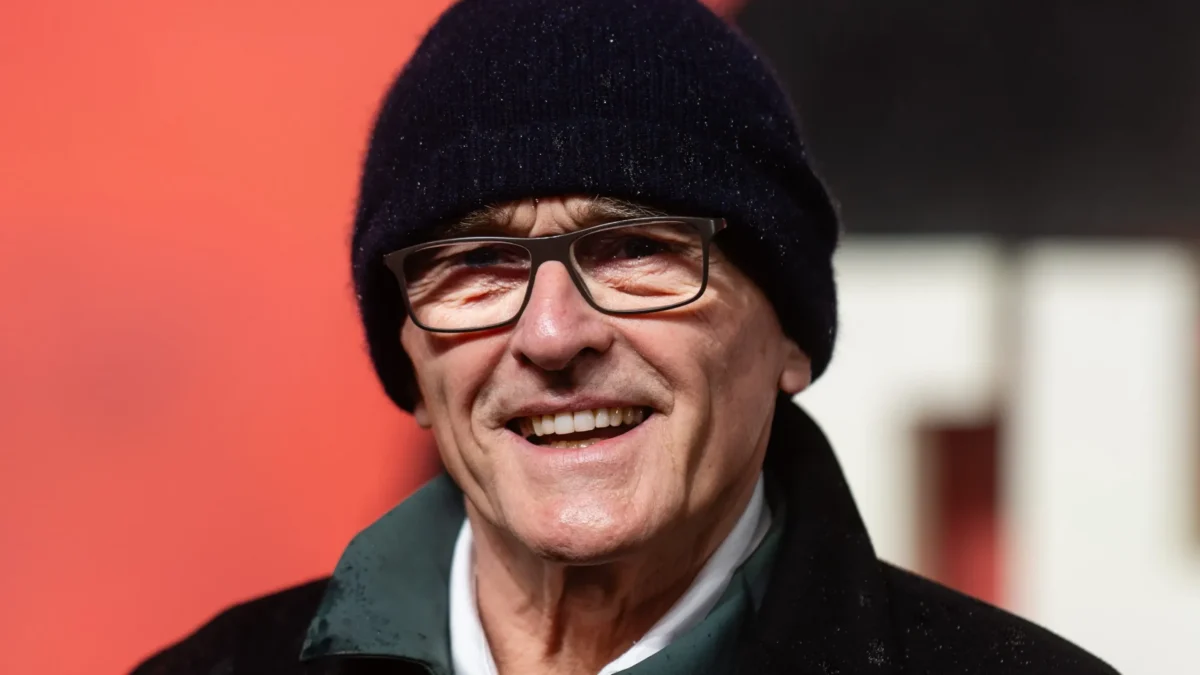
FEATURED ENTERTAINER OF THE WEEK
Danny Boyle
Film director
November 15, 2026
Danny Boyle Talks ‘Ink,’ the Common Architecture of His Movies and More ‘28 Years Later’ as He Receives the Deadline Legend Award
Danny Boyle has spent four decades changing genres without losing his fingerprints. A Boyle film may unfold in a heroin-soaked Edinburgh flat, a Mumbai television studio, a spacecraft approaching the sun or an abandoned London overrun by infection, but the machinery beneath it is remarkably consistent: characters are placed under pressure, the pace accelerates, music becomes propulsion and a moral choice waits at the finish. That underlying architecture explains why his work feels connected even when the subjects appear to have nothing in common.
The Deadline Legend Award arrives at an unusually revealing point in his career. Boyle is not being celebrated from retirement. He has returned to the apocalyptic world he helped reinvent with ‘28 Years Later,’ is developing ‘Ink,’ an adaptation of James Graham’s drama about Rupert Murdoch and the transformation of The Sun, and is still discussing what might come next. The honor recognizes the Oscar-winning director of ‘Slumdog Millionaire,’ certainly, but it also acknowledges the restless filmmaker who made ‘Trainspotting,’ staged an Olympic opening ceremony and then went back to experimenting with modified smartphones. Boyle remains difficult to classify because he has never treated prestige as a destination. For him, the interesting question is always what can be attempted next.
Quick Facts
| Born | October 20, 1956 |
| Birthplace | Radcliffe, Lancashire, England, now part of Greater Manchester |
| Nationality | British |
| Years Active | Early 1980s–present |
| Residence | London, England |
| Spouse | Not married; formerly partnered with casting director Gail Stevens |
| Children | Three: Gabriel, Grace and Caitlin |
Early Life
Daniel Francis Boyle grew up in Radcliffe, north of Manchester, in a family whose Catholic faith initially gave him a very different idea of his future. As a boy he served at church and considered entering the priesthood. At 14, however, a priest advised him not to enter the seminary immediately. Boyle later suggested that the intervention redirected the intensity he might have brought to religion toward drama instead.
He attended Thornleigh Salesian College in Bolton and studied English and drama at University College of North Wales, now Bangor University. Theatre became his practical education. He worked with the Joint Stock Theatre Company and moved to the Royal Court, directing writers including Howard Brenton and Edward Bond. That foundation matters: even Boyle’s most visually aggressive films are built around actors, entrances, reversals and the mounting pressure of a live performance.
Family
Parents
- Frank Boyle, his father
- Annie Boyle, his mother
Siblings
- Marie Boyle, his twin sister
- Bernadette Boyle, his younger sister
Career
Boyle arrived in cinema through theatre and television rather than film school. His early screen work included directing episodes of ‘Inspector Morse’ and the BBC serial ‘Mr. Wroe’s Virgins.’ At BBC Northern Ireland he also produced Alan Clarke’s ‘Elephant,’ a stark film about sectarian killings whose repetition and refusal to explain violence made a lasting impression. Years later, Gus Van Sant borrowed its title for his own film ‘Elephant.’
Boyle’s feature breakthrough was ‘Shallow Grave,’ made with screenwriter John Hodge, producer Andrew Macdonald and actor Ewan McGregor. The film turned a modest Edinburgh flat into a laboratory of greed and mistrust. Its commercial and critical success gave the team enough leverage to make ‘Trainspotting,’ adapted from Irvine Welsh’s novel. Released in 1996, it was fast, funny and deliberately abrasive, matching addiction and betrayal with pop music, fantasy and furious movement. It also demonstrated Boyle’s ability to make difficult material accessible without making it respectable.
Hollywood followed, but not with a smooth upward curve. ‘A Life Less Ordinary’ mixed romance, crime and angels without finding the same audience, while ‘The Beach,’ starring Leonardo DiCaprio, arrived with enormous expectations and divided critics. Those experiences helped push Boyle back toward smaller, faster production. ‘28 Days Later,’ written by Alex Garland and shot largely with lightweight digital cameras, made financial limitations part of its aesthetic. The deserted London streets looked immediate rather than polished, and the infected moved with a speed that altered the visual language of modern screen horror.
Boyle then swerved again. ‘Millions,’ written by Frank Cottrell-Boyce, viewed money, faith and generosity through a child’s imagination. ‘Sunshine,’ another Garland collaboration, sent an international crew toward a dying sun and gave physicist Brian Cox an early role as a scientific adviser. Neither film was designed as a repetition of Boyle’s previous success. That willingness to risk tonal and commercial uncertainty prepared the way for his largest awards triumph.
He initially had reservations about ‘Slumdog Millionaire,’ but Simon Beaufoy’s screenplay drew him into its construction: an impoverished young man’s life is revealed through the questions on a television quiz show. The film’s kinetic storytelling, A. R. Rahman score and international cast turned it into a global phenomenon. Boyle won the Academy Award, BAFTA, Golden Globe and Directors Guild Award for directing. The Oscar mattered not because it transformed him into a prestige filmmaker, but because it confirmed that his restless, music-driven approach could carry an emotionally direct story to the industry’s highest level.
Rather than make a conventional follow-up, Boyle chose ‘127 Hours,’ placing James Franco’s trapped climber at the center of a film that had to create momentum with almost no physical movement. Boyle and Beaufoy received an Oscar nomination for their adapted screenplay, and Boyle shared a Best Picture nomination as a producer. ‘Trance’ returned him to psychological crime; ‘Steve Jobs,’ written by Aaron Sorkin, treated three product launches like theatrical acts; and ‘T2 Trainspotting’ revisited characters who had spent 21 years discovering that escape and progress were not the same thing.
His career also expanded beyond cinema. Boyle directed ‘Frankenstein’ at the National Theatre, with Benedict Cumberbatch and Jonny Lee Miller alternating the roles of Victor Frankenstein and the Creature. In 2012 he served as artistic director of the London Olympic opening ceremony. Titled ‘Isles of Wonder,’ it moved from pastoral Britain through the Industrial Revolution, the National Health Service, popular music and digital culture. Its most audacious filmed sequence placed Daniel Craig’s James Bond opposite Queen Elizabeth II. Boyle later declined a knighthood, explaining that the ceremony had been a collective achievement and that he preferred to remain an equal citizen.
‘Yesterday’ gave him a commercially inviting Richard Curtis premise about a world without the Beatles. Television projects ‘Trust’ and ‘Pistol’ let him examine, respectively, dynastic wealth and the manufactured chaos surrounding the Sex Pistols. With ‘28 Years Later,’ Boyle and Garland returned to the infected Britain they had left behind. The film was not merely an exercise in nostalgia: Boyle again embraced unconventional technology, using modified iPhones among its camera tools, while shifting the story toward a generation born after the original catastrophe.
That trajectory makes ‘Ink’ a logical Boyle project. James Graham’s play examines how institutions, competition and mass appetite reshape behavior—the same pressures that animate many Boyle films. His characters often enter systems they believe they can control, only to discover that the system is changing them. Whether the arena is a newspaper, a game show, a technology company or a post-apocalyptic island, Boyle is drawn to the instant when ambition becomes a test of identity.
Television
- Elephant (1989) — Producer
- Inspector Morse (1990–1992) — Director
- Mr. Wroe’s Virgins (1993) — Director
- Strumpet and Vacuuming Completely Nude in Paradise (2001) — Director
- Babylon (2014) — Director and executive producer
- Trust (2018) — Director and executive producer
- Pistol (2022) — Director and executive producer
Filmography
- Shallow Grave (1994) — Director
- Trainspotting (1996) — Director
- A Life Less Ordinary (1997) — Director
- The Beach (2000) — Director
- 28 Days Later (2002) — Director
- Millions (2004) — Director
- Sunshine (2007) — Director
- Slumdog Millionaire (2008) — Director
- 127 Hours (2010) — Director, co-writer and producer
- Trance (2013) — Director and producer
- Steve Jobs (2015) — Director
- T2 Trainspotting (2017) — Director and producer
- Yesterday (2019) — Director and producer
- 28 Years Later (2025) — Director and producer
Awards & Honors
- 1995 — BAFTA Film Award (Alexander Korda Award for Best British Film) — Won
- 1997 — BAFTA Film Award (Alexander Korda Award for Best British Film) — Nominated
- 2009 — Academy Award (Best Director) — Won
- 2009 — BAFTA Film Award (Best Director) — Won
- 2009 — Golden Globe Award (Best Director – Motion Picture) — Won
- 2009 — Directors Guild of America Award (Outstanding Directorial Achievement in Theatrical Feature Film) — Won
- 2011 — Academy Award (Best Picture) — Nominated
- 2011 — Academy Award (Best Adapted Screenplay) — Nominated
- 2011 — BAFTA Film Award (Best Director) — Nominated
- 2025 — Deadline Legend Award (Career achievement) — Won
Business Ventures
- Co-founded the film and television production banner Decibel Films with Oscar-winning producer Christian Colson.
- Has regularly worked as a producer as well as a director, including on ‘127 Hours,’ ‘Trance,’ ‘T2 Trainspotting,’ ‘Yesterday’ and ‘28 Years Later.’
- Executive-produced ‘28 Weeks Later,’ helping continue the screen world created by ‘28 Days Later’ while another director led the sequel.
Philanthropy
- Has served as a patron of Early Break, a Greater Manchester charity supporting young people and families affected by substance misuse.
- Directed performances of ‘The Children’s Monologues’ in support of Dramatic Need, which uses creative arts to work with children in underserved African communities.
- Helped establish the community-focused Shuffle Festival in east London, combining film, music, performance and local environmental engagement.
Current Projects
- ‘Ink,’ a screen adaptation of James Graham’s play about Rupert Murdoch, editor Larry Lamb and the reinvention of The Sun as a mass-market tabloid.
- The continuing ‘28 Years Later’ story, developed with screenwriter Alex Garland. Boyle has remained involved as the revived series expands beyond the first film.
- ‘28 Years Later: The Bone Temple,’ directed by Nia DaCosta and written by Garland, with Boyle serving as a producer.
Interesting Facts
- Boyle seriously considered becoming a Catholic priest before a clergyman advised him to delay entering the seminary.
- He has a twin sister, Marie, as well as a younger sister, Bernadette.
- His professional foundation was theatre, including work at the Royal Court and with the Royal Shakespeare Company.
- He produced Alan Clarke’s ‘Elephant,’ whose title was later adopted by Gus Van Sant for his 2003 film.
- The near-empty London sequences in ‘28 Days Later’ were captured quickly during brief traffic closures, with lightweight digital equipment making the operation possible.
- Physicist Brian Cox served as a scientific adviser on ‘Sunshine’ before becoming widely known as a television presenter.
- Boyle was initially reluctant to direct ‘Slumdog Millionaire’ but was persuaded by the construction and emotional force of Simon Beaufoy’s screenplay.
- For the National Theatre’s ‘Frankenstein,’ Benedict Cumberbatch and Jonny Lee Miller alternated the roles of the Creature and Victor Frankenstein.
- The London Olympic opening ceremony included a short film in which Queen Elizabeth II appeared with Daniel Craig as James Bond.
- He declined a knighthood after the Olympics, emphasizing the ceremony’s collective nature and his preference for remaining an equal citizen.
- ‘Steve Jobs’ was structured as three extended acts set backstage before major product launches rather than as a conventional cradle-to-grave biography.
- ‘T2 Trainspotting’ arrived 21 years after ‘Trainspotting’ and used that passage of time as a central subject.
- ‘28 Years Later’ continued Boyle’s interest in accessible camera technology by employing modified iPhones as part of its production approach.
- Despite his association with horror, crime and science fiction, Boyle has repeatedly said that he approaches stories through character and performance rather than loyalty to any one genre.
Why ShowBiz Selected This Entertainer
Danny Boyle is featured this week because the Deadline Legend Award places a career of unusual range into focus while he remains deeply engaged in new work. His reflections on ‘Ink,’ ‘28 Years Later’ and the recurring structure beneath his films reveal why the honor is more than a retrospective gesture. Boyle has moved between independent British cinema, Hollywood productions, television, theatre and one of the most-watched live spectacles ever staged without settling into a house style that can be copied easily. The current moment connects his past and present particularly well: ‘28 Years Later’ revives one of his most influential collaborations, while ‘Ink’ returns him to questions of ambition, institutions and mass culture that have run through his work from ‘Shallow Grave’ to ‘Steve Jobs.’
Watch Next
- ‘Shallow Grave’ — the compact debut in which Boyle’s visual and moral instincts were already fully visible.
- ‘Trainspotting’ — his defining fusion of performance, music, editing and unruly social observation.
- ‘28 Days Later’ — a production experiment that changed the appearance and pace of modern horror.
- ‘Millions’ — evidence that Boyle’s velocity can serve tenderness rather than violence.
- ‘Slumdog Millionaire’ — the film that converted his kinetic style into an Oscar-winning global success.
- ‘127 Hours’ — a masterclass in creating movement around a physically immobilized protagonist.
- ‘Steve Jobs’ — Boyle directing dialogue and backstage conflict with the momentum of an action film.
- ‘28 Years Later’ — a return to familiar territory that uses time, technology and generational change to make it new.