
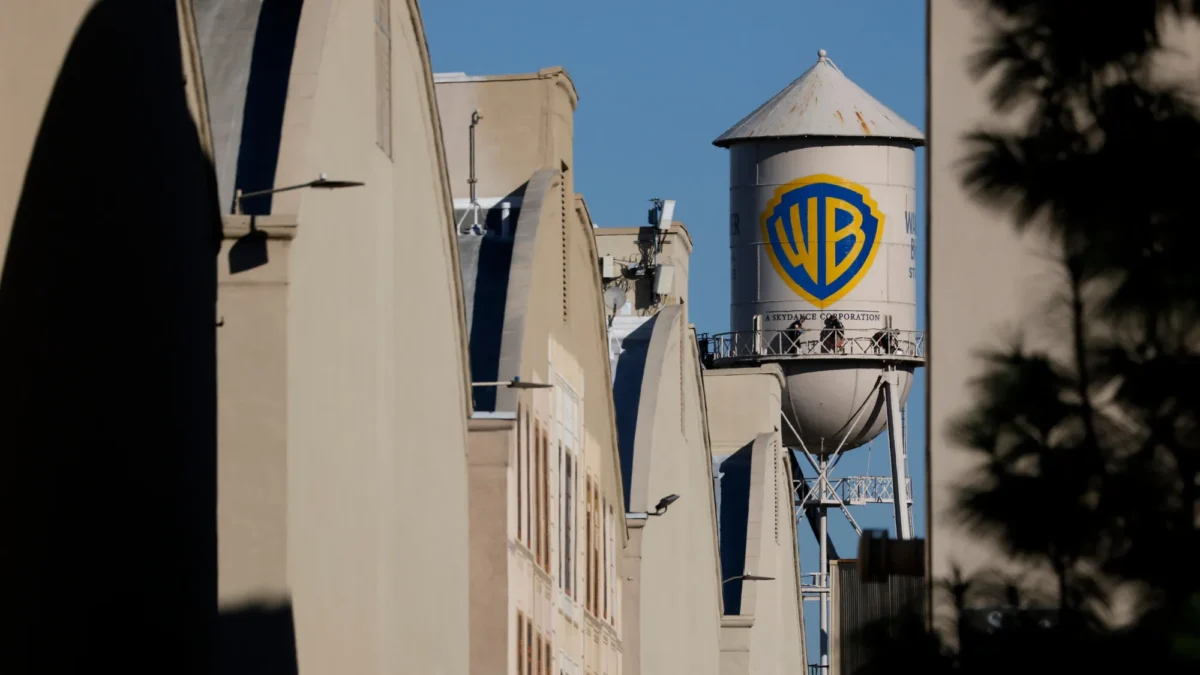
David Ellison marked what he called “Day 1” at Warner Bros. on Tuesday, addressing employees at the studio’s Burbank lot with a message that paired sweeping ambition with a warning that difficult changes lie ahead.
Speaking inside the Steven J. Ross Theatre, the Skydance chief acknowledged the long road to acquiring the studio and told staff that the work of bringing the companies together was only beginning.
“We have a long runway ahead of us, and we have a tremendous amount of work to do,” Ellison said.
His pitch centered on creating a media and entertainment company with enough creative strength, technology and global scale to compete not only with traditional entertainment businesses, but also with major technology companies fighting for consumers’ time.
“When we set out to acquire Paramount, we did so with an even larger ambition,” Ellison told the audience. “We believed then — and we believe even more strongly today — that this industry needs another company with the scale, resources, technology and creative firepower to go toe-to-toe with the biggest players in the world.”
Ellison argued that the competitive environment has “fundamentally changed,” with entertainment companies now battling sophisticated technology groups possessing vast resources, reach and scale.
A sizzle reel showcasing intellectual property from the two companies preceded the speeches and emphasized the breadth of the newly combined operation. One person who saw the presentation described it as “impressive.”
Leadership Team and New Priorities
Ellison used the gathering to introduce members of his leadership group, including president Andy Gordon and chief financial officer Dennis Cinelli. He also presented Skydance co-chairs and chief creative officers Casey Bloys and George Cheeks, as well as Skydance motion picture group co-chairs Dana Goldberg and Josh Greenstein, among others. Gerry Cardinale of RedBird also received a mention.
The transition was visible beyond the theater. Workers were applying fresh paint to the Warner Bros. water tower, adding the words “a Skydance Corporation” beneath the logo. The wording mirrors language used at the Paramount lot in Hollywood, located a few miles away.
Ynon Kreiz offered a more detailed look at the company’s operating goals. The former Mattel CEO is expected to play a central role in carrying out the strategy and making decisions involving costs and job reductions. One person described his presence at the meeting as that of an “intense dude.”
Kreiz said the team intends to establish Skydance as “the premier Hollywood content engine,” accelerate its integrated DTC platform and optimize its profitable linear television portfolio. He said that global effort would be anchored by CBS, which he called “the crown jewel of broadcast television.”
Achieving those aims, Kreiz said, will require success in storytelling and the creation of a highly capable technology operation. He also urged employees to look for innovation throughout the business rather than limiting it to content or technology.
“Innovation can happen in every part of the company, in any job, by any one,” Kreiz said. He pointed to potential opportunities involving new businesses, products, games and fan experiences, adding that the company wants to follow where consumers are going.
Ellison Addresses CNN’s Future
Following their prepared remarks, Ellison and Kreiz sat for an interview with CNN anchor Anderson Cooper, who questioned them about the company’s next steps and CNN’s place within it.
Ellison expressed full confidence in CNN chief Mark Thompson and said he supports the network’s editorial independence. He also backed CNN’s effort to gain full access to cover the White House. Access has been restricted for CNN, MS NOW and Politico, prompting a lawsuit.
Cooper also raised comments made earlier this year by Secretary Pete Hegseth, who attacked “more fake news from CNN” and said, “The sooner David Ellison takes over that network, the better.”
Ellison said he had seen Hegseth’s quote but did not know what the secretary was talking about.
What Happens Next?
For employees, the largest unresolved issue remains the potential effect of the integration on their jobs. Some people left the town hall underwhelmed because Ellison did not specify the scale of the coming changes, even as he openly acknowledged that there would be pain and disruption.
“Bringing together two companies of this size and complexity will require difficult decisions,” Ellison told staff. “There will be changes, and there will be impacts. I’m not going to pretend otherwise.”
He pledged that leadership would make those decisions as quickly and thoughtfully as possible, communicate directly and share information when it becomes available. Ellison also said the company would not allow a prolonged integration to distract from its stated objective: building what he described as the next generation of media and entertainment company.