
Why This Matters
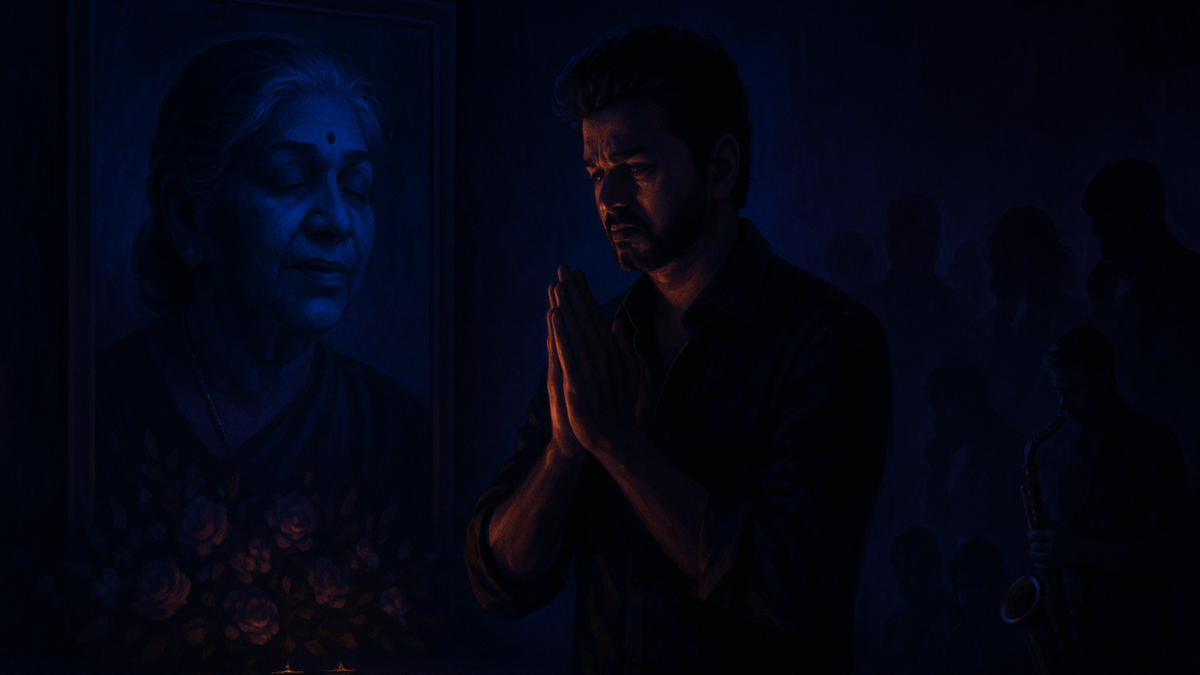
The reported passing of legendary playback singer S Janaki on Saturday has prompted an outpouring of grief from political leaders, actors, composers, singers and generations of listeners who grew up with her voice as part of the emotional vocabulary of Indian cinema.
Chief Minister C Joseph Vijay led the tributes, saying Janaki’s distinctive voice had reached across regions and languages, captivating music lovers for decades. In his message of condolence, he acknowledged the scale of her contribution to cinema, noting that her thousands of songs in multiple languages had left an imprint far beyond the recording studio.
For the film fraternity, the loss is not simply that of a celebrated singer, but of an artist whose work helped define the sound of South Indian popular culture. Janaki’s voice carried lullabies, laments, folk-inflected melodies, romantic duets and classical-based compositions with equal command. Her singing became inseparable from the screen presence of many leading actors, giving emotional depth to characters and scenes that remain part of the collective memory.
Across Chennai and the wider entertainment world, tributes reflected the unusual breadth of her appeal. Senior actors remembered her as a voice that could elevate a performance. Music directors hailed her precision, range and instinctive understanding of composition. Younger singers described her as a benchmark whose recordings continue to be studied for phrasing, breath control and emotional modulation.
Janaki’s stature rests not only on volume, though the number of songs associated with her career is staggering, but on versatility. She sang across Tamil, Telugu, Malayalam, Kannada and other Indian languages, moving with remarkable ease between regional idioms. Her diction, one of the qualities often cited by musicians, allowed her to sound rooted in each language rather than merely present in it.
That ability made her one of the rare playback singers whose career belonged to more than one industry. At a time when regional film markets had distinct musical identities, Janaki became a bridge between them. Her recordings travelled through radio, vinyl, cassette, television and digital platforms, bringing her voice to listeners who may not have known the films but knew the songs by heart.
Industry Context
Playback singing occupies a singular place in Indian cinema. While actors appear on screen, playback singers often supply the emotional force that turns a scene into a memory. Janaki emerged during an era when film music was not a promotional accessory but a central storytelling device, and her career grew alongside some of the most influential composers in South Indian cinema.
Her collaborations with leading music directors produced songs that remain reference points for singers and composers. Whether working within orchestral arrangements, folk-inspired tunes or minimalist melodies, she brought a performer’s intelligence to the microphone. Industry veterans often speak of her ability to understand a song’s dramatic situation, not just its notes, and to deliver a performance that served the film as much as the composition.
Janaki’s career also underscores the importance of women playback singers in shaping the soundscape of Indian cinema. For decades, the female singing voice in film carried complex narrative functions: it conveyed longing, innocence, sensuality, grief, devotion and defiance. Janaki’s artistry lay in refusing to flatten those emotions. She could sound youthful without affectation, vulnerable without fragility, and powerful without sacrificing nuance.
Her work coincided with major transitions in the music business. She began in an age of studio orchestras and analog recording, when singers often performed with live musicians and limited room for correction. Later, her songs found renewed circulation through television channels, compilation albums, streaming platforms and social media clips. Each technological shift introduced her recordings to new audiences, ensuring that her legacy was not confined to nostalgia.
The tributes from the film fraternity also reflect a broader concern within the industry: the passing of an era in which playback singers were household names across linguistic and geographic boundaries. Today’s film music ecosystem is more fragmented, with independent releases, shorter promotional cycles and algorithm-driven discovery changing how songs become popular. Janaki belonged to a period when a singer’s voice could anchor decades of cinematic history.
At the same time, her influence remains visible in contemporary music. Many of today’s playback singers cite her as an inspiration not because she represented a single style, but because she resisted being boxed into one. Her repertoire is a training ground for vocalists seeking to understand emotional clarity, tonal variation and the discipline required to make a song feel spontaneous while executing it with technical control.
For South Indian cinema, which has increasingly gained national and global visibility in recent years, Janaki’s legacy is a reminder that its cultural power has long been built through music as much as through stars, directors and box office milestones. Her voice helped carry regional cinema into homes, festivals, public gatherings and private memories, often outlasting the commercial life of the films themselves.
What Happens Next?
In the coming days, the entertainment industry is expected to organize memorial events and musical tributes celebrating Janaki’s vast body of work. Film associations, music unions and cultural organizations are likely to join political leaders in honoring her contribution, while broadcasters and digital platforms may revisit some of her most enduring recordings.
For fans, the mourning will likely unfold through songs. Social media has already become a space where listeners share personal memories tied to her music: a parent’s favorite melody, a childhood radio staple, a wedding song, a lullaby, or a film sequence made unforgettable by her voice. That kind of remembrance is fitting for an artist whose career lived in intimate spaces as much as grand public ones.
The larger question for the industry is how to preserve and present such a legacy for future generations. Archival restoration, curated playlists, documentary projects and institutional recognition could help ensure that Janaki’s work is not reduced to a handful of familiar hits. Her catalog spans languages, moods and decades, and it deserves the kind of careful curation afforded to the most significant figures in Indian film history.
As tributes continue to arrive from across politics and cinema, the sentiment is clear: S Janaki’s voice was more than a soundtrack to films. It was a companion to millions of lives, a defining element of South Indian cinema’s golden musical tradition, and a standard that will continue to guide singers long after the final note of public mourning fades.