
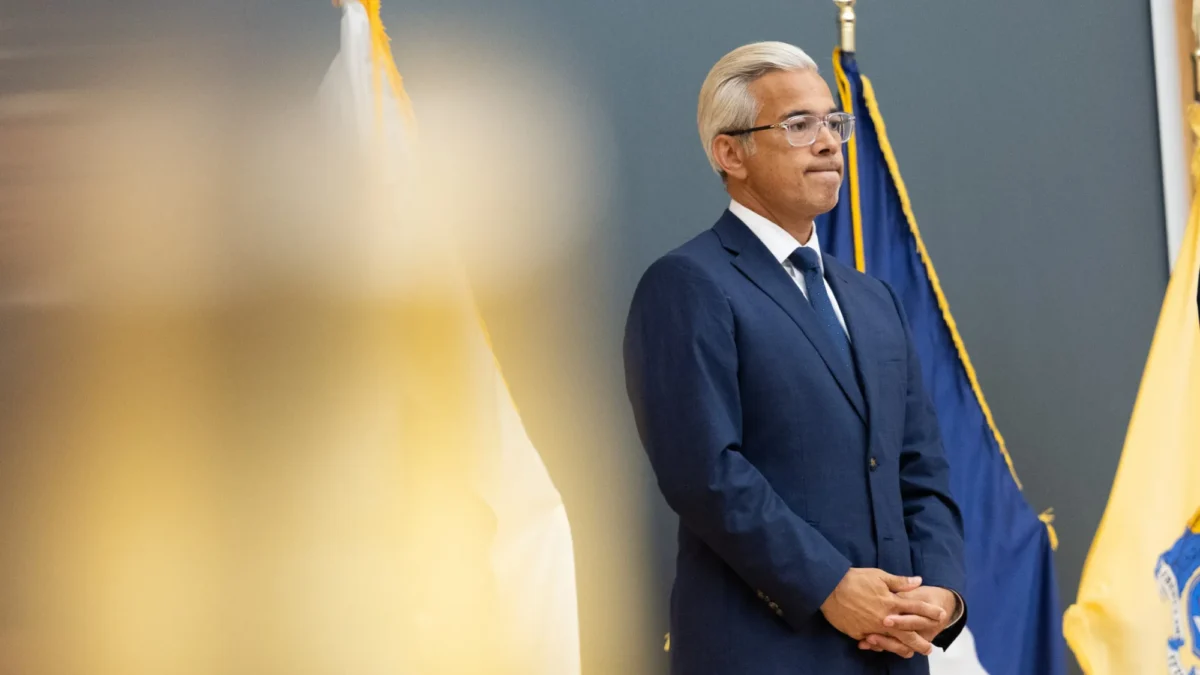
California Attorney General Rob Bonta spent months arguing that Paramount’s $111 billion bid for Warner Bros. Discovery would damage Hollywood and could be stopped. Instead, California has agreed to a settlement that allows the acquisition to move forward under a sweeping five-year consent decree.
The reversal followed mounting political and economic pressure, led by Gov. Gavin Newsom. The governor had raised concerns about the lawsuit’s potential effect on employment and became involved in negotiations to encourage a resolution. Paramount acknowledged that role in its settlement announcement, thanking Newsom “for his support throughout this process.”
Newsom had also publicly addressed Paramount CEO David Ellison’s threat to leave California. “I’m very mindful of what this means to the state — our reputation,” he said at a press appearance last month, adding that he took the possibility of a move “seriously.”
Los Angeles Mayor Karen Bass and gubernatorial nominee Xavier Becerra also pressed toward a settlement, leaving Bonta caught between his antitrust position and the risk that Paramount could relocate its headquarters and hundreds of employees even while the case remained in court.
What California secured in the deal
The agreement does not require the kind of major divestitures that can accompany an enforcement settlement. Instead, it places operating requirements on the combined company for five years, including commitments covering theatrical releases, production spending, studio facilities, cable negotiations and news standards.
Paramount and Warner Bros. must release at least 30 theatrical films annually during the first two years, followed by 32 films per year for the next three. The companies must maintain minimum levels of wide and independent releases, with at least half of the films produced or jointly produced by the combined operation.
Qualifying titles must retain a 45-day theatrical window and a 90-day SVOD holdback. Missing the annual film quota carries a $30 million penalty for each film, while an unresolved shortfall could put Paramount’s stake in Miramax at risk of divestiture.
The company must also increase annual spending on U.S. production by $300 million, totaling $1.5 billion above its 2025 baseline across the five-year period. The Paramount and Warner Bros. studio lots in Los Angeles are required to stay open and operating for the duration of the decree.
Other provisions require Paramount and Warner Bros. to keep their basic-cable negotiations separate. A violation could result in an order to divest channels including BET, VH1 and Comedy Central. CNN and New Line Cinema are not included among the assets subject to those divestiture scenarios.
The settlement also creates a five-member independence board, selected by Paramount, to oversee editorial standards at CBS News and CNN.
Why Bonta backed down
Bonta has not changed his underlying view of the combination. “I don’t think these two companies should merge,” he said at Monday’s press conference, which was titled “Attorney General Bonta Makes Announcement to Keep California Vibrant.”
Timing, however, narrowed California’s options. An Oct. 1 deadline would trigger a $7 million-per-day ticking fee, increasing the urgency to reach an agreement. Ellison had also been holding talks with officials in Tennessee and Texas, with a decision on a possible move expected at the beginning of next month.
That prospect carried particular weight as Los Angeles experiences historically low filming levels. Newsom, who has teased a presidential run, faced the possibility that one of Hollywood’s most publicly visible companies could leave California during his tenure.
The legal path was uncertain as well. The acquisition had already received government approval, and merger challenges are difficult to win. The states had a viable antitrust argument, but a trial remained a substantial gamble.
Paramount’s legal team included Jeffrey Kessler, who recently secured a major victory for states suing Live Nation; Beth Wilkinson, who helped guide Microsoft’s proposed acquisition of Activision Blizzard through the process; and former U.S. Solicitor General Paul Clement, an experienced Supreme Court litigator.
The Supreme Court also told Bonta earlier this month to respond to a challenge from Iowa and Montana seeking to halt the antitrust lawsuit, raising the possibility that the justices could review a case in which the government had sided with Paramount at various stages.
A divided coalition
California’s decision proved decisive within the broader multistate alliance. New York, Connecticut, Minnesota and Nevada appeared to remain holdouts as negotiations moved toward settlement, but continuing without California would have meant losing the state expected to be at the center of the trial.
Connecticut Attorney General William Tong made clear that his state wanted stronger remedies. “We wanted and demanded full divestiture of CNN and CBS News. We wanted to save ethical and independent journalism and news,” he said. “We fought aggressively for that remedy. I am deeply disappointed that we could not do more.”
The WGA also highlighted the financial consequences of proceeding without government support. As a nonprofit, it said, the organization would have to consider the reality of pursuing a complicated antitrust case through trial on its own at a cost of millions of dollars.
What Happens Next?
Paramount is now positioned to acquire Warner Bros. under the settlement’s five-year restrictions. For Hollywood workers and consolidation critics, the outcome leaves a larger question hanging over the industry: whether political leaders will continue fighting major combinations when the legal risks and potential economic costs become this substantial.