
Why This Matters
Brenda Fricker’s death at 81 closes a significant chapter in Irish screen history and in the broader story of character actors whose work reshaped prestige cinema without always occupying the center of the spotlight. Fricker, who died Thursday night in Dublin following a period of ill health, according to her agent Phil Belfield, leaves behind a career defined by emotional precision, working-class authenticity and an ability to make supporting roles feel indispensable.
Her Academy Award win for the 1989 drama My Left Foot was a landmark moment. In the film, Fricker played Bridget Fagan Brown, the fiercely protective mother of Christy Brown, the Irish writer and painter born with cerebral palsy. Opposite Daniel Day-Lewis, whose performance as Christy also won an Oscar, Fricker brought quiet force to a role that could easily have been reduced to saintly endurance. Instead, she gave Bridget humor, exhaustion, stubbornness and dignity — the full weight of a woman holding a family together under punishing circumstances.
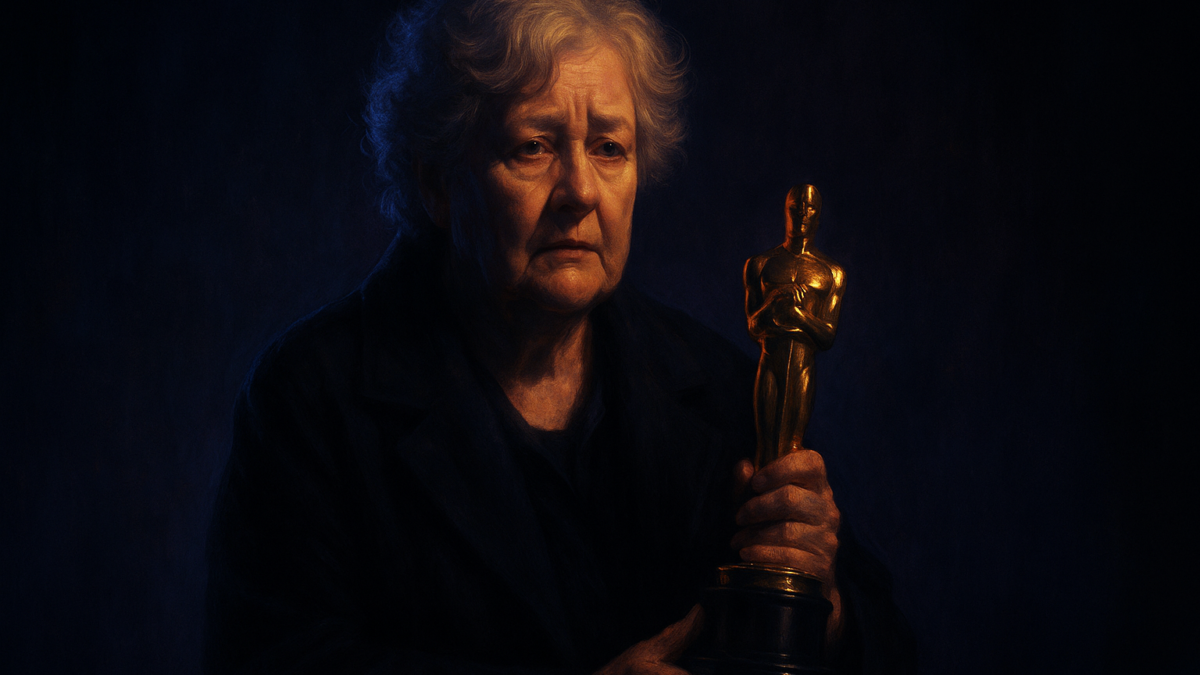
When Fricker won best supporting actress in 1990, she became the first Irish actress to receive an Academy Award. That achievement mattered not only as a personal triumph but as a cultural marker for Ireland, whose actors had long contributed to international film and theater while often working within British or American production systems. Fricker’s victory helped signal that Irish stories, Irish performers and Irish emotional textures could command the attention of Hollywood’s highest institutions.
Fricker’s appeal came from her refusal to soften the edges of the women she portrayed. She often played mothers, nurses, neighbors and survivors, but she approached them as people with contradictions rather than symbols of resilience. Her screen presence suggested a life already lived before the camera found her. That quality made her invaluable to filmmakers seeking credibility, especially in dramas grounded in social hardship or family conflict.
For many viewers outside Ireland, Fricker may also be remembered for a very different role: the “Pigeon Lady” in Home Alone 2: Lost in New York. In that 1992 holiday sequel, she played a lonely woman who befriends Macaulay Culkin’s Kevin McCallister in Central Park. The part introduced her to a younger global audience and showed her range beyond awards-season drama. Even in a studio comedy, she found melancholy and warmth without sentimentality, turning a supporting character into one of the film’s most memorable emotional anchors.
Industry Context
Fricker belonged to a generation of performers who moved fluidly between stage, television and film, building careers less through celebrity machinery than through craft. Before her international breakthrough, she worked extensively in British and Irish television, including a notable run on the medical drama Casualty. That background gave her a grounded naturalism that became central to her film work.
My Left Foot, directed by Jim Sheridan, arrived at a pivotal time for Irish cinema. The film’s success helped open doors for a wave of Irish-centered stories that would gain international traction in the 1990s, including Sheridan’s later work and films by Neil Jordan and others. Fricker’s Oscar win was part of that momentum, demonstrating that films rooted in specific Irish communities could travel globally when anchored by powerful performances.
The Oscar race of 1990 also reflected the Academy’s appetite for serious, performance-driven dramas at the end of the 1980s. Fricker’s win placed her alongside a tradition of supporting-actress honorees who elevated intimate family stories into awards-season events. Yet her career afterward did not follow the conventional Hollywood trajectory of leading roles and franchise visibility. Instead, she continued to take character parts across film and television, including appearances in The Field, So I Married an Axe Murderer, Angels in the Outfield, A Time to Kill and Veronica Guerin.
That path speaks to a larger industry pattern. Character actors, especially women past a certain age, have historically faced narrow casting options even after major awards recognition. Fricker’s career illustrates both the prestige afforded by an Oscar and the limitations of an industry that too often reserves its most expansive opportunities for younger performers or conventional stars. Her work endured because she brought depth to roles that might have been minor in another actor’s hands.
Within Ireland, Fricker’s legacy sits alongside a remarkable lineage of screen talent that includes Maureen O’Hara, Peter O’Toole, Richard Harris, Gabriel Byrne, Fiona Shaw, Saoirse Ronan, Cillian Murphy, Kerry Condon, Barry Keoghan and many others. But her Oscar breakthrough remains historically distinct. Long before the recent surge of Irish actors across awards ballots and global streaming platforms, Fricker had already shown that Irish performers could win at the highest level while retaining an unmistakably local identity.
Her death also comes at a time when the entertainment industry is reassessing the importance of regional authenticity. Audiences increasingly respond to stories that are culturally specific rather than flattened for international consumption. Fricker’s best work anticipated that shift. She did not chase universality by sanding away particularity; she found the universal through accent, gesture, fatigue, faith, anger and humor.
What Happens Next?
In the coming days, tributes are expected from colleagues across Ireland, Britain and Hollywood, particularly from those connected to the Irish film community and to the generation of filmmakers shaped by My Left Foot. Her Oscar-winning performance is likely to receive renewed attention on streaming and repertory platforms, where audiences can revisit the film not only as a showcase for Daniel Day-Lewis but as a two-hander powered by Fricker’s deeply human work.
Institutions in Ireland may also move to formally honor her contribution to the country’s screen heritage. Fricker’s place in film history is secure because of the Academy milestone, but her larger legacy rests in the cumulative impact of performances that treated ordinary women as worthy of extraordinary attention.
For the industry, her passing is a reminder that cinema is often defined by actors who do not dominate posters or box-office campaigns, but who give stories their moral and emotional architecture. Brenda Fricker did that with uncommon honesty. Her work will remain a benchmark for performers who understand that the smallest role, played truthfully, can echo for decades.