
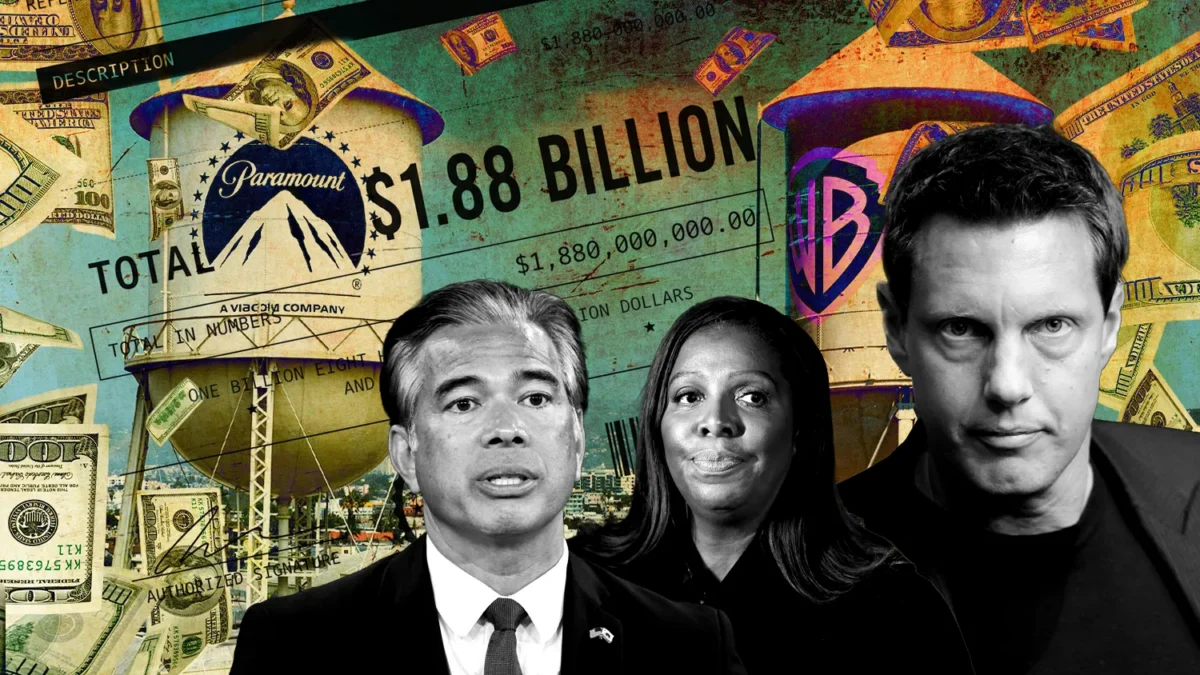
Paramount, Warner Bros. Discovery and attorneys general from 12 blue states have mounted a united defense of the antitrust settlement covering the companies’ proposed $111 billion merger, rejecting Sen. Cory Booker’s argument that the agreement falls short of the states’ original case.
In court filings submitted Monday, the companies and the states urged U.S. District Judge Araceli Martinez-Olguin to approve the proposed consent decree unveiled September 21. Their responses came after Booker, New Jersey’s senior senator, challenged the settlement in a six-page letter dated September 24.
“The fact that a proposed consent decree does not contain every outcome that one party may have wanted in a multilateral negotiation does not make it substantively unfair,” the states said in a court-ordered response signed by Marguerite Sullivan. “This is the very essence of a negotiated agreement that includes compromises on behalf of all of the parties involved.”
The 17-page filing came from California, Massachusetts, Arizona, Colorado, Connecticut, Minnesota, Nevada, New Jersey, New Mexico, New York, Oregon and Washington. The coalition, led by California Attorney General Rob Bonta, described the decree as a reasonable compromise addressing the competitive concerns identified in the states’ complaint.
“And the Decree’s enforcement provisions have teeth,” the attorneys general argued. “Thus, … the Decree meets the applicable standards and it should be entered.”
The states presented a unified position in court despite at least four members of the coalition having serious reservations about the settlement until late in the negotiations. Their filing emphasized that each attorney general had independently concluded that the agreed relief was sufficient to resolve the claims.
“Twelve attorneys general, each accountable to their own electorate, judged this relief to be a fair compromise sufficient to resolve the claims they asserted in the complaint,” the filing said.
Booker Pushes for More Scrutiny
Booker has argued that the proposed remedies should be compared with what the states initially sought: an injunction stopping the merger. His letter requested several measures, including an independent review of the settlement.
“The Court should measure the proposed remedies against the relief the States originally sought: an injunction blocking the merger altogether,” Booker wrote. “The decree does not address the core of the case—that the merger is anticompetitive and will eliminate jobs.”
The senator’s intervention continued his previous criticism of the merger. The proceedings have also attracted longtime opponents of the combination, while Mark Ruffalo has attended hearings connected to the case.
Additional opposition arrived in amicus briefs filed late last week by Block the Merger and the League of United Latin American Citizens. The Monday responses from the companies and the states focused on Booker’s objections rather than those filings.
Booker did not provide a response Monday to the new submissions from Paramount, WBD and the attorneys general.
Companies Cite the Risk of Continued Litigation
Lawyers for Paramount and WBD argued in a separate 16-page filing that the consent decree should not be judged against the assumption that the states would have ultimately secured a permanent injunction. Instead, they said, the court must consider the possibility that continued litigation could have left the states with no relief.
“The adequacy of the decree must therefore be assessed against the risk of continued litigation—including the substantial prospect that Plaintiff States would have recovered nothing at all—rather than against an assumed permanent injunction that Plaintiff States did not obtain,” the companies’ attorneys wrote. They concluded that the relief secured by the states was substantively reasonable.
The parties had hoped Martinez-Olguin would approve the decree last week. But a September 24 proceeding, which replaced a long-scheduled virtual hearing, instead brought renewed opposition and questions about the settlement.
The earlier hearing had been set to address Paramount’s pre-settlement request for a $1.88 billion bond. The company sought the bond to offset what it characterized as “extraordinary losses” that could result from waiting for a March 2027 trial.
The settlement remains in legal limbo as the parties await a decision from the Oakland-based federal judge. The unresolved status carries additional pressure: a $7 million fee to WBD shareholders is set to take effect October 1, while a leaked threat from David Ellison to move headquarters out of California has added another point of tension.
The push to settle has also drawn criticism from parts of the Democratic base directed at Bonta, California Gov. Gavin Newsom, Los Angeles Mayor Karen Bass and others.
What Happens Next?
Martinez-Olguin, who was appointed by Joe Biden, has not indicated when she will decide whether to approve the consent decree. Until she rules, the merger settlement remains unresolved despite the joint effort by Paramount, WBD and all 12 states to establish that the negotiated agreement is fair and enforceable.