
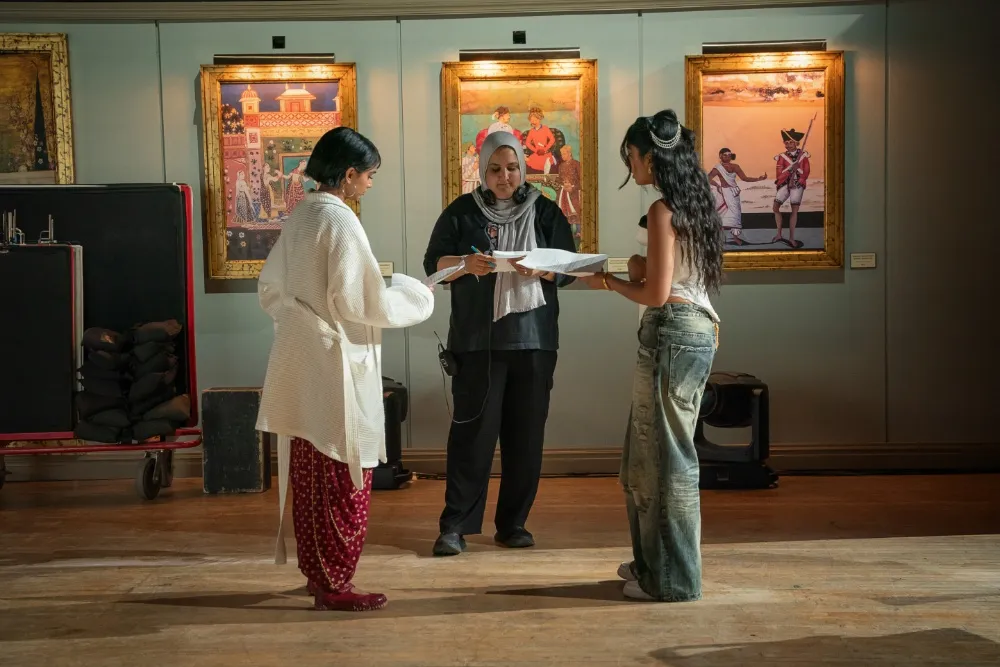
Lena Khan’s “Best of the Best” has arrived on Netflix with a subject that has long had a life on American college campuses but has rarely been centered in a scripted feature: competitive Bollywood fusion dance.
The film follows Maya and Anjali, childhood best friends who join UCLA’s competitive dance team and quickly learn that the path to the U.S. Championship is louder, tougher and more cutthroat than they expected. Written by Hasan Minhaj and Prashanth Venkataramanujam, the movie draws on a world both writers knew personally from growing up around similar competition circuits.
For Khan, the project became more than a campus dance story. The director says an early conversation with a childhood friend helped clarify the larger cultural charge behind the film. When she mentioned the premise, the friend reacted dismissively — “Bollywood competitions, really?” — a response Khan saw as part of a broader issue around how South Asian communities in the diaspora sometimes view their own cultural spaces.
“I think South Asians, especially in the diaspora, are so used to not even having our own self-respect,” Khan says.
That idea informed the confidence she wanted the movie to project. Khan says South Asian audiences are accustomed to respecting the artistry of other cultures, citing kung fu and other arts, while too often seeing themselves represented as “Apu” or “the funny nerdy side characters.” With “Best of the Best,” she wanted to approach the dance world from a place of pride.
“We can be proud of things that we do as South Asians,” she says.
Building a Dance Movie From the Inside
Minhaj and Venkataramanujam brought firsthand experience to the script. Minhaj’s wife danced competitively, while Venkataramanujam performed with an a cappella team called Chai Town, giving him direct knowledge of how all-consuming the competition circuit can become. Khan, for her part, prepared by spending time with UCLA’s own dance team and traveling to North Carolina to observe competitions.
The director also brought lessons from another Netflix project into the film. Khan previously directed episodes of “Never Have I Ever,” an experience that shaped her thinking about representation and ensemble storytelling.
“When you have more than one of a minority character, then there’s suddenly become real characters,” Khan says. “You get to focus on the humanity between them, the things that become relatable to everybody else.”
That approach carried into casting “Best of the Best,” where Khan needed performers who could handle both comedy and emotional weight. Several cast members, including Maitreyi Ramakrishnan, had not danced competitively before being cast. Khan recalls pushing Ramakrishnan to think of the role as a physical transformation as much as a performance.
“I need you to give me some Channing Tatum energy,” Khan says she told her. “And then I was like, no, actually, I need you to do a Christian Bale on me. I need a complete athletic transformation.”
Ramakrishnan went on to complete months of intensive dance training before filming.
One-Day Dance Shoots and a Mix of Styles
The film’s dance sequences were created with choreographers Phillip Chbeeb and Makenzie Dustman, with Joya Kazi credited as co-choreographer. Khan says each number began with a simple creative question: “What is the essence we are trying to bring out in this particular moment?”
The production also faced a compressed schedule. Khan says a typical Bollywood dance sequence might get five days to shoot, while “Best of the Best” often had only one. Within those limitations, the choreography incorporated multiple regional styles, including Kuthu, Bharatanatyam and Pakistani-influenced dance, reflecting the range of identities within the fictional team.
Khan, whose credits include the 2016 independent feature “The Tiger Hunter,” says the industry’s relationship with South Asian stories has changed since that film came out, though she still sees limits. “We still don’t have that many romances or romantic comedies with South Asians,” she says, adding that South Asian men are often not given opportunities to play romantic leads.
In “Best of the Best,” Khan says the film flips another familiar dynamic: “The nerdy minority character is actually a white guy. Like we have a token white guy.”
The director also points to a broader wave of South Asian musicians and actors as part of what helped make the film possible, including Joy Crookes, whose song Khan says she fought to include on the soundtrack. “And now we’re like, well, we’ve really made it when we make a movie that’s just good,” Khan says.
Khan also resisted pressure to over-explain South Asian cultural references for Netflix’s global audience. She says shows such as “Never Have I Ever” had already demonstrated that viewers do not need every detail spelled out. “At some point this country and the world is just full of people in different cultures,” she says.
Working with Minhaj and Venkataramanujam, who are both first-time feature writers, involved frequent creative disagreements, Khan says, but she describes those debates as substantive rather than superficial. “There would be such a thoughtful reason that we were always fighting over why we’re doing a certain thing, but it was never for a vapid reason,” she says. “And they’re also just the most gracious people.”
“Best of the Best” also stars Lilly Singh, Nihar Duvvuri, Nico Greetham, Amryn Khurana, Tanishq Joshi, Saara Chaudry and Sasha Bhasin.
As for what comes next, Khan says she remains interested in projects about overlooked people or subjects, along with a personal passion project already underway. “I’m always on the hunt for that,” she says, describing her search for stories she wishes already existed and ways to bring them to a wide audience.
“Best of the Best” is streaming now on Netflix.