
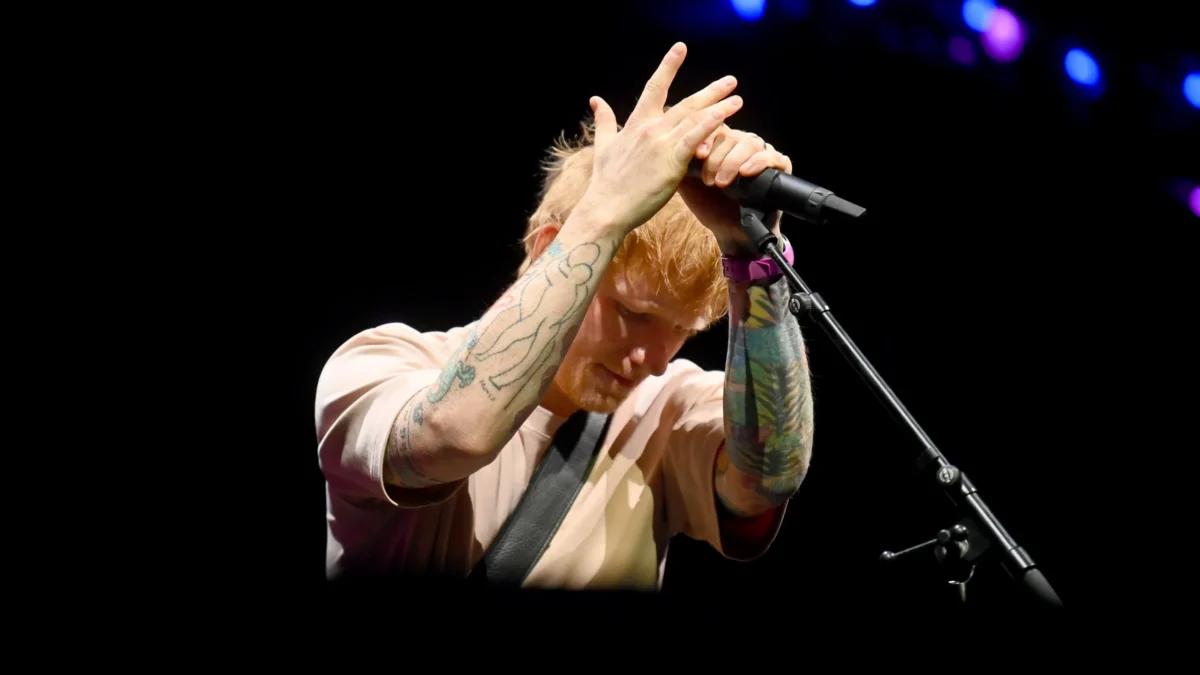
Ed Sheeran’s Philadelphia concert became the latest flashpoint in the controversy surrounding Macklemore’s removal from the tour, but inside Lincoln Financial Field, the reaction was far more muted than the online uproar suggested.
At Saturday night’s 8 p.m. performance, Sheeran addressed the situation from the stage in a four-minute speech near the beginning of the show, reiterating the position he had taken in an online post earlier in the week. Macklemore had been dropped as an opening act following his pro-Palestinian remarks, a decision that has drawn protests and criticism around Sheeran’s tour.
“I’ve had to take and make difficult decisions, and I am making mistakes, and I’m so, so sorry,” Sheeran told the crowd. He said he was “appalled by the conflict between Israel and Palestine,” calling the suffering caused by the war a “human tragedy,” while explaining that he has generally tried to keep his concerts centered on “unity, joy, escapism, love” rather than his own political views.
Later in the show, Sheeran became emotional again, speaking without a teleprompter as he reflected on whether the tour would continue. “I really didn’t know if this tour would be carrying on,” he said through tears. “I really didn’t know whether I’d even be getting on stage again, whether I even wanted to be an artist at all. In these situations, you really find out who your friends are.”
That moment quickly became part of the wider online debate, where critics seized on both the phrasing of Sheeran’s comments and his use of a teleprompter during the earlier remarks. One X user wrote sarcastically, “Everyone fails to consider the important thing about the genocide: Ed Sheeran’s feelings.” Others contrasted Sheeran’s comments with Macklemore’s own statement, in which the rapper wrote, “I am not a victim. Ed Sheeran is not a victim. Pink is not a victim. We have careers, money, opportunities, safety and audiences around the world. Whatever consequences any of us face for what we say, we get to go home to our families. The victims are the Palestinian people.”
Inside the stadium, however, many fans appeared ready to move past the controversy. Kim Shafer, a middle-aged UX designer who drove four hours from Paris, Pennsylvania with two friends, said Sheeran’s remarks affected her emotionally.
“It brought a tear to my eye — I think it was very heartfelt,” Shafer said. “And I think he made his position, where he stands, very clear.”
As “Galway Girl” could be heard from the concourse, Shafer added, “It was very well-spoken. I really appreciated it, and I think a lot of the fans really appreciated it.”
Protest Outside, Calm Inside
Before the concert, pro-Palestinian demonstrators gathered at a nearby corner outside the venue. The protest drew around 100 participants and included organizers from Writers Against the War on Gaza, the Boycott Cooknsolo Coalition and Shut Down Day & Zimmermann.
The demonstration attracted a noticeable media presence, with outlets including CNN, ITV News, Variety and The Hollywood Reporter stationed outside the NRG train station. But the protest itself remained relatively small. Only a handful of passing cars honked in support along the quiet road, and speakers using megaphones addressed the modest crowd, many of whom wore masks and patterned keffiyehs.
“We heard about it, but it made no difference,” a Lincoln Financial Field security guard said of the planned protest.
Another security guard inside the venue described the backlash as an “attempted cancellation” of Sheeran and argued that blame was being unfairly placed on the singer. The guard said it was the promoters, not Sheeran, who dropped Macklemore from the tour. “Shame on them!” the guard said of the protesters. “It’s entertainment, not politics.”
That sentiment echoed the mood among a number of concertgoers. Asked about Sheeran’s speech, one woman seated near concessions replied, “Nope!,” while her friend said, “I’m just here for the music.”
Younger attendees were more cautious. One high school-aged girl in a denim skirt and cowboy boots said she “really doesn’t follow politics,” while a teenage boy said he didn’t “feel educated enough” to comment.
Some fans did have reservations. Two Boomer-aged sisters in matching denim outfits said they had been “on the fence for a while” before deciding to attend. “There’s a time and place for political speech, and nothing’s gonna change [whether] I go to the concert or not,” one said. The other quickly added, “I’m for freedom of speech, by the way!”
Sheeran Points to Ticket Sales
Onstage, Sheeran said that ticket activity helped convince him to keep the tour moving despite calls to cancel remaining dates. “In the back of my mind, I saw the ticket sales and I didn’t see the cancellations,” he told the audience. “Everyone’s telling me to cancel and I’m feeling all of my friends and family and people I know abandon me — and I look at the end of the week, and I see 50,000 people who haven’t abandoned me.”
The stadium appeared nearly packed, though two large sections were completely empty, with ticketholders apparently relocated to consolidate the crowd. One $90 ticket purchased Thursday was upgraded to a better seat the morning of the show. While many attendees paid upward of $250 for seats, tickets were available for as little as $66 on Saturday morning and had dropped to $44 shortly before showtime.
By the end of the two-and-a-half-hour concert, the atmosphere inside Lincoln Financial Field reflected the kind of “unity, joy, escapism [and] love” Sheeran said he wanted his shows to provide. Fans left the concourse upbeat, even as the debate outside the stadium — and online — showed no sign of quieting.