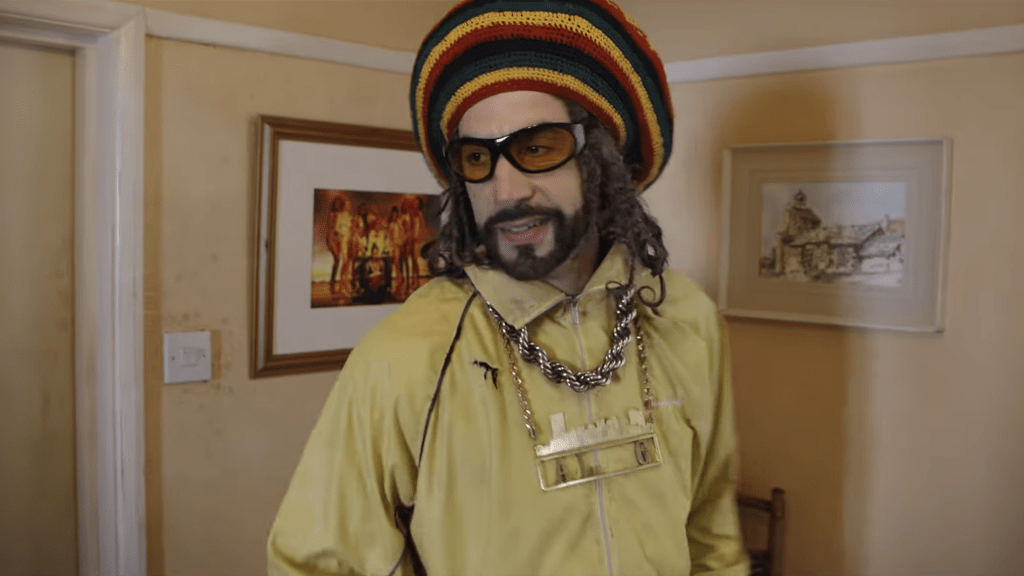
The trailer for Sacha Baron Cohen’s upcoming Ali G: Who Iz I? has triggered a fresh wave of criticism, with some social media users calling for audiences to avoid theaters that book the film.
🎬 Watch the Trailer
The preview, built around Cohen’s long-running faux interviewer character Ali G, quickly became a flashpoint after its release, reviving a debate that has followed the comedian for years: whether the character functions as sharp satire of ignorance and cultural appropriation, or whether the act now lands as an outdated caricature that major distributors should not be reviving for a theatrical audience.
Within hours of the trailer circulating online, detractors began posting boycott messages aimed not only at the film but also at exhibitors that may screen it. The criticism has centered on the character’s exaggerated accent, streetwear persona and hip-hop-inflected slang — elements that were central to Ali G’s original comic identity when Cohen introduced him on British television in the late 1990s.
Supporters of Cohen have countered that Ali G was never designed as a joke at the expense of the communities he imitates, but rather as a satire of privileged, suburban cluelessness and performative masculinity. That defense has long been part of the character’s history. But the response to the new trailer suggests that a portion of the potential audience is no longer willing to separate the satirical target from the method used to reach it.
Representatives for Cohen and the film’s release team did not immediately respond to requests for comment.
A character from another comedy era
Ali G first emerged as one of Cohen’s breakout creations before the comedian became an international name with Borat, Brüno and a run of high-profile film and television projects built around undercover performance. The character’s format typically placed an absurdly uninformed interviewer opposite politicians, academics, public figures and celebrities, allowing Cohen to expose vanity, prejudice or confusion in his subjects.
At the height of Ali G’s popularity, the act was widely discussed as a disruptive form of prank comedy. Cohen’s skill was in staying in character while drawing unguarded reactions from people who often did not realize they were participating in a bit. The comedy depended on discomfort, and for many viewers, that discomfort was the point.
But the cultural conversation around representation, racial mimicry and who gets to perform certain identities has shifted significantly since Ali G’s peak. What could once be broadly marketed as anarchic satire is now being reexamined through a more skeptical lens, especially when older characters are repackaged for new platforms and younger audiences.
That generational divide appears to be fueling the latest backlash. Some longtime fans view the trailer as a nostalgic return to Cohen’s most influential material. Others see it as a studio-backed attempt to revive a persona whose comic tools feel increasingly difficult to justify.
Why the backlash matters
The reaction to Ali G: Who Iz I? arrives at a moment when the film business is leaning heavily on recognizable names, legacy properties and pre-sold awareness. Comedy, in particular, has struggled theatrically in recent years, with many mid-budget titles moving to streaming and studios becoming more cautious about original theatrical releases.
Cohen remains one of the few comedy figures whose name can still generate global attention. His work has also generated controversy by design. Borat Subsequent Moviefilm became a major streaming event in 2020, in part because of the political conversation surrounding it. Earlier projects similarly blurred the line between performance, provocation and public spectacle.
That history is precisely why the response to the new trailer is being watched closely. The controversy could raise awareness and curiosity around the film, but it could also complicate marketing if the campaign becomes defined by questions over whether the character should have returned at all.
For theater owners, boycott calls create a more delicate calculation. Exhibitors are still trying to rebuild consistent attendance across a marketplace dominated by franchise tentpoles, horror hits and premium-format spectacles. A buzzy comedy with a known star can be valuable counterprogramming. But theaters are also increasingly sensitive to online campaigns that can frame a booking decision as a cultural statement.
In practice, social media boycotts do not always translate into measurable box office damage. Many flare quickly and fade before opening weekend. Still, they can influence publicity, force distributors to adjust messaging and shape the tone of interviews and promotional appearances. For a film built around comedy, that matters: once a campaign becomes defensive, it can be harder to sell the audience on fun.
The satire question
The central challenge for Ali G: Who Iz I? is whether it can make a persuasive case for the character’s relevance in 2026. If the film simply replays familiar beats, critics may argue that it is trading on nostalgia while ignoring the reasons the material has become contentious. If it reframes Ali G with sharper self-awareness, it may find a way to engage with the debate rather than be overwhelmed by it.
Cohen’s best-known work has often relied on implicating the audience as much as the subjects on camera. The question now is whether viewers will see Ali G as part of that tradition, or as a relic being revived without enough evolution.
The answer could have implications beyond one release. Studios and streamers routinely mine older comedy brands for new projects, but the Ali G response underscores a broader reality: familiar intellectual property is not automatically safer when the cultural meaning of that property has changed.
What Happens Next
The next phase will depend on how Cohen and the film’s backers respond. They could lean into the controversy, positioning the movie as a deliberately provocative return. They could also pivot toward explaining the satire more directly, emphasizing the character’s original target and the film’s broader purpose.
Exhibitors, meanwhile, are likely to monitor the intensity of the boycott calls before making any public moves. Unless pressure grows beyond social media, widespread cancellations appear unlikely.
For now, Ali G: Who Iz I? has accomplished one thing Hollywood always wants from a trailer: it has people talking. Whether that conversation helps sell tickets or hardens opposition will become clearer as the release campaign moves forward.