
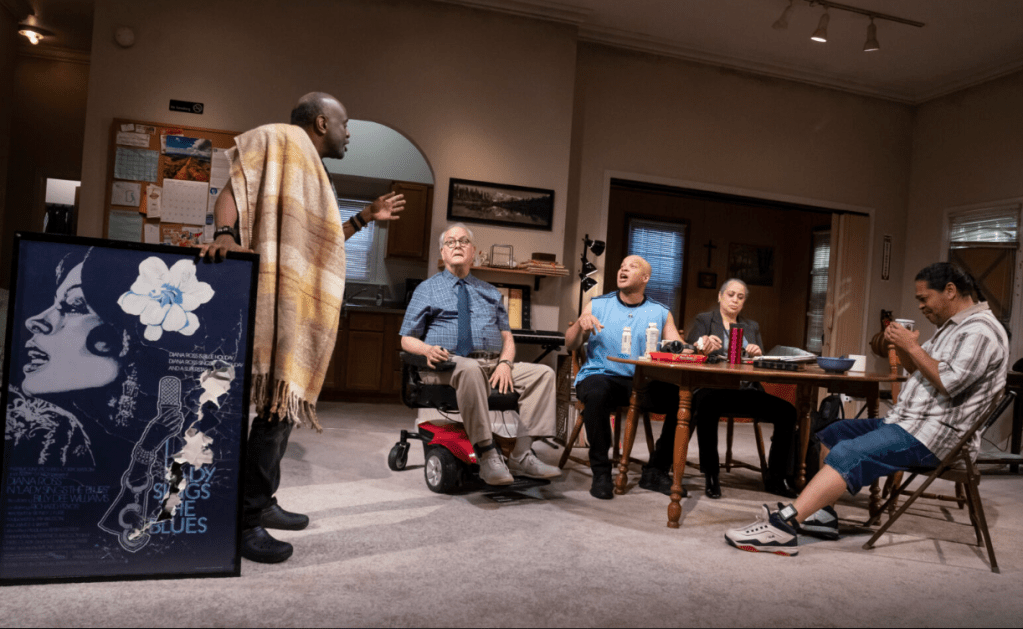
Downstate, Bruce Norris’ acclaimed and provocative drama about men living in a group home after serving sentences for sex crimes, appears headed to Broadway, with new signage at the Booth Theatre indicating that Joe Mantello will direct the production.
The marquee display, spotted at the Shubert-owned venue, effectively confirms weeks of industry chatter that the play was being positioned for a Broadway run. Formal details — including dates, cast, producers and ticketing information — have not yet been announced, but the Booth’s exterior advertising strongly suggests that an official rollout is imminent.
The move brings one of the most debated American plays of the past decade to the commercial theater arena, where challenging dramas can either become defining cultural events or face the harsh realities of a market increasingly dependent on star casting, brand recognition and limited-run urgency.
Norris, who won the Pulitzer Prize and Tony Award for Clybourne Park, has long specialized in theater that makes audiences uncomfortable without offering easy moral exit ramps. Downstate may be his most divisive work. The play takes place in a halfway house in downstate Illinois, where residents attempt to live under intense legal restrictions, social isolation and the permanent stigma of their crimes. Its central dramatic tension arrives when a man confronts one of the residents over abuse he says destroyed his childhood.
That premise has made the play both a magnet for critical attention and a flashpoint for debate. Admirers have praised its theatrical nerve, its refusal to flatten characters into symbols and its willingness to ask what punishment looks like after prison. Critics and some audience members have questioned whether the play risks extending empathy in a way that can feel destabilizing or even offensive, particularly to survivors of abuse.
On Broadway, that tension is not incidental to the sale — it is the story.
A risky play in a cautious market
The Broadway ecosystem has become increasingly bifurcated. On one end are major musicals and revivals with built-in awareness; on the other are tightly framed limited engagements built around major stars. Serious new plays without household-name performers remain a difficult proposition, even when the pedigree is strong.
Downstate enters that landscape with a different kind of commercial hook: controversy, critical reputation and the involvement of Mantello, one of Broadway’s most respected directors. Mantello’s résumé spans large-scale commercial juggernauts such as Wicked and rigorously acted dramas and revivals. His attachment signals that the Broadway staging is being treated not as a simple transfer, but as a major theatrical event requiring precise tonal control.
That control will matter. Downstate is not the sort of drama that can survive on provocation alone. Its power depends on the balance between argument and observation, between discomfort and dramatic credibility. A Broadway staging will need to manage not only what happens onstage, but also how the production is framed for audiences before they enter the theater.
The Booth Theatre is an especially intriguing home for the piece. One of Broadway’s more intimate houses, it has often been used for plays that benefit from close audience attention rather than spectacle. For a work like Downstate, that intimacy could intensify the moral pressure of the evening, putting spectators in uncomfortably close proximity to characters many might prefer to keep at a distance.
Why the move matters
A Broadway production of Downstate would mark a significant moment for contemporary American drama at a time when many producers are weighing how much risk audiences will tolerate. The play has already been tested in major nonprofit environments, including highly visible stagings that helped establish its reputation as a work critics and theatergoers could not easily ignore.
Bringing it to Broadway raises the stakes. The commercial stage amplifies conversation, expands visibility and invites a broader audience than the nonprofit circuit typically reaches. It also places the play under sharper financial and cultural scrutiny. In an era when productions are quickly measured by weekly grosses, social-media reaction and awards momentum, Downstate is likely to become more than a theatrical offering; it could become a public argument.
For Norris, the Broadway staging would also reaffirm his position as one of the few American playwrights whose original work can still command serious commercial attention. Since Clybourne Park, he has remained a writer associated with sharp social critique and an often merciless view of polite liberal assumptions. Downstate fits within that body of work while pushing into even more volatile territory.
For Mantello, the project offers a different kind of challenge from the high-polish musical and revival work with which many Broadway audiences associate him. The director’s task will be to keep the production from tipping into either sensationalism or advocacy, allowing the play’s difficult questions to remain active rather than resolved.
Industry observers will also be watching casting closely. A play this charged will depend on performers capable of earning the audience’s attention without asking for automatic sympathy. The right ensemble could make the production a major awards-season contender; the wrong tonal approach could make it a target before previews even begin.
What Happens Next
An official announcement is expected to clarify the production timeline, creative team, casting and first preview date. If the Booth marquee is any indication, the producers are preparing to move quickly from rumor to rollout.
Once details are confirmed, attention will shift to how the show is marketed, whether it arrives with notable names attached and how Broadway audiences respond to a play designed to provoke serious discomfort. Downstate is not arriving as escapism. It is arriving as a test — of the market, of audience appetite and of Broadway’s willingness to make room for difficult new drama.