
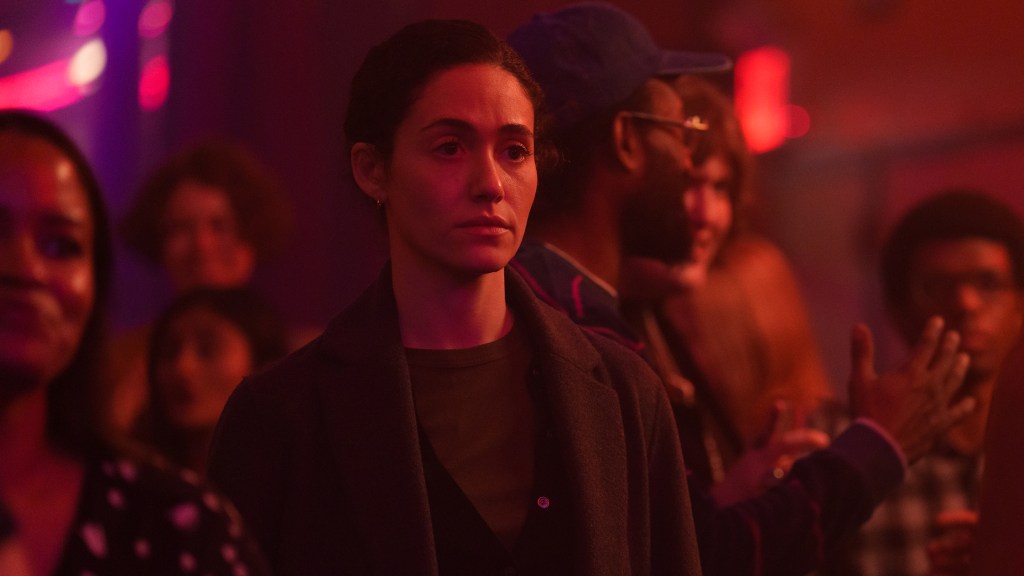
Furious closed its first season by giving viewers a measure of resolution in one character’s long pursuit of justice, while leaving enough emotional and narrative space for creator Liz Meriwether and star Emmy Rossum to imagine a broader second chapter.
The finale, which has become a flashpoint for viewers invested in the show’s depiction of trafficking survivors, does not treat closure as a clean finish line. Instead, the episode positions justice as something more complicated: part legal reckoning, part personal reclamation and part ongoing recovery. That approach has helped distinguish the series from more conventional crime dramas, where a verdict or arrest often functions as the end of the story.
Rossum, whose performance has anchored much of the season’s emotional weight, has been central to that balance. Her character’s arc has required the show to dramatize trauma without reducing a survivor to trauma alone. Across the season, Furious has focused as much on the aftermath — relationships, distrust, anger, resilience and the bureaucratic barriers survivors face — as it has on the events that set the story in motion.
Meriwether, best known for bringing a sharply observed character sensibility to projects including New Girl and The Dropout, has steered Furious into darker territory without abandoning her interest in human behavior under pressure. The result is a series that blends elements of thriller, courtroom drama and character study, while asking viewers to sit with the reality that justice systems rarely move at the pace survivors need.
A Finale Built Around Complicated Closure
The season’s final episode provides an answer to the central question that has driven one character’s search for accountability, but it avoids the easy catharsis of a simple triumph. That choice matters. Stories about trafficking can often fall into sensationalism, leaning on shock value or rescue fantasies. Furious has instead framed survival as an ongoing process, one that continues long after a case file is closed.
For Rossum, the material sits in the kind of demanding dramatic lane she has increasingly embraced in recent years. Following her long run on Shameless and her transformation in Angelyne, she has gravitated toward women whose public narratives clash with private wounds. Furious gives her another layered role: someone navigating fear, rage and agency without being defined by victimhood.
The finale also leaves the show with a strategic advantage if it moves forward. By resolving a major season-one thread, Meriwether avoids the frustration of a cliffhanger that withholds emotional payoff. At the same time, the series has established a world large enough to continue — one filled with advocates, investigators, survivors, institutions and unresolved moral questions.
Why This Story Resonates
Furious arrives at a moment when television is reassessing how it tells stories about crime, abuse and exploitation. Audiences remain drawn to high-stakes dramas, but there is growing scrutiny around whose perspective is centered and whether the entertainment value comes at the expense of people who have lived through similar experiences.
That scrutiny has reshaped the landscape for limited series and prestige thrillers. Networks and streamers increasingly court creative teams that can bring sensitivity and specificity to difficult subject matter, often involving consultants, advocates or survivor-informed research. While those practices do not guarantee a responsible portrayal, they reflect a broader industry awareness that trauma cannot simply be used as a plot engine.
For a show like Furious, the challenge is particularly delicate. Trafficking narratives carry political, social and cultural weight, and they are frequently distorted in popular media. A series that attempts to place survivors at the center of the story must navigate public misconceptions while still delivering the momentum expected from a serialized drama.
That is where Meriwether’s background becomes notable. Her work has often been driven by character chemistry and emotional contradiction rather than procedural mechanics. In Furious, that sensibility helps prevent the show from becoming a case-of-the-week vehicle. The mystery matters, but the characters’ interior lives matter more.
The Season 2 Question
No formal second-season announcement has been made, but the creative direction appears open. Rossum and Meriwether have both indicated there is more story to explore, particularly if the series expands beyond one character’s quest and examines the network of people affected by exploitation and the systems built to confront it.
A potential second season could deepen the show’s ensemble, shifting focus to other survivors or advocates while keeping Rossum’s character connected to the emotional core. That model would allow Furious to evolve without undoing the closure achieved in the finale. It could also position the series as an anthology-adjacent drama: not a complete reset, but a widening lens.
From a business standpoint, that flexibility is valuable. Streamers and cable networks are increasingly cautious about renewals, especially for dramas that require significant production investment and careful marketing. A show with a strong lead performance, a socially relevant subject and a finale that generates conversation has a clearer case to continue — provided audience completion rates and critical response support it.
The industry has also seen renewed appetite for star-driven limited or limited-plus series, where a season can stand on its own while leaving room for continuation. That format gives platforms the ability to promote prestige storytelling without locking themselves into an open-ended commitment. Furious fits neatly into that evolving category.
What Happens Next
The immediate question is whether the platform behind Furious will move forward with a renewal and how quickly Meriwether’s team can shape a second-season premise. If the show returns, expect the creative conversation to center on expansion rather than repetition: new cases, new survivor perspectives and a deeper look at the institutions that determine who gets believed and who gets justice.
Rossum’s continued involvement would likely be key to maintaining the show’s identity, even if the narrative broadens. Her performance has given Furious its emotional center, and her character’s next step could become one of the most compelling questions of a second season.
For now, the finale leaves the series in a strong position: resolved enough to satisfy viewers, unresolved enough to continue, and timely enough to remain part of the larger conversation about how television depicts survival, accountability and the cost of being heard.