
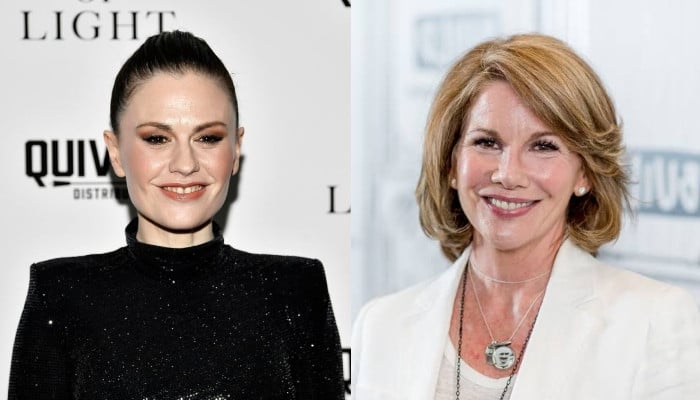
Anna Paquin is using a moment of public grief to press Hollywood on a question it has avoided for decades: what happens to girls who are made famous before they are old enough to understand the machinery around them?
The Oscar-winning actor addressed the issue in an Instagram post shared Friday, Aug. 21, following the death of Hayden Panettiere, whose career began in childhood and later unfolded under intense public scrutiny. Paquin, who became an Academy Award winner at 11 for Jane Campion’s The Piano, wrote that the industry’s treatment of young female performers has left a trail of damage too visible to ignore.
“It’s not a coincidence that so many former, specifically presexualized female, child ‘stars’ have profoundly sad lives,” Paquin wrote, framing the issue not as a string of individual tragedies but as a systemic failure.
Melissa Gilbert, another actor whose childhood was spent in front of cameras, also weighed in, adding her voice to a growing conversation among former young performers about the entertainment business’ responsibilities. Gilbert, who became famous as Laura Ingalls on Little House on the Prairie, has long spoken about the emotional toll of growing up on a set and in the public eye.
The comments from Paquin and Gilbert arrive at a moment when Hollywood is once again being forced to reckon with the cost of child stardom — particularly for girls who were expected to be marketable, composed and emotionally resilient while still developing a sense of identity away from work.
Panettiere’s career began before kindergarten, with commercials and soap work leading to film and television roles that made her one of the most recognizable young actors of her generation. She later broke through to a wider audience with Remember the Titans, Heroes and Nashville, becoming a familiar presence in both family entertainment and adult-skewing drama. Along the way, her personal life was repeatedly treated as public property, including her struggles with postpartum depression, addiction and family loss.
For Paquin, the issue is not simply fame at a young age. It is the specific experience of girls being evaluated, styled, marketed and discussed in ways that often blur the line between youth and adult desirability. That dynamic has been a recurring point of criticism from former child actors, many of whom have described being asked to perform maturity before they were emotionally equipped to process the consequences.
A long-running industry problem
Hollywood has always depended on child performers, but the protections around them have historically focused more on work hours, schooling and finances than psychological safety. The Coogan Law, created after silent-film child star Jackie Coogan’s earnings were mishandled, was a landmark for financial protection. But the law did not answer deeper questions about emotional exploitation, media exposure, sexualized image-making or the pressure to support entire productions while still legally a minor.
Those concerns have gained renewed attention in recent years as actors who grew up on studio lots, network sitcoms, teen dramas and children’s cable shows have described environments where boundaries were inconsistent and adults held extraordinary power. The rise of social media has made the situation more complicated. Young performers today are not only watched on screen; they are expected to maintain public personas, respond to fans and absorb criticism in real time.
Paquin’s remarks are notable because she is not speaking from the outside. Her own childhood success was meteoric, and unlike many child stars, she transitioned into a long adult career that includes X-Men, True Blood and numerous independent films. That longevity gives her comments additional weight: she is not arguing that early success always prevents professional survival, but that survival should not be the standard by which the industry judges its conduct.
Gilbert’s participation adds a generational layer to the conversation. Her rise came in the network-television era, when a young actor could become part of the weekly fabric of American family life. Paquin came up in the prestige-film and franchise era. Panettiere came of age as tabloid culture intensified and the internet began flattening the distance between celebrity and audience. Together, their experiences trace a pattern across decades rather than a problem confined to one studio, one show or one era.
Why this moment matters
The entertainment industry is currently in a period of institutional self-examination, though often reluctantly. Conversations about workplace safety, intimacy coordination, mental-health resources and power imbalances have become more common in production circles. Yet child performers remain a uniquely vulnerable group because their parents, managers, agents, studios and networks may all have competing incentives.
A young actor can be the emotional center of a project, a marketing asset and a family breadwinner before reaching adulthood. When that performer is female, the pressure often expands to appearance, likability and perceived maturity. The result, critics argue, is an industry that benefits from youthful charisma while frequently failing to provide a stable path into adulthood.
Panettiere’s public life had already become part of a broader conversation about how audiences consume the pain of former child stars. Her candor about mental health made her a sympathetic figure to many fans, but it also placed deeply personal struggles into the same media ecosystem that had profited from her image since childhood. Paquin’s post suggests that sympathy after the fact is not enough.
The business stakes are also significant. Studios, streamers and networks continue to build projects around young talent, from coming-of-age dramas to franchise origin stories and youth-skewing streaming hits. As the industry competes for younger audiences, it also needs to demonstrate that its treatment of young performers has evolved beyond compliance checklists.
That may mean stronger on-set mental-health support, clearer boundaries around publicity, age-appropriate media training, limits on sexualized styling and photography, and independent advocates who are not financially tied to a production’s success. It may also require a cultural shift among fans and press outlets that have historically treated young female celebrities as public commodities.
Paquin and Gilbert’s comments are unlikely to be the final word. But they sharpen a question Hollywood can no longer sidestep: if so many former child stars describe similar wounds, the industry cannot keep treating each story as an isolated exception.
What Happens Next
Expect the conversation to move beyond social media in the coming days, particularly among actors, child-performer advocates and industry guild members. Paquin’s post has already reframed the discussion around responsibility rather than nostalgia, and Gilbert’s response underscores that the issue spans generations. Whether studios and networks answer with concrete policy changes remains to be seen, but the pressure for Hollywood to better protect its youngest performers is growing louder — and more difficult to dismiss.