
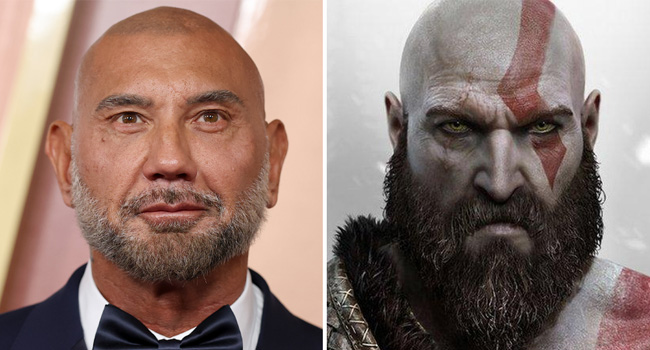
Dave Bautista is taking on the role of Kratos in Prime Video’s live-action adaptation of God of War, stepping into one of the most closely watched parts in the current wave of video game-to-television projects.
The casting marks a significant change for the Amazon MGM Studios series, which had previously moved forward with Ryan Hurst as the Ghost of Sparta. Hurst, who was cast in January, suffered a serious bicep tear during rehearsals, an injury that required surgery and a lengthy recovery window. Rather than delay production for an extended period, the studio and producers moved to recast the lead role.
For Bautista, the part represents one of the most physically imposing and emotionally demanding roles of his post-wrestling acting career. The former WWE champion has steadily built a reputation as one of the more selective and ambitious performers to emerge from sports entertainment, balancing blockbuster work in Guardians of the Galaxy, Dune and Blade Runner 2049 with smaller, character-driven projects that have showcased his range beyond action spectacle.
Kratos, however, is not just another warrior role. In the God of War franchise, the character is a brutal former Spartan haunted by grief, rage and the consequences of his own violence. The modern era of the games, beginning with the acclaimed 2018 installment, reframed him as a widowed father trying to raise his son, Atreus, while suppressing the monstrous parts of his past. That evolution has made Kratos one of gaming’s most recognizable antiheroes and one of the most challenging figures to translate into live action.
Bautista’s casting is likely to be received as a statement of intent. He brings the physical scale audiences associate with the character, but his more recent screen work has leaned into restraint, vulnerability and wounded authority — qualities that are essential if the series follows the emotional blueprint of the PlayStation games rather than treating the property as a conventional sword-and-monster adventure.
A high-stakes adaptation
God of War has been considered one of Prime Video’s major genre swings since the streamer began developing the series with Sony Pictures Television and PlayStation Productions. The property arrives with built-in global awareness, a deeply loyal fan base and the kind of mythological world-building that streaming platforms have increasingly pursued in the hunt for long-running franchise television.
The timing is no accident. Hollywood’s relationship with video game adaptations has changed dramatically over the last several years. Once treated as risky material with a poor track record, game-based film and television has become a major growth area following the success of projects such as HBO’s The Last of Us, Prime Video’s Fallout and Universal’s The Super Mario Bros. Movie. Studios no longer see games simply as recognizable intellectual property; they see them as expansive story engines with established mythology, emotional stakes and audiences accustomed to serialized storytelling.
That shift raises expectations for God of War. Fans will be watching not only for fidelity to the games’ visual language, but for whether the series can capture the quieter father-son dynamic that gave the later entries their dramatic weight. The relationship between Kratos and Atreus is central to why the franchise broadened beyond action spectacle and earned mainstream critical acclaim.
Bautista’s arrival also gives Prime Video a proven genre name at a moment when streaming services are under pressure to justify the cost of large-scale fantasy and action dramas. A series like God of War requires elaborate production design, stunt work, visual effects and long-term planning. Its success or failure could influence how aggressively Amazon continues to pursue premium adaptations of major gaming titles.
The recasting challenge
Replacing a lead actor so close to production is never simple, particularly on a series built around a character as physically specific as Kratos. Hurst’s departure was driven by injury rather than creative issues, making the transition unusually delicate. Production teams now must recalibrate fight choreography, costume fittings, rehearsal schedules and possibly the rhythm of scenes built around the original casting.
Still, Bautista’s background may help accelerate that process. His years in professional wrestling gave him extensive experience with physical performance, fight timing and character presentation in front of a live audience. More importantly, his film career has shown a willingness to disappear into ensemble-driven projects rather than dominate them through star persona alone.
That matters for God of War, because Kratos is not a role that can function on physique alone. The character’s silence, simmering anger and emotional repression are as important as the combat. The best version of the series will depend on whether viewers believe in Kratos as both a destroyer of gods and a father terrified of passing his damage on to his child.
For Prime Video, the casting gives the show a fresh burst of momentum after an unexpected setback. It also provides a clear marketing hook: Bautista, an actor with action credibility and fan goodwill, taking on one of PlayStation’s most iconic characters.
What Happens Next
Production is expected to adjust its schedule around Bautista’s onboarding, with stunt rehearsals, costume work and camera tests likely to become the immediate priority. The studio will also need to finalize how much of the early production material, if any, can be retained following the casting change.
The next major announcements are expected to center on the supporting cast, including the actor playing Atreus, as well as confirmation of the series’ creative team and filming timeline. Given the scale of the project, Prime Video is unlikely to rush its first public look until the show’s visual identity is firmly in place.
For now, Bautista’s move into Midgard gives God of War the kind of headline casting that can reset conversation around the series. The bigger test will come later: whether the adaptation can turn a beloved game into a television drama with the emotional force, mythic scope and brutal intimacy that made Kratos endure in the first place.