
FEATURED ENTERTAINER OF THE WEEK
Xulfi
Music producer, composer, guitarist, songwriter and music curator
July 11, 2026
Xulfi turns Pakistan into a global music collaboration hub
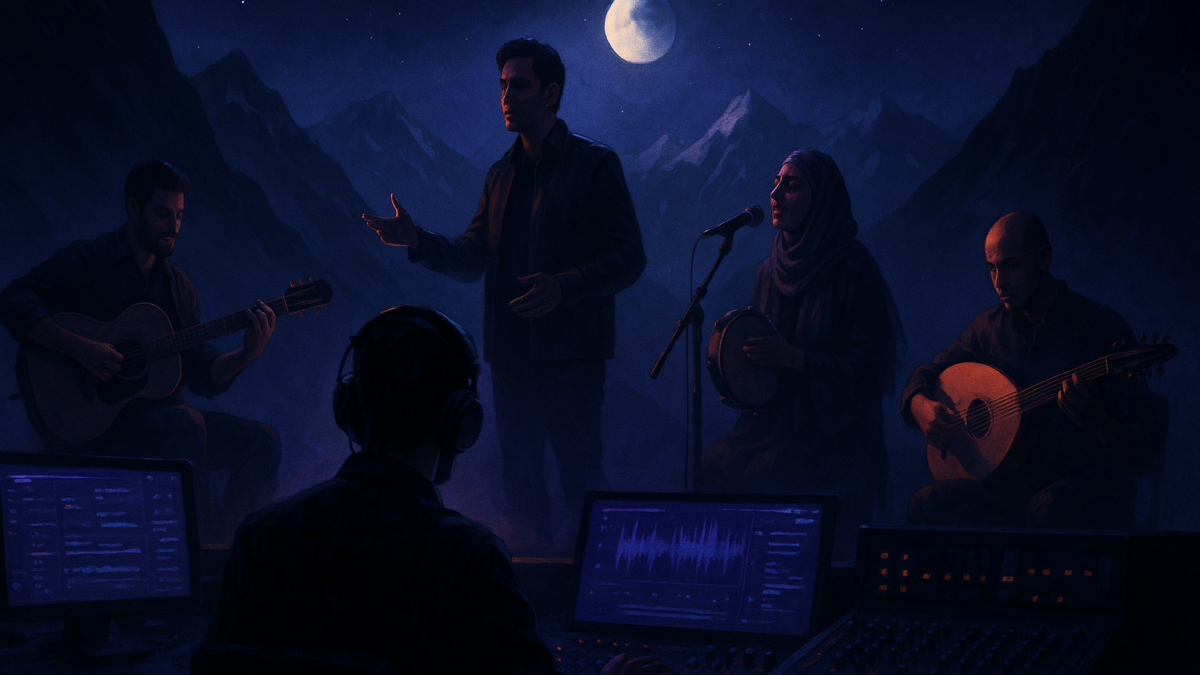
Xulfi’s most revealing instrument may not be the guitar he first became known for, or even the studio console that now carries his signature. It is his instinct for placing musicians in a room and making the room matter. In Pakistan’s modern pop history, Zulfiqar Jabbar Khan, known to listeners simply as Xulfi, has moved from rock-band insurgent to one of the country’s most influential architects of collaboration. This week, that instinct has led him to Humnava, a project that brings musicians from North Africa and beyond into the mountains of Hunza, turning a spectacular Pakistani landscape into a meeting ground for sound, language and shared musical memory. The reason Xulfi matters now is not just that he is producing another music project. It is that he has spent years preparing Pakistani music for exactly this moment. Long before the word global became a streaming-era slogan, he was building bridges: between rock and folk, between young unknown players and household names, between regional languages and international playlists. His work on Nescafe Basement made rehearsal-room talent feel cinematic. His stewardship of Coke Studio Pakistan Season 14 helped create a new grammar for the country’s music television, where songs such as Pasoori, Kana Yaari, Tu Jhoom and Peechay Hutt did not sound like museum pieces or market research. They sounded alive, risky and emotionally immediate. Humnava feels like the next turn in that story. It takes Xulfi’s long-running belief in collaboration and removes it from the familiar studio frame, placing Pakistani music in conversation with artists arriving from other musical geographies. For an entertainer whose career began in the charged atmosphere of Pakistani rock, it is a striking evolution: the guitarist who once helped define a youth movement is now helping define how Pakistan hears, presents and shares itself with the world.
Quick Facts
| Born | 28 October 1980 |
| Birthplace | Lahore, Pakistan |
| Nationality | Pakistani |
| Years Active | Mid-1990s-present |
| Residence | Lahore, Pakistan |
Early Life
Xulfi grew up in Lahore, a city whose musical identity is unusually layered: classical traditions, film songs, qawwali, college rock, underground gigs and the constant hum of a culture that treats music as both inheritance and argument. He came of age during a period when Pakistani pop and rock were becoming visible to a generation that wanted its own sound. The 1990s and early 2000s produced bands that could play to university crowds, appear on television and still carry a sense of rebellion. Xulfi entered that environment not as a polished industry insider but as a musician formed by band culture, where ideas are tested loudly and arrangements are argued into shape. That background matters because it explains much of his later production style. He has never sounded like someone who sees musicians as interchangeable session players. Whether working with a star vocalist, a folk performer or a teenager holding a guitar in a television studio, he tends to foreground the personality of the performer. His early years in Lahore’s music circles also gave him fluency in two languages that would define his career: the emotional directness of pop and the structural discipline of rock. The producer he became was built out of both.
Career
Xulfi first became widely visible through Pakistan’s alternative-rock scene, particularly as a founding figure in the bands Entity Paradigm and Call. Entity Paradigm, often shortened to EP, emerged from the early-2000s band explosion that gave Pakistani youth culture one of its loudest eras. The group’s appearance on Pepsi Battle of the Bands introduced them to a national audience and placed them among the defining names of that moment. EP’s music had the urgency of young musicians trying to stretch the limits of mainstream Pakistani sound: heavy guitars, restless arrangements and a mood that felt distinctly urban. For Xulfi, it was a public education in scale. A song was no longer only something built in rehearsal; it had to survive television, live performance, fan expectation and the strange speed with which a band can become a symbol. Call gave him another chapter. With songs such as Laree Chootee and Dhadke Jiya finding space across the border in Indian films, the band reached listeners far beyond the Pakistani rock circuit. Those songs were important not simply because they travelled, but because they showed how Pakistani bands could cross into South Asian popular culture without sanding away their identity. Xulfi’s time in bands remains essential to understanding his production career. He knows the thrill of a chorus that lands, the vulnerability of a vocalist, the practical tension between ambition and budget, and the way a song changes when it meets an audience. The shift from front-facing musician to behind-the-scenes architect did not feel like a retreat. It felt like an expansion. His most influential platform before Coke Studio was Nescafe Basement, where he served as producer and mentor. The show became known for giving young musicians a national stage and for treating covers, medleys and ensemble performances with unusual seriousness. Xulfi did not present the participants as novelty discoveries. He arranged around them, pushed them toward precision and gave them the visual and sonic scale that young talent rarely receives. For many viewers, Nescafe Basement became a place to encounter the next generation of Pakistani musicians before the mainstream had fully noticed them. It also sharpened Xulfi’s reputation as a talent spotter with a producer’s patience. Then came Coke Studio Pakistan Season 14 in 2022, the project that transformed him from respected producer into a globally discussed creative force. Coke Studio was already an institution when he took the reins, with a legacy built by earlier producers who had turned it into one of Pakistan’s most important cultural exports. Xulfi’s challenge was not to prove the platform mattered; it was to make it feel new. His solution was bold. Season 14 leaned into original songwriting, high-concept videos, regional languages, cinematic sound design and collaborations that felt engineered for emotional surprise rather than polite fusion. Tu Jhoom brought Abida Parveen and Naseebo Lal together in a performance that felt both spiritual and human-sized. Kana Yaari placed Balochi expression at the center of the national pop conversation. Peechay Hutt paired young voices with a bright, futuristic pulse. Pasoori, performed by Ali Sethi and Shae Gill, became the kind of song that escapes its original context and starts living many lives at once. Its mix of longing, rhythm, visual style and melodic ease made it a rare South Asian global phenomenon, reaching listeners who may not have understood Punjabi but immediately understood the ache in the song. What made Xulfi’s Coke Studio work significant was not only the success of individual tracks. It was the larger argument the season made: Pakistani music did not need to choose between roots and modernity, between local specificity and international reach. The more specific the songs became, the further they seemed able to travel. Season 15 continued that philosophy with another carefully designed edition, confirming that Season 14 had not been an accident but a method. Xulfi’s method is unusually collaborative for an industry that often prefers a single star narrative. He talks through voices, dialects, textures and places. He gives producers, lyricists, singers and instrumentalists space within a unified frame. That is why Humnava arrives as a natural continuation rather than a sudden detour. Bringing musicians from North Africa and beyond to Hunza extends the question he has been asking for years: what happens when Pakistani music is not treated as a closed category, but as a living participant in a wider musical conversation? The mountains are not merely scenery in that equation. Hunza carries its own cultural and emotional resonance, and placing international collaboration there changes the energy of the project. Xulfi is not exporting a studio formula; he is inviting musicians into Pakistan’s landscape and asking the place itself to become part of the sound. That is the clearest through-line of his career. From Lahore rock rooms to television stages to global music platforms, he has remained fascinated by what happens when people who might not ordinarily share a song are asked to listen to one another first.
Television
- Pepsi Battle of the Bands (2002) — Guitarist and member of Entity Paradigm
- Nescafe Basement (2012-2019) — Producer, arranger and mentor
- Coke Studio Pakistan Season 14 (2022) — Producer and curator
- Coke Studio Pakistan Season 15 (2024) — Producer and curator
- Humnava (2025) — Producer and creative lead
Filmography
- Ek Chalis Ki Last Local (2007) — Musician as part of Call
- Aloo Chaat (2009) — Musician as part of Call
Business Ventures
- Founder and creative force behind Xth Harmonic, his Lahore-based music production and creative studio.
- Producer and curator of large-scale branded music platforms including Nescafe Basement and Coke Studio Pakistan.
- Creative lead for Humnava, a collaboration-led music initiative connecting Pakistani and international musicians.
Current Projects
- Humnava, a cross-cultural music collaboration project set in Hunza and involving musicians from North Africa and beyond.
- Ongoing production and curation work connected to Pakistan’s contemporary music scene.
- Development of collaborative music projects through his studio and creative network.
Interesting Facts
- Xulfi’s real name is Zulfiqar Jabbar Khan.
- He is one of the rare Pakistani musicians to have had major public identities as a rock-band member, television music mentor and global music curator.
- His early reputation was built through bands before he became best known as a producer.
- Entity Paradigm was formed from Lahore’s rock scene and became one of the most talked-about Pakistani bands of the early 2000s.
- Pepsi Battle of the Bands was a crucial breakthrough for Entity Paradigm and helped introduce Xulfi to a national television audience.
- Call’s songs travelled into Indian cinema, giving Xulfi and his bandmates cross-border visibility at a time when Pakistani rock was finding new South Asian audiences.
- Nescafe Basement became a training ground for young musicians rather than just a performance show, with Xulfi acting as mentor as much as producer.
- His production style often treats regional languages as central to the song rather than decorative additions.
- Coke Studio Season 14 under Xulfi leaned heavily on original songs, a notable shift from the platform’s earlier dependence on reinterpretations.
- Pasoori’s global success helped introduce many international listeners to contemporary Pakistani music through a Punjabi song.
- Kana Yaari’s popularity brought Balochi-language music into a mainstream pop conversation across Pakistan and beyond.
- Xulfi’s work often pairs established legends with newer voices, creating collaborations that are intergenerational as well as cross-genre.
- He is closely associated with Lahore’s music-production ecosystem, but many of his most visible projects have emphasized Pakistan’s regional diversity.
- Humnava extends his collaborative approach outside the studio by placing musicians in the physical landscape of Hunza.
- His career shows a gradual widening of scale: band rehearsal rooms, national television, streaming platforms and now international artist residencies.
Why ShowBiz Selected This Entertainer
Xulfi is featured this week because Humnava makes visible the larger purpose that has been running through his career for years. He is not simply producing songs; he is building meeting points. By bringing musicians from North Africa and beyond to Hunza, he is using Pakistan not as a backdrop but as an active cultural host. That matters at a time when music travels instantly but collaboration can still be shallow. Xulfi’s best work has always resisted the easy version of fusion. In Nescafe Basement, he gave young musicians discipline and scale. In Coke Studio, he helped Pakistani songs become globally legible without stripping away language, region or texture. With Humnava, he is pushing the idea further, inviting international artists into a Pakistani setting and asking what new music can emerge from shared listening. The project connects directly to the career arc that made him important: a rock musician who learned how bands breathe, a producer who learned how to frame talent, and a curator who understands that the future of Pakistani music depends not on imitation but on confident exchange.
Watch Next
- Coke Studio Pakistan Season 14
- Coke Studio Pakistan Season 15
- Nescafe Basement performances produced by Xulfi
- Pasoori by Ali Sethi and Shae Gill
- Tu Jhoom by Abida Parveen and Naseebo Lal
- Kana Yaari by Eva B, Kaifi Khalil and Abdul Wahab Bugti
- Peechay Hutt by Hasan Raheem, Justin Bibis and Talal Qureshi
- Entity Paradigm performances from Pepsi Battle of the Bands
- Call music videos including Laree Chootee and Dhadke Jiya
- Humnava