
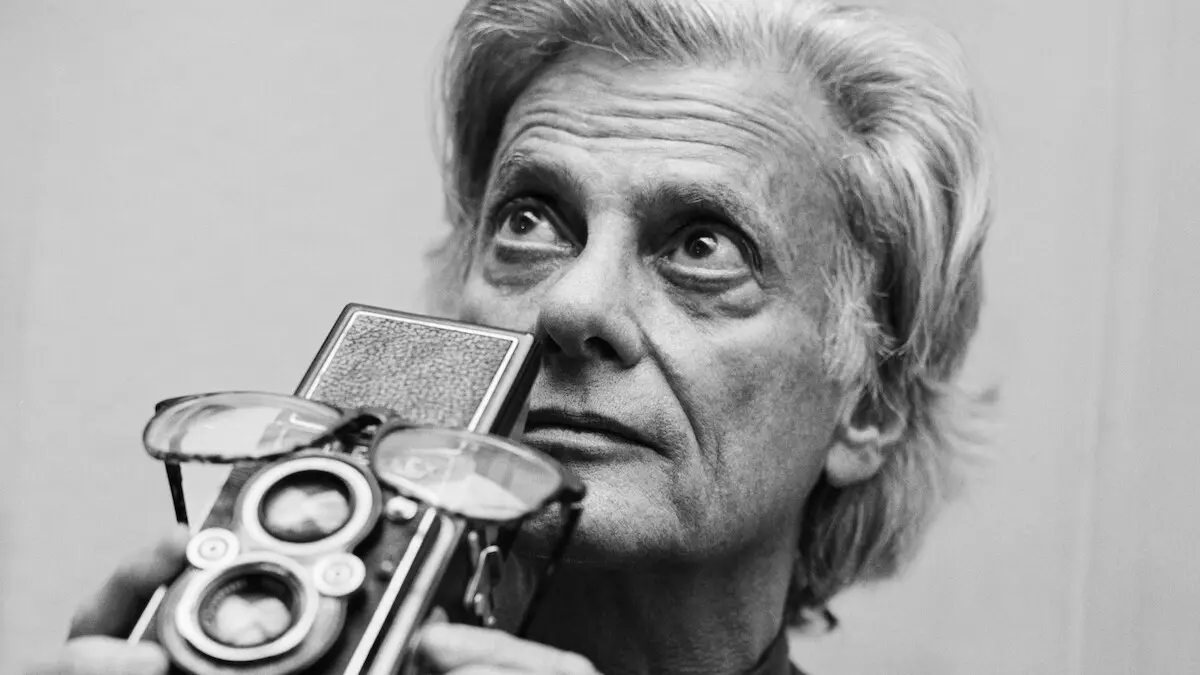
Ron Howard has found an ideal documentary subject in Richard Avedon. “Avedon” is a richly assembled portrait of the photographer that connects his fashion, celebrity, commercial and documentary work into one sweeping creative story — and ranks as Howard’s best nonfiction film yet, surpassing even “The Beatles: Eight Days a Week.”
Editor Andrew Morreale threads hundreds of Avedon photographs through the film with remarkable fluidity. Rather than treating the images as illustrations around a conventional biography, the documentary builds its argument through them: Avedon changed not only portrait photography, but the way viewers perceived the people standing before his camera.
The film opens with Avedon declaring his independence from convention. “I can say very little about photography,” he says in an archival clip. “I follow no rules, no laws, and no advice.”
From there, a montage scored to Spoon’s “I Turn My Camera On” introduces an extraordinary collection of subjects, including John Lennon, Orson Welles, Michael Jordan, Elizabeth Taylor, Groucho Marx, Twiggy, Anjelica Huston, Truman Capote and J. Robert Oppenheimer. Marilyn Monroe appears embracing Arthur Miller, while Twiggy is captured in mid-air.
Inside Avedon’s Process
Howard uses archival footage and interviews to keep Avedon himself at the film’s center. The documentary also draws on observations from Tina Brown, Larry Gagosian, John Lahr, Twiggy, Adam Gopnik, Hilton Als, Calvin Klein and Avedon’s son, John Avedon.
James Martin, executive director of the Richard Avedon Foundation, provides access to the photographer’s archives. They contain the results of 16,000 sittings conducted from 1944 until Avedon’s death in 2004 — a workload averaging roughly one sitting every weekday for 60 years.
Yet the film makes clear that Avedon was less captivated by technical discussion than by the psychological dynamics of a session. Isabella Rossellini recalls that, instead of continually taking pictures, he might expose a frame, ask his subject to think about something and then wait before shooting again. A session could produce only about 10 photographs.
Avedon describes another tactic: spend much of an hour having coffee, then move to the white paper background with only minutes remaining. That stripped-down setting became one of his signatures, removing distractions and placing every expression, gesture and imperfection in full view.
The roots of that visual approach reached back to his early life. Born in New York in 1923, Avedon remembered closing his eyes while walking as a child so he could hold an image in his mind. At 19, he entered the U.S. Merchant Marines and secured a position in its photographic department.
He estimated that he made perhaps 100,000 ID-card portraits of enlisted men and other workers. Faced with thousands of people against a plain white background, he began to recognize how completely an individual face could reveal itself without scenery or embellishment. The documentary shows several of those photographs, already carrying the foundations of the style that would define his work.
The Stories Behind Famous Images
“Avedon” is especially compelling when it reconstructs the circumstances surrounding photographs that later became iconic. A 1953 session with Charlie Chaplin ended with the performer grinning and raising his fingers like devil horns. The spontaneous gesture became one of Avedon’s best-known images.
His 1957 shoot with Marilyn Monroe, connected to “The Prince and the Showgirl,” lasted all day. Avedon photographed her in exuberant form, but the enduring frame came when she dropped her guard for approximately 10 seconds. The image captured a quieter, sadder expression and revealed the woman behind the carefully prepared public image.
That same year, the Hollywood musical “Funny Face” paired Audrey Hepburn with Fred Astaire as a magazine photographer pointedly modeled on Avedon, by then already moving toward legendary status.
The documentary ranges well beyond celebrity portraiture. It revisits Avedon’s 1980 photographs of Oklahoma oil workers, his motion-filled fashion images, and his seven-week wait in Vietnam to photograph American generals. It also examines his approaches to the Chicago 7, the figures of the Warhol Factory and residents of the new American West. The latter series was so uncompromising that no New York museum wanted it.
His commercial work receives attention as well, including Obsession perfume television spots constructed like surrealist short films. The film presents that advertising not as a departure from his art, but as part of the same sustained vision visible across six decades.
Howard does not avoid the more painful material. “Avedon” recounts the tragedy of the photographer’s mentally ill sister, whom he revered, and traces his troubled marriages. It also tells how photographing his aging father became a path toward reconciliation.
ShowBiz Take
The documentary’s real accomplishment is its ability to reconcile the apparent opposites within Avedon’s career. He operated at the highest levels of fashion and glamour while repeatedly using his camera to strip away status, setting and performance. His white background could hold Monroe, a military worker, a model or an oil worker on equal terms.
Howard and Morreale turn that contradiction into the film’s organizing pulse. The photographs do not merely document Avedon’s life; they reveal how he saw other people and how much of himself entered every encounter. “Avedon” ultimately makes the case that his portraits, fashion work and advertisements were inseparable parts of one ambition: to make viewers look again, and more closely.