
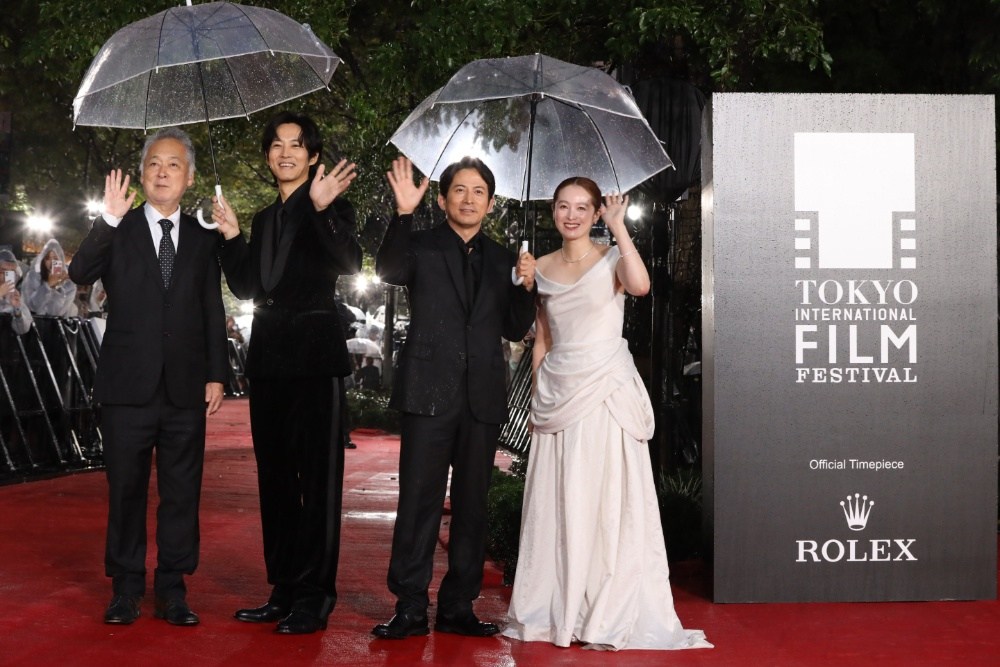
The 39th Tokyo International Film Festival is opening with “Sukiyaki,” director Zeze Takahisa’s account of the creators, conflicts and political inspiration behind the Japanese song that became a worldwide hit in 1963.
Known in Japan as “Ue o Muite Aruko,” translated as “I’ll Walk with My Head Up,” the song went on to become a widely loved standard. Foreign-language recordings have also reached the top of music charts.
Rather than treating that success as a straightforward musical triumph, Zeze’s film focuses on the three figures who created it: lyricist Ei Rokusuke, played by Matsuzaka Tori; composer Nakamura Hachidai, portrayed by Okada Junichi; and singer Sakamoto Kyu, played by Nakano Taiga.
The three became known in Japan as the “689 trio,” a nickname drawn from the number characters in their names: Roku for six, Hachi for eight and Kyu for nine. “Sukiyaki” explores both their creative partnership and the tensions that complicated their personal and professional relationships.
A pop song with political roots
One of the film’s central revelations is the source of Ei’s Japanese lyrics. They were inspired by the 1960 demonstrations against the Japan-U.S. Security Treaty, during which protesters called for peace but were unable to prevent the treaty’s ratification.
“He wanted them to ‘walk with their heads up,’ despite their defeat,” Zeze said. “So the song has depth — it’s not just a cheery pop tune.”
Zeze said listeners outside Japan may not have understood the words, but they still responded to what the song conveyed. “Of course people abroad didn’t understand the lyrics, but the song’s energy came across to them,” he said. “The lyrics reflect what was happening in Japan at that time.”
The film also examines the different musical influences that fed into the recording. Nakamura was an accomplished jazz pianist who demonstrated his abilities in New York clubs, while Sakamoto came out of early rock and was a major Elvis fan. Ei supplied the reflective lyrics that connected the song to Japan’s political and social mood.
Success, conflict and a troubled partnership
Although all three creators are key to the story, much of the film’s dramatic weight rests on Nakamura and Ei. The pair collaborated on a series of hits during the 1960s, but their partnership eventually fractured as Nakamura descended into alcoholism.
“Nakamura went through a tough period after ‘Sukiyaki’ became a hit so we show that,” Zeze said. “If the film were just a success story, it wouldn’t be interesting — it has to have both ups and downs.”
That approach allows “Sukiyaki” to look beyond the song’s international performance and into the cost of success for the people behind it. The worldwide hit did not prevent disagreements or personal struggles from disrupting the creative alliance that produced it.
For the principal roles, Zeze said physical resemblance was not his primary concern. He instead selected performers for the qualities and emotions they could project.
Nakano nevertheless closely captures Sakamoto’s energetic stage presence. Zeze said the actor also had a natural connection to the part because he comes from a show-business family with roots in the period depicted by the film.
Nakano performs Sakamoto’s singing himself in “Sukiyaki.” “When Sakamoto sings in the film, it’s Taiga’s voice you’re hearing — he has an amazing talent as a vocalist,” Zeze said.
A renewed spotlight on the Showa Era
Speaking at the headquarters of Toho, the film’s Japanese distributor, Zeze connected the story to changes in the country’s cultural climate. He described postwar Japan as a place absorbing a wide range of ideas and influences from overseas.
“Those influences created an energy that propelled the popular culture here,” he said. “Now Japan is absorbing fewer influences from abroad. The culture used to be wide open — now it’s become narrower.”
Zeze also pointed to renewed interest in the Showa Era, the 1926-1989 period of Emperor Showa’s reign. Younger Japanese audiences have been discovering the era’s cultural energy, while older viewers have approached it with nostalgia.
That mix was reflected in the audience for “Godzilla Minus One,” the 2023 hit installment set during the early postwar period. Yamazaki Takashi’s follow-up, “Godzilla Minus Zero,” is also part of the Tokyo festival as its Centerpiece screening. Zeze jokingly characterized the renewed attention as “a kind of Showa boom.”
ShowBiz Take
Opening the festival with “Sukiyaki” puts the emphasis not merely on an internationally successful song, but on the historical moment and complicated artists behind it. The film’s account links popular music, political disappointment, imported musical influences and personal turmoil without reducing the story to a victory lap.
Alongside the Centerpiece selection of “Godzilla Minus Zero,” the choice also gives the festival two prominent projects connected to renewed interest in the Showa period. For “Sukiyaki,” that backdrop makes the song’s enduring appeal more layered: its upbeat force carried words born from defeat, while its global success emerged from a creative partnership that was anything but harmonious.