
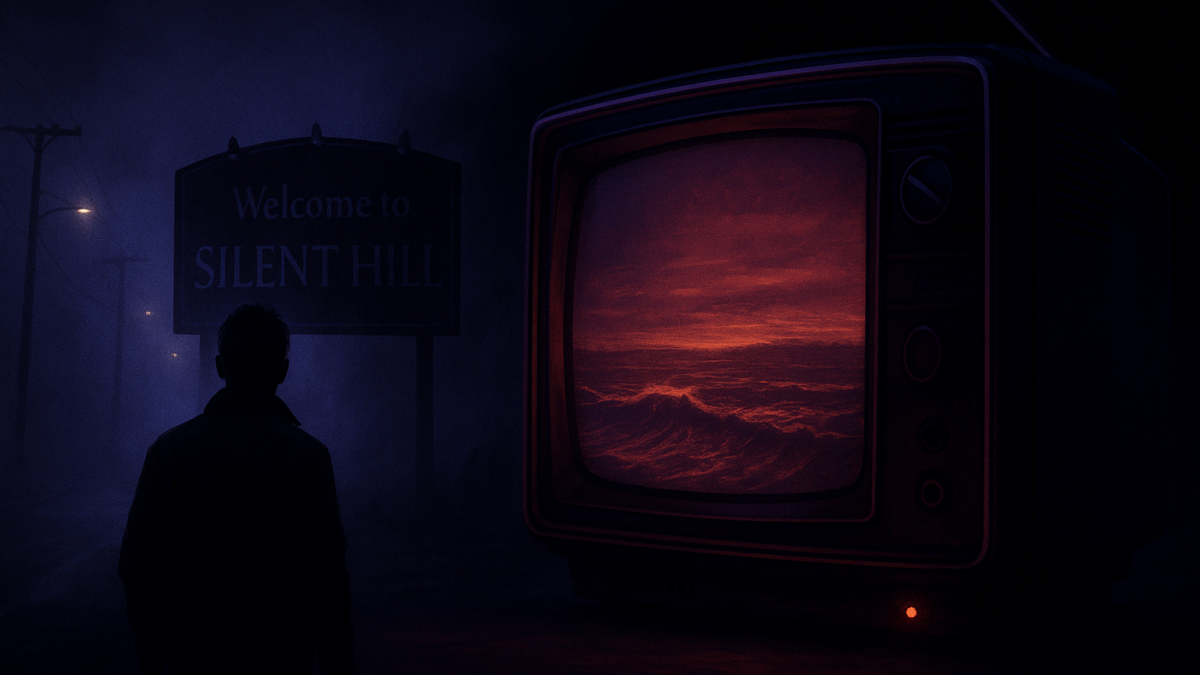
Silent Hill: Townfall steers Konami’s long-running survival horror series back toward psychological unease, intricate puzzles and a mystery designed to keep players digging for answers.
Reviewed by Tristan Ogilvie on PlayStation 5 and also available on PC, Townfall is presented as a return to the series’ core strengths after the more action-oriented direction of 2025’s Silent Hill f. The result is an oppressively ominous experience built around disfigured creatures, unsettling exploration and themes that bring something fresh to its central mystery.
The atmosphere is the game’s most immediate strength. Townfall creates tension not only through direct encounters with its demons, but also through the pressure of trying to evade them. Both facing and escaping these enemies prove exhilarating, allowing the horror to work through anticipation as much as confrontation.
That tension is shaped by a CRTV device capable of detecting enemies concealed within the surrounding environment. The mechanic gives players a way to identify nearby threats, although that advantage comes with a trade-off: it can somewhat weaken the story’s capacity to deliver major scares during its early stages.
That does not mean the game loses its ability to shock. Once Townfall begins landing its scares more forcefully, they make a powerful impact. The initial reassurance offered by its detection device ultimately does not prevent the game from finding effective ways to unsettle the player.
A mystery strengthened by standout puzzles
Beyond its monsters and oppressive mood, Townfall is driven by a genuinely compelling mystery. Its themes help distinguish the story, while the process of piecing together what is happening provides a strong reason to continue through its hostile world.
The puzzle design is another major highlight. The game features some exceptionally clever and demanding challenges, ranking among the strongest horror-game puzzles Ogilvie has encountered in recent memory. Rather than treating those sections as interruptions, Townfall makes them a central part of the experience.
Many of the puzzles involve meticulously recreated technology from years past. Those devices are more than visual decoration: they help transport the player into the game’s mid-1990s setting while also contributing directly to its challenges. The attention paid to that older technology gives the setting a particularly convincing sense of time and place.
The game’s disturbing imagery also extends to its protagonist, whose wrist has an intravenous needle permanently protruding from it. It is an appropriately uncomfortable detail for a title that repeatedly brings physical unease together with psychological horror.
While the CRTV mechanic slightly softens some of the early fear factor, it does not outweigh the strength of Townfall’s atmosphere, mystery, creature encounters and elaborate puzzles. In Ogilvie’s assessment, the game delivers “a welcome shot in the arm” for the Silent Hill series — a fitting verdict for a horror experience that reconnects with the qualities it handles best.