
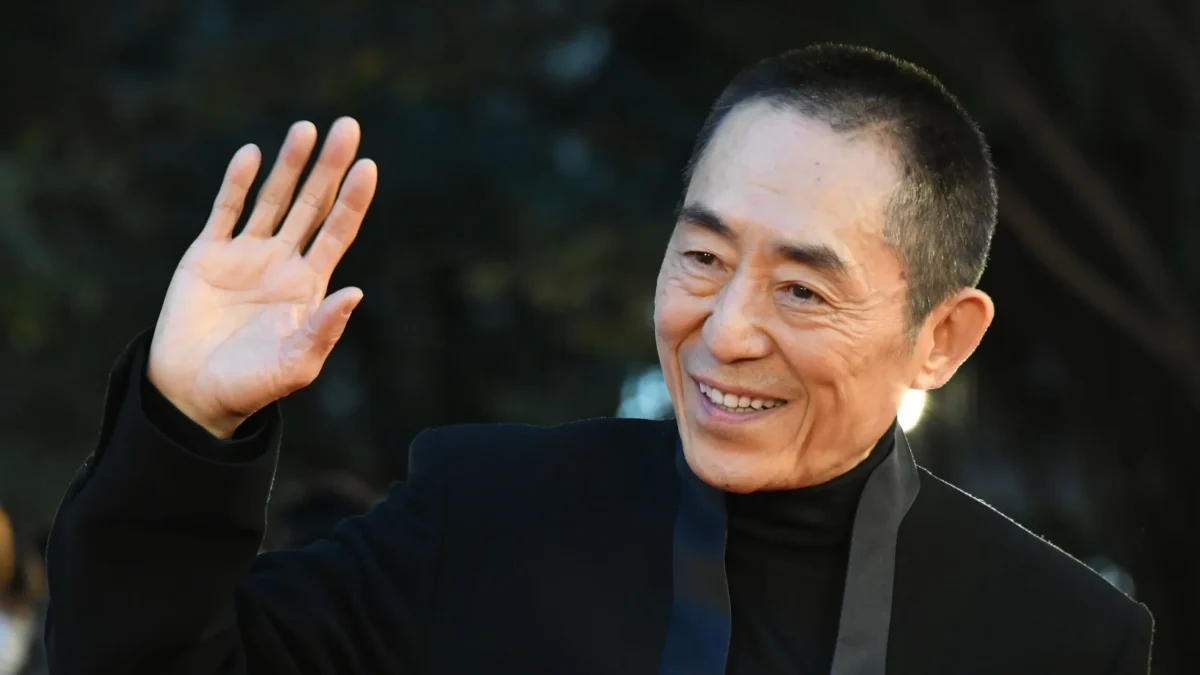
Zhang Yimou’s film adaptation of “The Three-Body Problem” remains in the script stage after several years of work, with the director acknowledging the challenge of bringing Liu Cixin’s science-fiction novel to the screen.
Zhang offered an update during the opening ceremony of the Busan International Film Festival, where he is serving as president of this year’s competition jury. Speaking with festival director Jung Hanseok, Zhang said he is preparing a new film and had recently been discussing the difficulties of filmmaking with several directors backstage.
“‘The Three-Body Problem’ is a great science fiction novel, and I like it very much,” Zhang said. “But it is very difficult to adapt into a film, which is why we have spent several years polishing the script.”
That process is not finished. Zhang said the screenplay is “still” being refined as the team works to meet the considerable expectations surrounding the project.
“I hope this film will not disappoint everyone’s expectations, that it will satisfy the audience, and I hope we can make it well,” he added.
Audience response brings added pressure
Jung addressed the intense reaction that followed the announcement of Zhang’s involvement, describing a response that included both anticipation and concern. Zhang said he instructed his company to gather online audience commentary once the news emerged that he would direct the film.
The result was approximately 400,000 comments collected in a single week.
For Zhang, that extraordinary volume of feedback underscored how closely viewers are watching the adaptation. He said the comments revealed that audiences had “a great many concerns,” adding that public expectations for filmmakers are now particularly high.
Zhang linked that pressure to broader changes in visual culture. “In the age of AI, where visual media has become democratized, the audience’s discernment has risen considerably compared to the past,” he said. “Because of that, we all feel tremendous pressure, and we hope not to disappoint their expectations.”
The director said he intends to examine carefully what viewers want from the movie as he tries to get the adaptation right.
A novel with an established screen history
“The Three-Body Problem” is the opening book in Liu Cixin’s “Remembrance of Earth’s Past” trilogy. Ken Liu’s English translation won the Hugo Award for best novel in 2015.
The material has already reached viewers in several forms. Bilibili released the animated series “The Three-Body Problem” in 2022, followed by Tencent’s live-action “Three-Body” in 2023 and Netflix’s “3 Body Problem” in 2024.
At Busan, Jung characterized the book as a science-fiction novel with an enormous worldwide readership. He also noted that Zhang, more than 40 years into his career, continues to release new work almost every year.
Zhang’s comments made clear that familiarity with the source material has not made the movie version straightforward. Instead, the existing audience and the breadth of reaction to his involvement have become central considerations as work on the screenplay continues.
Zhang reflects on the search for a great film
The director also expanded the conversation beyond “The Three-Body Problem,” reflecting on the ambitions shared by filmmakers attending the festival. He said they all want to create work that satisfies them, even though there is no certain formula for achieving a truly great movie.
“Many people spend an entire lifetime wanting to make a truly great film, yet no one knows where that great film comes from,” Zhang said. “From a Chinese perspective, it might be luck — your effort combined with luck.”
Whatever part chance may play, Zhang said the commitment behind the work endures. “But regardless of luck, the love and passion for cinema in our hearts will always keep burning.”
Zhang is leading Busan’s seven-member competition jury. The 31st edition of the festival runs through Oct. 15. For “The Three-Body Problem,” meanwhile, his immediate focus remains on the screenplay and the years-long effort to shape the novel into a film capable of satisfying its expectant audience.