
Xavier Becerra’s 1,600-word Hollywood policy is drawing scrutiny on two fronts: what it promises California’s film and television industry, and whether artificial intelligence helped write it.
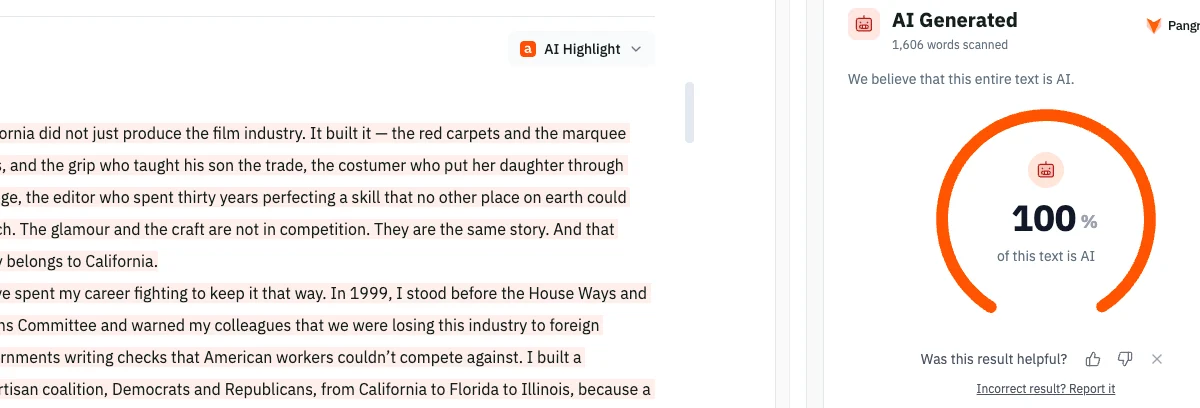
Pangram, a widely used AI-detection tool, assessed the campaign statement and concluded that “100% of this text is AI.” Becerra and his campaign firmly deny that finding.
“No,” Becerra said when asked at a campaign event whether the policy was AI-generated. “That’s absolutely incorrect.”
Campaign spokesman Jonathan Underland also challenged the reliability of the assessment, saying, “These AI assessors are notoriously inaccurate.” He maintained that AI was not involved in brainstorming or developing the platform.
“We don’t do that,” Underland said. “We don’t talk to AI about policy. We talk to people about policy.”
A Film Platform With Few Firm Commitments
The campaign page declares, “California Is the Home of Film and TV and We Intend to Keep It That Way,” but offers few concrete promises about how Becerra would support the entertainment business if elected governor.
That lack of specificity is particularly significant because the next governor is expected to face pressure over California’s film and television production incentive. The program is currently capped at $750 million annually, and state lawmakers argue that California will need to do more to compete for production jobs even if Congress approves a federal film incentive.
Attorney General Rob Bonta has said he will sponsor legislation eliminating the state cap altogether. Rick Chavez Zbur, the Burbank assemblyman described as one of Hollywood’s strongest allies in Sacramento, also supports strengthening the program.
“We do need to, early next year, take steps to strengthen it,” Zbur said. “A number of us have wanted to uncap the program for some time.”
Another proposal would make “above the line” salaries, including compensation for actors and directors, eligible under the incentive. Both ideas could carry substantial costs and would need to be balanced against California’s other fiscal priorities.
Becerra has not endorsed either proposal. At a Monday stop in Glendale, he offered broad support for protecting the industry without committing to a particular expansion.
“I will support anything that will help us keep Hollywood in Hollywood,” he said. “We have to fight for this industry.”
Asked directly about removing the $750 million cap or covering above-the-line expenses, Becerra said he would confer with lawmakers about the proposals presented to him. “But we’re going to fight,” he added.
The cautious approach reflects Becerra’s wider campaign strategy. He has denied most interview requests and avoided firm commitments on subjects including AI, housing and electric vehicles. He has also presented that restraint as a reason to support him.
“It’s easy when you’re a candidate to make all sorts of promises. It’s harder to prove you can deliver,” Becerra said in Glendale. “Vote for someone who knows how to deliver, because the promises go away after Election Day.”
Assemblyman John Harabedian, who introduced him at the event, characterized Becerra as someone who would “underpromise and overdeliver.” Becerra currently holds a 20-point polling lead and is given a 96% chance of winning by prediction markets.
AI Questions Reach Both Campaigns
Becerra’s Republican opponent, Steve Hilton, has been more explicit on the incentive issue, promising both to eliminate the cap and include above-the-line costs. Pangram also identified Hilton’s film policy as AI-written, although its shorter length and heavy use of bullet points make it more difficult for the detector to evaluate. Hilton’s campaign declined to comment.
Hilton’s campaign has separately used AI to produce campaign advertisements and disclosed that use in accordance with state law. One ad features an AI-generated version of Becerra approving a “vague policy tweet” and saying, “Great idea, but keep it vague like all the other ones. Not too much detail.”
Becerra’s campaign says it does not use AI in its videos and has criticized Hilton’s material as “AI slop.” California’s campaign disclosure requirement applies to audio, video and images, but not to text.
The disputed Becerra platform includes wording identified as characteristic of AI-generated prose, including the construction: “California did not just produce the film industry. It built it.” The document also endorses a state requirement for productions to disclose AI use.
Pangram says its false-positive rate is one in 10,000 and that its system is particularly accurate when examining political speeches. The company claims human political writing is incorrectly flagged as AI 0.0% of the time, while independent research has also supported the tool’s accuracy.
The Economist previously used Pangram to examine parliamentary speeches and reported that AI drafted 10% of the words spoken in the British Parliament. It also found AI use in Australia, Canada and the United States, with “surprise and denial” described as the most common response from speakers questioned about the findings.
ShowBiz Take
The authorship dispute is not merely a campaign-side curiosity. Becerra’s platform addresses an industry confronting AI policy while simultaneously leaving major financial questions unresolved. His categorical denial means Pangram’s finding remains contested, but the episode puts additional attention on the absence of text from California’s existing AI disclosure rules.
For Hollywood, the more consequential issue is still what Becerra would actually do with the production incentive. Removing the cap and adding above-the-line costs could substantially reshape the program, yet the candidate favored to win has committed only to reviewing lawmakers’ proposals and fighting to keep the industry in California.
What Happens Next?
If elected, Becerra is expected to face early calls to strengthen the film and television incentive. Bonta plans to pursue legislation eliminating its cap, while lawmakers including Zbur are already advocating expansion. Whether Becerra ultimately backs that approach—and whether his campaign provides any further evidence about how its Hollywood policy was written—remains unresolved.