
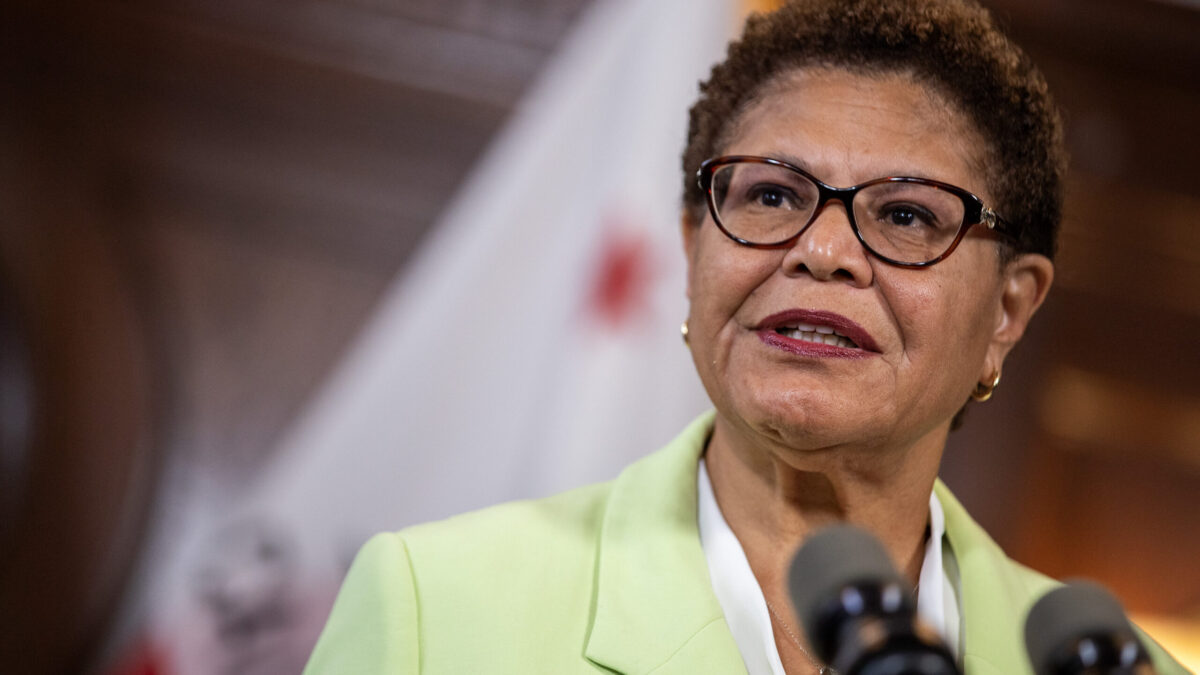
The Writers Guild is pushing back sharply against Los Angeles Mayor Karen Bass after she endorsed a proposed Paramount-Warner Bros. merger framework that she says would keep production jobs in the city, escalating a dispute over whether Hollywood consolidation is a lifeline for workers or a threat to them.
Bass appeared at a press conference Thursday to argue that the prolonged uncertainty surrounding the $111 billion deal has contributed to a production standstill in Los Angeles. The mayor said the impasse is bad for crews, writers, vendors and the broader entertainment economy, and she framed the proposed agreement as a way to keep Paramount rooted in Los Angeles rather than allowing more work to drift elsewhere.
The Writers Guild, however, responded by criticizing Bass for backing a transaction it believes could reduce employment opportunities across the industry. The guild’s objection centers on a familiar but increasingly urgent concern in Hollywood: that fewer major studios means fewer buyers, fewer shows, fewer writing rooms and less leverage for creative workers.
The clash is notable because Bass had previously voiced opposition to the merger, aligning with labor and competition concerns about another large-scale combination in an industry already dominated by a shrinking group of conglomerates. Her shift toward supporting a deal tied to keeping Paramount’s operations in Los Angeles has put City Hall at odds with writers who see consolidation as one of the forces behind the industry’s jobs crisis.
For Bass, the political calculation is clear. Los Angeles has been hit hard by a sustained production downturn that began before the 2023 strikes and has continued through the streaming pullback, studio cost-cutting and aggressive tax credit competition from other states and countries. Soundstages have sat underused, below-the-line workers have struggled with long gaps between jobs, and local businesses that depend on film and television production have warned that the city’s signature industry is no longer guaranteed to remain centered in Southern California.
That reality has placed enormous pressure on local officials to show they are fighting for entertainment jobs. Bass has made production retention a central economic issue for the city, arguing that Los Angeles cannot afford to lose more studio activity to Georgia, New York, Canada, the U.K. or Australia. In that context, a commitment to keep Paramount’s footprint in Los Angeles could be presented as a tangible win.
But the Writers Guild is looking at the deal through a different lens. For writers, the question is not only where a studio is headquartered or where productions are shot, but whether the combined company would commission enough films and television series to sustain employment. A merger between two legacy Hollywood players could produce promised efficiencies for investors while also leading to overlapping divisions, fewer development slates and additional layoffs.
That tension is at the heart of the guild’s criticism. A report examining the proposed transaction has raised concerns that the same production jobs being cited as a reason to support the deal could be vulnerable if the merged company seeks to reduce costs. In mergers of this size, savings often come from consolidation — combining departments, trimming duplicative staff and narrowing content pipelines.
Hollywood labor groups have become increasingly skeptical of consolidation after years in which mega-deals reshaped the business without delivering stability for workers. Disney’s acquisition of 21st Century Fox reduced the number of major studios. WarnerMedia’s merger with Discovery was followed by layoffs, cancellations and a broad reassessment of spending. Streaming services that once fueled a content boom have shifted toward profitability, leaving writers and producers to compete for fewer greenlights.
The Writers Guild’s position reflects a broader anxiety across the creative community. The 2023 writers strike was driven in part by fears that the old employment model had been broken by streaming, mini-rooms and shorter seasons. Although the guild secured gains in its contract, members remain concerned that structural changes in the industry could undermine those wins if fewer companies control more of the market.
The Bass administration is focused on immediate local job retention, while the guild is warning about long-term market power. Both arguments speak to a city that is heavily dependent on entertainment but increasingly uncertain about how to protect it. A studio can pledge allegiance to Los Angeles and still make fewer shows. A merger can preserve a corporate campus while shrinking the number of creative opportunities that flow through it.
The dispute also underscores the complicated role of elected officials in entertainment industry mergers. City leaders do not approve or block major media transactions; that responsibility falls largely to federal regulators. But mayors and governors can influence the public debate by signaling whether a deal is seen as beneficial to local economies. Bass’ support may give merger advocates a valuable political talking point as they argue the transaction is necessary to stabilize two historic Hollywood brands.
For the guild, that is precisely why the mayor’s endorsement matters. If the deal is framed primarily as a jobs-saving measure, labor opponents may face a tougher challenge explaining why they believe it could ultimately result in fewer jobs. The battle is not just over the terms of one corporate transaction, but over the story Hollywood tells about its future: whether bigger companies are needed to compete globally, or whether bigger companies are part of the reason workers are struggling.
What Happens Next
The proposed Paramount-Warner Bros. merger is expected to face continued scrutiny from labor groups, lawmakers and regulators, particularly around competition and employment impacts. The Writers Guild is likely to keep pressing for assurances that any deal would not lead to reduced development, diminished writer employment or further consolidation of studio power.
Bass, meanwhile, will have to balance her push to keep production in Los Angeles with concerns from the very workforce she says she is trying to protect. If merger proponents can offer enforceable commitments on jobs, production levels and local investment, the political debate may shift. Without those guarantees, the guild’s opposition is likely to intensify as Hollywood workers ask whether saving the studio address is enough to save the industry jobs attached to it.