
Why This Matters
The Writers Guild of America has escalated its opposition to the proposed combination of Paramount and Warner Bros. Discovery, asking a federal court in Oakland to issue a preliminary injunction that would stop the companies from advancing the deal while legal challenges play out.
The filing, submitted July 22, places the guild squarely in the center of one of the most consequential media consolidation fights in years. For writers, the issue is not simply corporate scale or Wall Street strategy. It is whether another major studio merger would further shrink the number of buyers for scripted television, film and streaming projects at a time when employment across Hollywood remains fragile.
The guild’s motion seeks to align with a parallel lawsuit brought by the State Attorney General, which argues that the merger could reduce competition in entertainment production and distribution. The WGA’s intervention adds a labor-focused dimension to the case, emphasizing how consolidation can affect working writers through fewer greenlights, reduced leverage in negotiations and a narrower market for original ideas.
A preliminary injunction would not decide the ultimate legality of the merger. Instead, it would pause the transaction while the court considers broader antitrust claims. That pause, however, could be hugely significant. Once major entertainment companies combine operations, unwind shared assets and staffing structures, the practical consequences can be difficult to reverse even if courts later find competitive harm.
The WGA is expected to argue that writers are uniquely vulnerable to consolidation because studios function not only as distributors but also as employers and buyers of creative labor. If two major buyers become one, the guild contends, writers may face fewer bidding opportunities, fewer development deals and diminished bargaining power when seeking fair compensation, staffing protections and residual payments.
Industry Context
The move arrives during a volatile period for legacy media companies, many of which are attempting to bulk up in response to streaming losses, cord-cutting and pressure from technology giants. Traditional studios have spent the past decade chasing scale, believing larger libraries, broader distribution platforms and deeper balance sheets are necessary to compete with Netflix, Amazon, Apple and YouTube.
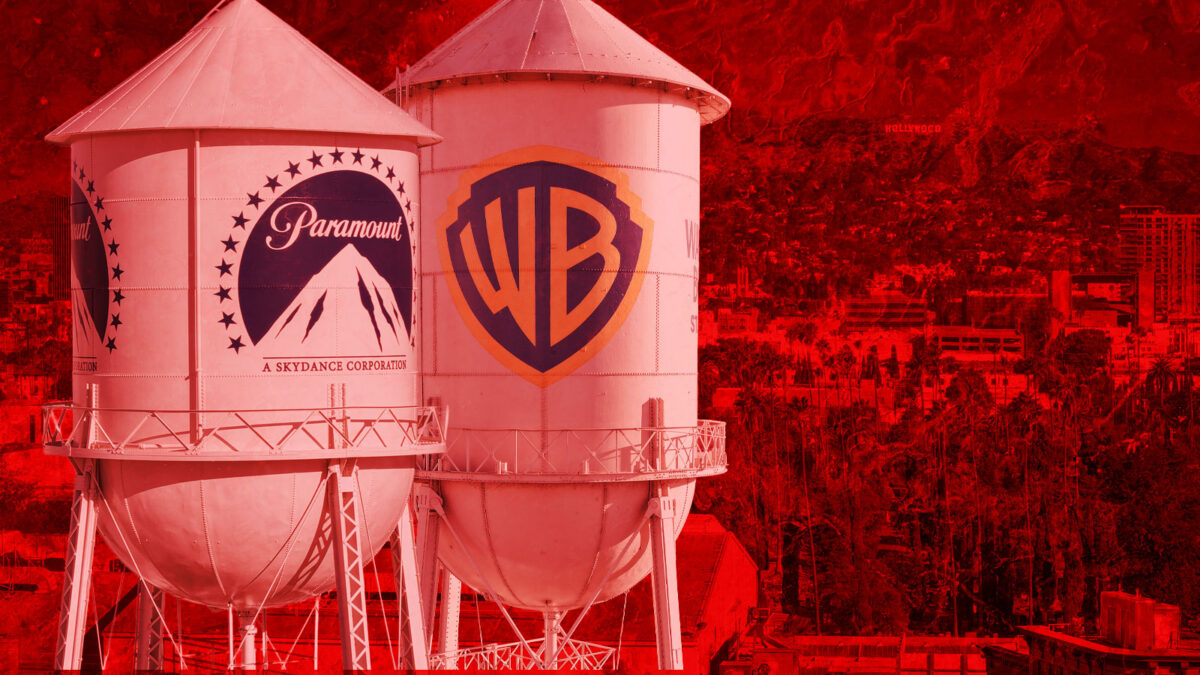
Paramount and Warner Bros. Discovery each control valuable film and television assets, including major studio lots, cable networks, streaming platforms, news divisions and deep libraries of scripted programming. A combination would create a sprawling entertainment company with significant influence over theatrical releases, television production, streaming distribution and licensing markets.
Supporters of consolidation typically argue that larger companies are better positioned to finance ambitious projects, invest in technology and preserve legacy brands in a brutal marketplace. They also point to mounting debt, declining linear television revenue and the soaring cost of global streaming competition as reasons the old studio model needs to be restructured.
Labor groups see the matter differently. To the WGA, a merger of this scale risks accelerating the contraction that writers have already experienced through shorter seasons, smaller writers’ rooms, fewer overall deals and a more selective development pipeline. The guild’s 2023 strike centered in part on concerns that streaming had changed the economics of writing without providing equivalent stability for creative workers.
The guild’s latest legal push builds on those concerns by framing consolidation as a structural threat to the creative workforce. If fewer companies control more of the market, writers may have less ability to take projects elsewhere, pit offers against one another or find alternative homes for material that does not fit a merged studio’s priorities.
Antitrust scrutiny of entertainment mergers has intensified in recent years, though regulators and courts have often struggled to apply traditional competition frameworks to a business reshaped by streaming platforms, global tech companies and shifting consumer habits. The key legal question may be whether the court views Paramount and Warner Bros. Discovery primarily as competitors in the same labor and content markets, or as legacy companies trying to survive against much larger digital rivals.
The WGA’s involvement could broaden the discussion beyond consumer prices and subscription bundles. Unlike industries where antitrust debates focus heavily on what customers pay, Hollywood consolidation also affects who gets hired, what stories get made and how revenue flows to the people who create the content that fuels studio libraries.
That argument is likely to resonate with other entertainment unions watching the case closely. SAG-AFTRA, the Directors Guild of America and IATSE all have members whose employment depends on the volume and diversity of production. While each union has distinct priorities, the broader labor community has increasingly treated consolidation as a threat to bargaining power and job access.
What Happens Next?
The federal court in Oakland will now consider whether the WGA and state officials have shown that the merger poses enough immediate risk to justify blocking further progress before a full trial. The court will likely weigh potential harm to competition, the public interest and whether the companies can demonstrate that the deal would produce benefits that outweigh the alleged risks.
Paramount and Warner Bros. Discovery are expected to fight the injunction, arguing that the transaction is lawful and necessary in a rapidly changing media environment. They may contend that the entertainment market is broader than the guild suggests, with streamers, tech platforms, independent studios and international buyers continuing to compete aggressively for talent and programming.
If the injunction is granted, the merger timeline could be significantly delayed, giving regulators and opponents more time to build their cases. If it is denied, the companies would gain momentum, though the underlying legal challenges could still continue.
For writers, the stakes extend beyond this single transaction. The case could help define how courts evaluate media mergers in an era when creative labor, streaming economics and corporate consolidation are increasingly intertwined. A ruling in the guild’s favor would signal that worker impact can play a larger role in antitrust fights involving Hollywood power players.
For the industry, the dispute is another reminder that the next phase of the streaming wars will not be fought only over subscribers and franchises. It will also be fought in courtrooms, bargaining rooms and regulatory offices, where the future shape of the entertainment business is being contested by the people who make it and the companies that sell it.